• Members of the previous forum can retrieve their temporary password here, (login and check your PM).

Botany Acacia and Mimosa Identification Thread

Growing logs with advice and results.
Migrated topic.
nen888 said:
..there are completely active, dmt containing varieties of A. longifolia (with red tips)...this has multiple confirmations, and these varieties should be actively investigated for seed...Aum, the species you were hoping to find is now so completely fkd up and butchered in the wild in many areas that we've lost valuable diverse seed stock for generations to come, if not forever..i earnestly feel, for its sake, that unless people are collecting seed, it should be left alone to recover..that would be the right thing to ensure a future for it in natural ecosystems.

(This is also the official Nexus policy on the species as reflected in the nexus-wiki page)

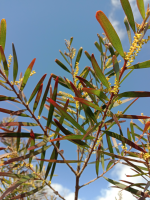
Wow, I didn't realise the state of obtusifolia was so compromised. Sad to hear! I've tried a few extractions on two types of A. longifolia but with no success. But like Aum, I think I've spotted another potential candidate. A few months ago my floribunda started exhibiting red tips and I assumed it was associated with new growth but maybe it's also an indicator that it's active - fingers crossed!
 

Attachments

  • Screen+Shot+2023-11-20+at+71646+AM.png
    Screen+Shot+2023-11-20+at+71646+AM.png
    7.6 MB · Views: 2
Wow that’s a gorgeous photo CheeseCat.. funny how a photo can make a species look so different to in real life. It looks quite different to how floribunda “usually” looks.. but then it doesn’t exactly have a usual look as we are discovering!
 
Thanks Acacian, yeah the phyllodes aren't particularly long on my floribunda, they were when it was younger though. Growing it in a container has probably affected/stunted its growth to an extent. My tree's under quite a bit of stress at the moment... I've just discovered it has Uromycladium maritimum...acacia rust! :cry: Yikes! A lot of the new growth is covered in black spots and looking pretty shabby. I'm aiming to get it in the ground late January, hopefully it can hang in there. If anyone knows anything about acacia rust I'd be grateful for any insight on treatment.
 
Hi all

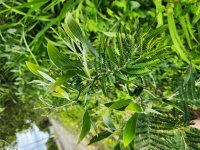
I have been driving and walking around trying to find some active acacias.

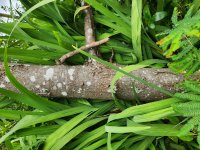
I have attached one photo for each of the plants, as well as the bark/trunk of what I believe to be Acacia melanoxylon, though really not sure.

I am pretty sure that the one with some bipinnate leaves is acacia dealbata.

I am from NZ, and so have also attached a word doc containing pictures of all the acacias that grow in NZ, according to Flora of New Zealand | Taxon Profile | Acacia

Unfortunately acacias do not bloom around this time of year which makes identification difficult

I will be doing a TLC on each of them soon regardless

Thanks for any help
 

Attachments

  • 20231220_155557.jpg
    20231220_155557.jpg
    4 MB · Views: 1
  • 20231220_155524.jpg
    20231220_155524.jpg
    5.2 MB · Views: 1
  • 20231220_202939.jpg
    20231220_202939.jpg
    3.5 MB · Views: 2
  • 20231220_203016.jpg
    20231220_203016.jpg
    3.3 MB · Views: 2
  • 20231220_203026.jpg
    20231220_203026.jpg
    3.4 MB · Views: 2
  • Acacias+of+NZ.docx
    9.7 MB · Views: 0
Iglepiggle666 .. the first one with the bippinate leaves looks to be Acacia melanoxylon .. it grows both bipinnate foliage and true phyllodes at a young age, until it matures and only produces phyllodes. Even then you'll see some pinnae from time to time.

The other two pics look like either floribunda or longifolia.. all of the above are cultivated in NZ.. I'd lean towards Floribunda .. which is a complicated one as a lot of trees are lumped under the one species and as of yet no recognized sub species (same could be said for longifolia).. I'm hesitant to say with certainty that it is either.. floribunda is in need of revision as it is a wide umbrella at the current moment - with a certain active type (the native occuring form it seems).. the rest probably a combination of inactive cultivars and other species/sub species which contain alkaloids but no/very little dmt. The botanical key, being so broad, is probably lumping a few species together - hence the confusion around whether this species is reliable.

I'm just now stepping out of the lumper's floribunda matrix

if you can get some photos that tell us more that would be good.. it will no doubt be going to seed soon if not already so photos that show pods/seed and phyllodes in more detail would be helpful

thanks to CheeseCat, we know that there are tryptamine containing Acacia floribunda in NZ which is a good start.. and E.P White's findings of tryptamines (many of his tryptamine findings were later found to be DMT) in floribunda was from New Zealand cultivated plants too. If it is the type floribunda, then the phyllodes are perfectly fine - as is the twig/stem bark
 
Oops, sorry! I meant to say that the one with bipinnate leaves (and the bark) looks like melanoxylon.

Thank you for the response and for that information–I didn't realise the floribunda species had so many sub-profiles or chemo-types. This is what kind of put me off Phalaris Aquatica as a good source of DMT.

Good to know that at least some sub-types of floribunda contain DMT in NZ. Hopefully I get lucky.

I will go take some better photos later today.

Thanks again for the help :)
 
its probably that a lot of inactive cultivars/hybrids/sub species all get lumped together.. and maybe the un-tarnished genes of the native type are good. trying to get my head around it all.. but floribunda is good :)
 
Ok guys, this is a big post so instead of posting here and taking up space, I have collated everything into a word document which I have attached to this post.

Species 1 and 2 were growing in different areas, though their variants were growing near to each other.

Although I am quite sure that species 1 variants ABC are all floribunda and that species 2 variant B is melanoxylon, species 2 variant A has me very confused.

What do yall think these plants are?
 

Attachments

  • Species+1+(ABC)+and+2+(AB).docx
    14.6 MB · Views: 12
You've found some really interesting acacias, nice work my man! I think Species 1 Variant A is likely some kind of longifolia. Variant C is a potential floribunda candidate or maybe even longissima. Not too sure about Variant B but maybe a broader phyllode floribunda variety - hard to say. I'm curious to know what others think too...

If you haven't already, check out "Acacia floribunda - Workspace and Information" thread that Acacian started. There's some really valuable info there that may help :)
 
Hey, thanks CheeseCat!

I have been thinking about it a bit more, and after discovering this pretty awesome website (Identify, explore and share your observations of wild plants), I am now fairly certain that all variants of species 1 is acacia longifolia. The reason I don't think it is Longissima is because 99% of the phyllodes I saw contained 2 main nerves (Longifolia is said to contain 2-4), while Longissima is said to contain 3-5 main nerves with the centre nerve most prominent.
I also think it is Longifolia and not Floribunda because, aside from the fact that Floribunda is less common whereas Longifolia is considered a weed in NZ, Floribunda flowers are said to be 'loosely packed', whereas Longifolia flowers are densely packed (see image below of verified Longifolia and my Longifolia var A). Lastly, all of specie 1 variants had exactly the same bark texture, colour, and pattern.

I am currently extracting from ONLY the phyllodes of species 1 variants (~300g). Will be running tlc on crude product in coming days. I will also do the same on the FRESH stripped bark of species 1 variants (250g), then with the old bark to see if there is a difference here, and lastly with the twigs (still mulling over how I'm gonna break these up without a wood chipper).

I will most likely end up running a tlc on species 2 variant A via 24hr methanol soak because I am quite curious about this species/variant.
 

Attachments

  • 20231222_145704.jpg
    20231222_145704.jpg
    3.4 MB · Views: 0
  • image+(4).png
    image+(4).png
    940.4 KB · Views: 0
Something else to consider is flowering times. Floribunda flowers from late June to early September, whereas a lot of common NZ longifolia start before floribunda in early June. If I was you I would put my time and energy into the narrow phyllode specimen - Species 1 Variant C, followed by Species 2 Variant A.

I've never had luck with longifolia and have always been a bit overwhelmed at how varied it can look.
 
I'm almost certain the tree in the previous post in Acacia longifolia

re your word doc you put together - species 1 variant A and B are both longifolia to my eyes.. the stems and phyllodes are a giveaway. Note the reddish tinge and the upright erect leathery foliage. floribunda is quite different to all of those trees. variant C I'm unsure. The phyllodes look quite leathery. It is likely a form of melanoxylon.. it can have quite long and variable foliage at a young age.

I'd be surprised seeing longissima turn up in New Zealand.. its not a popular species in cultivation - unlike floribunda, melanoxylon and longifolia.

Also.. don't strip trunk bark off trees (your post indicated that may have been what you did).. twig/stem has the same content more or less and you can do some careful pruning and allow the tree a long healthy life. Stripping bark from the trunk may bring an acacia's life to a premature end..
 
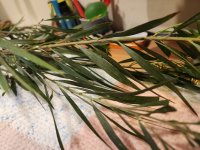
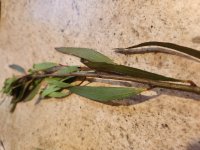
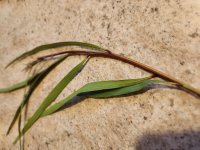
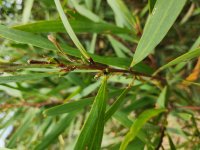
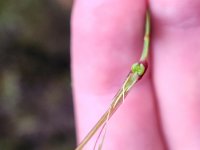
Hey CheeseCat, you seem to have really thrown a spanner in the works with those flowering times. I am still going to lean towards longifolia because longissima has a centre most prominent vein whereas the phyllodes on mine almost always had 2 off-centred main veins. I went back again today and have attached photos of variants B and C just beginning to flower (I think). Thanks for the tip regarding the phyllodes, I will keep that in mind.

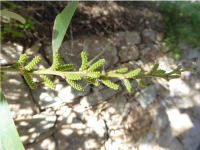
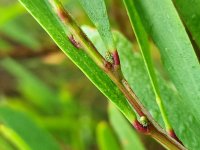
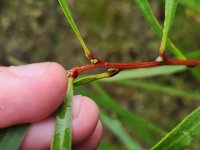
Acacian, now that I have better photos, have a look at the close ups of the new growth of species 1 variants B (top photo) and C (middle and bottom photo), the reddish tinge you mentioned seems to be quite prominent in all of them. Pretty sure variant C is just a young longifolia.

Longifolia are actually considered a threat to native vegetation in NZ, hence why it is classified as a weed. If they catch you with acacia Longifolia on your property, they will instruct you to destroy it. Regardless, I merely pruned the dead and dying low-lying branches – if anything I actually helped it!
 

Attachments

  • 20231226_200720(0).jpg
    20231226_200720(0).jpg
    2.4 MB · Views: 2
  • 20231226_194916.jpg
    20231226_194916.jpg
    2.1 MB · Views: 2
  • 20231226_200244.jpg
    20231226_200244.jpg
    2.1 MB · Views: 2
Its definitely longifolia :) .. the tightly packed flower rod, emerging from the node with no visible peduncle, as well as the red pulvinus and the numerous prominent veins is pretty text book longifolia .. I wouldn't worry too much about slight differences in flowering time. Trees can form their flowers quite a while before they actually bloom.. there are acacia where I live which won't flower until late winter/early spring next year but have already started forming their flower buds. Location/weather and climate can affect flowering time too slightly. And longifolia has a number of differen't forms to add yet another variable.. The rods forming in your last post are a long way off blooming.

As I said its unlikely you will run into Acacia longissima growing in NZ as far as I'm aware.. its not even really cultivated here in Australia. Longifolia is much more likely as is widely cultivated and like you say an invasive weed. Longissima has differen't flower rods too.. a little looser than longifolia.. but more tightly packed than floribunda.. and would be in bloom now.

And that is fair enough then about the harvesting.. I didn't realize it was such a bad weed there. just a good thing to keep in mind generally though..is good to be sure of ID before peeling bark off the trunks of trees. Look forward to hearing how your experiments go! Some forms of longifolia have DMT.. its a species people tend to overlook now and would be great to see more experiments.

below longissima flower vs longifolia

iu


iu
 
I had a look at a local longissima just to refresh my memory and you guys are right - Species 1 Variant C is not longissima. Longissima is just beginning to flower this time of year with phyllodes that are soft and pliable (see pics). Variant C looks familiar to me though so I'll check out another tree today for comparison.
 

Attachments

  • Screen+Shot+2023-12-27+at+71310+AM.JPG
    Screen+Shot+2023-12-27+at+71310+AM.JPG
    2.7 MB · Views: 1
  • Screen+Shot+2023-12-27+at+71726+AM.JPG
    Screen+Shot+2023-12-27+at+71726+AM.JPG
    2.7 MB · Views: 1
Hey cool to see a longissima in New Zealand! do you see many around? Happy to eat my words on that one

I just had a look on iNaturalist and there's more around than I thought. Not as common as floribunda of course. I was really surprised to see them flowering and also how soft the phyllodes are compared to narrow phyllode floribunda.

I wouldn't worry too much about slight differences in flowering time. Trees can form their flowers quite a while before they actually bloom.. there are acacia where I live which won't flower until late winter/early spring next year but have already started forming their flower buds. Location/weather and climate can affect flowering time too slightly. And longifolia has a number of differen't forms to add yet another variable...

Ah that makes sense, I was definitely scratching my head a bit! :)
 
CheeseCat said:
Hey cool to see a longissima in New Zealand! do you see many around? Happy to eat my words on that one

I just had a look on iNaturalist and there's more around than I thought. Not as common as floribunda of course. I was really surprised to see them flowering and also how soft the phyllodes are compared to narrow phyllode floribunda.

I wouldn't worry too much about slight differences in flowering time. Trees can form their flowers quite a while before they actually bloom.. there are acacia where I live which won't flower until late winter/early spring next year but have already started forming their flower buds. Location/weather and climate can affect flowering time too slightly. And longifolia has a number of differen't forms to add yet another variable...

Ah that makes sense, I was definitely scratching my head a bit! :)

Hmm floribunda should be soft papery phyllodes.. that is one of the defining characteristics of the species. If phyllodes are stiff its possible its a hybrid of some sort?
 
Well, I wouldn't describe the phyllodes as stiff, still thin and pliable but compared to longissima they appear firmer due to the phyllodes being a bit wider and a little shorter in length. It could be a hybrid though, given how vastly different they look compared to broader leaf varieties, particularly in Australia.
 
Back
Top Bottom