• Members of the previous forum can retrieve their temporary password here, (login and check your PM).

Botany Acacia and Mimosa Identification Thread

Growing logs with advice and results.
Migrated topic.
CheeseCat said:
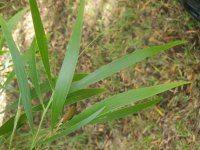
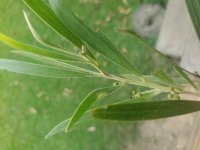
Well, I wouldn't describe the phyllodes as stiff, still thin and pliable but compared to longissima they appear firmer due to the phyllodes being a bit wider and a little shorter in length. It could be a hybrid though, given how vastly different they look compared to broader leaf varieties, particularly in Australia.

we get lots of variation across the board with this species here.. it really needs to be revised. The tryptamine yielding floribunda is really a completely different looking species to a lot of these other trees. But many of them have just been lumped into floribunda. Even most native nurseries tend stock these other types that don't display the true characteristics :surprised

Lots of other acacias are either separated into differen't species or at least have a few sub species when this kind of thing is observed. But floribunda's info is out of date
 
Even most native nurseries tend stock these other types that don't display the true characteristics
Yeah, I definitely think that is the case :)

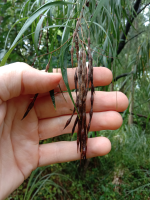
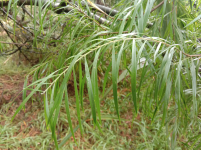
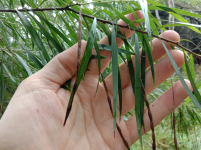
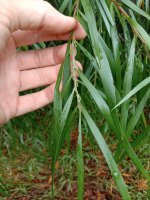
Do you recognise this acacia, Acacian? I'm stumped!
 

Attachments

  • Screen+Shot+2023-12-30+at+100423+AM.png
    Screen+Shot+2023-12-30+at+100423+AM.png
    7.3 MB · Views: 4
  • Screen+Shot+2023-12-30+at+100410+AM.png
    Screen+Shot+2023-12-30+at+100410+AM.png
    12.9 MB · Views: 3
  • Screen+Shot+2023-12-30+at+100356+AM.png
    Screen+Shot+2023-12-30+at+100356+AM.png
    12.8 MB · Views: 3
  • Screen+Shot+2023-12-30+at+100343+AM.png
    Screen+Shot+2023-12-30+at+100343+AM.png
    7.3 MB · Views: 4
  • Screen+Shot+2023-12-30+at+100329+AM.png
    Screen+Shot+2023-12-30+at+100329+AM.png
    12.3 MB · Views: 4
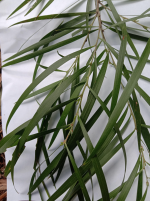
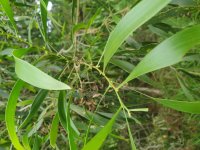
That to me looks a little more like the classic type floribunda.. is normal for them to start producing rods now. I saw some yesterday that were beginning to form since their pods have been dropped. Could you get some photos of the nerve networks? The soft phyllodes hanging from the stems is a good sign.. as is the 3 more prominent veins. Basal gland should be absent too.. some detailed pics would help though
 
Man, that would be amazing! It's an unbelievable spot. Lots of very mature trees, some have fallen over and some have really dark looking smooth bark. I'm so used to looking at council floribunda that I didn't consider/recognise they might be actual floribunda. As I was walking around there was a fragrance in the air and I thought to myself, I can smell floribunda tea! I'll go back and get some better photos. Interested to hear your thoughts on my latest post in Acacia floribunda workspace...
 

Attachments

  • Screen+Shot+2023-12-30+at+53402+PM.png
    Screen+Shot+2023-12-30+at+53402+PM.png
    10.7 MB · Views: 4
The main reason I didn’t consider these trees to be floribunda was because of the drooping/hanging phyllodes. I re-read what Nen said about the "phyllodes hanging pendulously from the stem rather than the weight of the stem making the phyllodes hang down" - a big distinction that I now understand.

Hmm floribunda should be soft papery phyllodes.. that is one of the defining characteristics of the species. If phyllodes are stiff its possible its a hybrid of some sort?
I've thought about this a lot and I think you are absolutely right. The common cultivator phyllodes are often more firm, with a thicker texture preventing the phyllodes from drooping. Having seen these latest trees (and the longissima) I have a much clearer understanding of what constitutes soft and papery.
 
Yeah I think the papery texture means the phyllodes tend to kind of hang a little bit more.. but also the branches of floribunda tend to grow upwards and the foliage forms at the ends in pendulous bursts .. each of these stems is no where near as thick as the main branch so the foliage naturally will weep. Kind of hard to describe but you can see this is the case below.. if the foliage was more stiff and concurrent with the larger stems you probably wouldn't see this.. but you do see it more with the cultivars
 

Attachments

  • image_67197697.png
    image_67197697.png
    23.6 MB · Views: 3
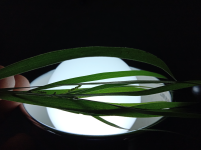
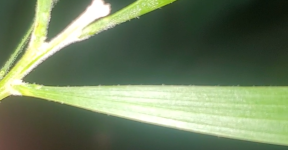
That's a good explanation, cheers Acacian. Here's a few more photos. Flower rods are twinned and phyllodes have incredibly tiny appressed hairs. Anastomisation and nerve/vein structure seem right. The location is like a haven for floribunda, there's probably in excess of 15+ wise old floribundas - seldom visited by people, so I'm feeling grateful to have found them. I took my Sony NEX-5N to try and get some arty shots too, inspired by some of your photos :thumb_up:

I tried chewing on a few phyllodes and these ones have a pronounced grassy taste followed by a bitterness (had to spit out after awhile). I'm hoping this is a good sign!
 

Attachments

  • 4Screen+Shot+2024-01-03+at+61412+PM.png
    4Screen+Shot+2024-01-03+at+61412+PM.png
    10.4 MB · Views: 3
  • 3Screen+Shot+2024-01-03+at+61431+PM.png
    3Screen+Shot+2024-01-03+at+61431+PM.png
    10.7 MB · Views: 3
  • 2Screen+Shot+2024-01-03+at+61445+PM.png
    2Screen+Shot+2024-01-03+at+61445+PM.png
    8.1 MB · Views: 3
  • 1Screen+Shot+2024-01-03+at+61353+PM.png
    1Screen+Shot+2024-01-03+at+61353+PM.png
    7.3 MB · Views: 3
Recently moved to north coast of NSW and have found what I believe to be a floribunda. When I put all the info into the wattles app it was the only match. Wanted to get another eye on it. I'm keen to try a local floribunda tea with some rue soon.
 

Attachments

  • 20240102_163734.jpg
    20240102_163734.jpg
    3.5 MB · Views: 5
  • 20240102_163749.jpg
    20240102_163749.jpg
    3.7 MB · Views: 5
That looks to me a little more like melanoxylon or possibly maidenii.. need to see finer details though. I thought I could spot a basal gland at the base of one of the phyllodes which floribunda won't have.
 
I know what you mean by the basal gland. I didn't even think about the basal gland until after I'd taken the picture and most phyllodes in pic don't look like they have one, except that one sneaky bugger. I'll go for a walk now and see if I can confirm basal glands or not. Thanks acacian.
 
it will likely have some pods laying around the base of the tree.. good to see those too

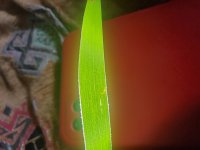
And also to see the veins in more detail.. if you can hold one up to the light it will be easy to see :)
 
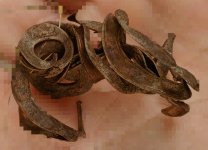
Okay, so it's definitely not floribunda. Yes basal glands everywhere, I can't believe I forgot to check for them lol. It took quite a bit of searching but I found a single seed pod, it was quite curly so I'm definitely going with melanoxylon now. It never ceases to amaze me just how variable in morphology an acacia species phyllodes can be.

Here's some more pictures though.
 

Attachments

  • 20240104_164926.jpg
    20240104_164926.jpg
    3.2 MB · Views: 5
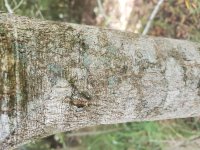
Do you have any pics of the seed pods? Were they flattened or more terete? Veins very similar to floribunda there.. the three all have reticulating nerves in phyllodes.. melanoxylon finer networks and the nerves narrower..what about phyllode texture? But yeah I think if it was covered in basal glands its fairly safe to rule out floribunda.. technically it can have an 'inconspicuous gland" though. The trunk is unlike that of any flori I've seen though.. should be smooth but mottled.

Photos of the tree could help too. With ID its important to try and cover as many things in your photos as possible.. so growth habit, pods/flowers/seeds, phyllodes close up and a description of texture. Also.. this is my subjective experience.. but taste can easily distinguish melanoxylon from floribunda.. floribunda is easy to chew.. slowly builds into a bitterness and as cheesecat mentioned has a grassy flavour. Melanoxylon will likely makes your mouth feel.. not right.. a kind of burning sensation which lasts a few minutes and leaves a sore-ish burning throat
 
Unfortunately I didn't grab the seed pod because I thought I'd find a more complete sample but ended up only finding one. It was only a section but that section was definite quite curved, unlike floribunda that I'm familiar with with much more straight pods. Quite old looking too. I know this type of acacia is around pretty abundantly where I am so I'll find another specimen and get a better view of the seed pod.

Hmm have you got pics of the inconspicuous gland? I'll attach the best shot I can get of them. Seems to match the the description that I see on the lucid keys website.

As for taste, after munching 3 or so phyllodes I can tell you this. It starts out mild for 5 seconds but then I get the burny throat. Not instilling confidence to brew :lol: wouldnt want my gut needing to process all that crap.

I've never seen a melanoxylon quite like this but it's looking to be that indeed. There's a big mama acacia close by that looks to be melanoxylon (or what I frequently call melanoxylon) but too tall for me to see phyllodes up close, covered in twisty seed pods though. Afaik it doesn't have hairs all over the phyllodes like this one does.
 

Attachments

  • 20240104_213239.png
    20240104_213239.png
    371.6 KB · Views: 1
I've never personally seen a gland on floribunda before but apparently its "possible" according to the botanical keys.. if its there its probably very subtle. Yours is quite pronounced. Gland present not quite a smoking gun but your latest photo indicates probably not floribunda.

Identification apps are not very reliable with acacias.. there are a lot of subtle features that don't get picked up.. especially if not in flower. So I would definitely take it's opinion with a grain of salt.

Floribunda should have a fair amount of pods around the base of the tree right now if its that.. it flowers around august/september so summer time is when it goes to seed. The fact that there aren't any even on the ground hints to me that it is probably something else.

Melanoxylon or maidenii seem the most likely candidates. Melanoxylon phyllodes can be pubescent too. Its a highly variable species and seems to have a number of different forms - difficult to distinguish from maidenii when not in flower.. even the pods are quite similar (I think more terete with maidenii). I think a lot of maidenii in northern NSW should be pretty close to flowering. Maidenii phyllodes are more glabrous than most melanoxylon and should have prominent lenticels on stems and trunk.

I'd be interested to see what the tree looks like, but I'm leaning toward melanoxylon. The burning throat thing shouldn't happen with floribunda - its a different kind of bitter which isn't so unpleasant.. subjectively speaking

A shot of the tree will help greatly though :thumb_up:
 
I'm actually using this app which is more of an interactive key than it is one of those dodgy ai ID apps. Its located here: Wattle - Acacias of Australia - Apps on Google Play errors in this will be user errors. When I tried doing it again it comes out with no maidenii or floribunda but only melanoxylon as the only candidate of those we're looking at.

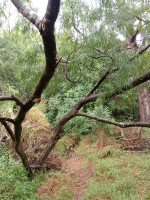
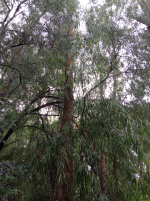
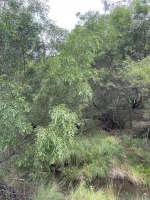
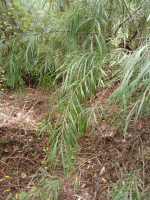
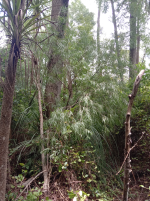
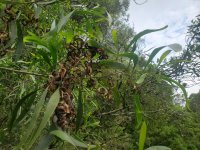
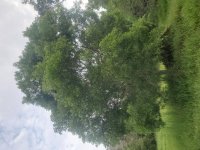
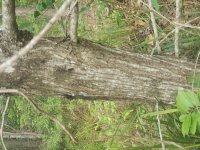
I went for a walk on a different track today and found some older specimens of the same tree. I've attached pictures of the growth habit, and trunk of older trees.

I also think I found a maidenii that has just started to flower. Seems to have rod flowers from what I can tell.

I'm out at the moment and saw some trees that from a very quick glance in the car looked more like floribunda that I'm familiar with. I'll stop on the way home and get some snaps.

Edit: Last 2 photos are of the suspected maidenii
 

Attachments

  • 20240105_083907.jpg
    20240105_083907.jpg
    3.4 MB · Views: 3
  • 20240105_083858.jpg
    20240105_083858.jpg
    3.8 MB · Views: 2
  • 20240105_151638.jpg
    20240105_151638.jpg
    797.1 KB · Views: 2
  • 20240105_083825.jpg
    20240105_083825.jpg
    4.7 MB · Views: 3
  • 20240105_100011.jpg
    20240105_100011.jpg
    4.2 MB · Views: 3
Found the smoking gun, while looking in thicker bush at a suspected floribunda (turns out it too was probably melanoxylon just very thin and long phyllodes, possibly maidenii) along a road I saw this specimen which is the same type of tree as I've shown pictures of but it was in the very start of flowering. Whatddya know, it's ball shaped!
 

Attachments

  • 20240105_164443.jpg
    20240105_164443.jpg
    3 MB · Views: 3
Back
Top Bottom