• Members of the previous forum can retrieve their temporary password here, (login and check your PM).

Acacia Extraction Workspace

Migrated topic.
tek for acuminata requiring no heat?
Not even an acidic boiling phase?

Rather than slowly evaporating a load of not-so-volatile xylene, you're better off pulling the alks back into vinegar then, after adding more base, extracting that back into a smaller amount of NPS for either freeze precipitation or evaporation to recover freebase, depending on the solvent used.
 
Not even an acidic boiling phase?

Rather than slowly evaporating a load of not-so-volatile xylene, you're better off pulling the alks back into vinegar then, after adding more base, extracting that back into a smaller amount of NPS for either freeze precipitation or evaporation to recover freebase, depending on the solvent used.
Hey mate,

In my research concerning Cyb's hybrid A/B salt tek, I saw your posts from a couple years ago in a thread where the user was having trouble pulling with Digger's shellite. He was recommended, and succeeded in, doing something similar to what you just described in this post. If you could give some guidance on some questions below, that would be greatly appreciated. The summary of what the user Upnorth implemented is as follows, and the original thread is referenced at the end for those who might be interested.

So basically I used xylene in the basic soup with the acacia grounds, pulled xylene out into a jar, made a new mix with just water/vinegar, xylene. Mix the new mix around for a while to pull the DMT from the xylene into the acidic water, pull xylene out, add lye/water, add shellite and pull dmt from the new solution same way I did with the xylene/basic soup.

I plan to follow the steps in Cyb's hybrid tek up to and including 'Step Six: Adding the Non-Polar Solvent'. In this case, the NPS would be xylene. With the xylene pulls, I would then add to a water/vinegar solution, pull the xylene from it, and then finish the tek as per normal, but using shellite as the final NPS to allow freeze precipitation.

1) In regards to the xyelene pulls, would I only do this once (as in the four suggested shake/separate cycles as per 'Step Six: Adding the Non-polar Solvent'), or would I do what is requested in 'Step Seven: Pulling', and do the xylene pull another 4 times (essentially 16 shake/separate cycles when all is said and done)?
2) When adding the pulled xylene into the water/vinegar solution as per 'Step Three: Acidifying', would I need to follow those steps explicitly, namely the heat bath for an hour with the xylene/water/vinegar mixture, or would simply combining them and allowing to separate be adequate?
3) Will pulling the xylene out from the water/vinger mixture be easily achieved, as I imagine there won't be the same contrast in colours that makes the NPS as distinct when working with the original mixture containing the plant matter?
4) If the salting was undertaken as part of the initial xylene pulls, would it be redundant to salt again as per 'Step Four: Salting', or perhaps I should only salt for the first time, after the xylene has been pulled from the now alkaline laden water/vinegar mixture, and before/during the subsequent basifiying step?

Cheers

Reference:

 
1) In regards to the xyelene pulls, would I only do this once (as in the four suggested shake/separate cycles as per 'Step Six: Adding the Non-polar Solvent'), or would I do what is requested in 'Step Seven: Pulling', and do the xylene pull another 4 times (essentially 16 shake/separate cycles when all is said and done)?
You can do a couple of extra vinegar washes to ensure that all the DMT gets recovered from the xylene.

Before that, the xylene pulls from the bark soup tend to be a lot more effective than naphtha, therefore you'll likely get away with doing just a couple of them. Xylene's greater solvent ability for DMT is the reason why it can't be used as a solvent for freeze precipitation - it holds onto the DMT too well, even at low temperatures.

2) When adding the pulled xylene into the water/vinegar solution as per 'Step Three: Acidifying', would I need to follow those steps explicitly, namely the heat bath for an hour with the xylene/water/vinegar mixture, or would simply combining them and allowing to separate be adequate?
No heat bath necessary with xylene, for the aforementioned reason. Combine, separate, done.


3) Will pulling the xylene out from the water/vinger mixture be easily achieved, as I imagine there won't be the same contrast in colours that makes the NPS as distinct when working with the original mixture containing the plant matter?
There should still be a visible boundary between the two layers because the have different indices of refraction - i.e., each bends light by a differing amount. This would be an ideal usecase for a separatory funnel, btw. Otherwise, do something to ensure that the boundary layer sits within the confines of as narrow a vessel as possible (e.g. bottle neck), or use the funnel trick, to make pipetting easier.

4) If the salting was undertaken as part of the initial xylene pulls, would it be redundant to salt again as per 'Step Four: Salting', or perhaps I should only salt for the first time, after the xylene has been pulled from the now alkaline laden water/vinegar mixture, and before/during the subsequent basifiying step?
There' a confusion here stemming from "salting" being used as a term to describe two separate things on different occasions. Step 4 refers to the addition of common salt - sodium chloride - to the mixture prior to doing the pulls. This is done in order to increase the ionic strength of the solution, so the non-polar freebase migrates to the NPS more readily. This is not strictly necessary when working with xylene, but it won't hurt.

What is necessary with xylene is that you use an acid to recover the DMT (if you don't want to evaporate a load of incredibly stinky solvent, which is both wasteful and environmentally irresponsible) since, as already mentioned, freeze precipitation won't work. This is also commonly referred to as "salting" since the DMT gets converted back into its protonated "salt" form, and thereby reverts to being water-soluble.

You can, therefore, wholly omit the bit about putting the solvent in the freezer iff you're using xylene, as you said:
finish the tek as per normal, but using shellite as the final NPS to allow freeze precipitation.
(y) you got this!

[This also highlights to me that the freeze precipitation step (part 6 of step seven) isn't explicitly mentioned in the index structure - maybe I'll remedy that soon.]

And apologies for occasionally stating the obvious - I'm writing as though this information will be more generally applicable.
 
(y) you got this!

[This also highlights to me that the freeze precipitation step (part 6 of step seven) isn't explicitly mentioned in the index structure - maybe I'll remedy that soon.]

And apologies for occasionally stating the obvious - I'm writing as though this information will be more generally applicable.

Absolute legend mate, thanks for the fast turn around and detailed response for my questions. And no dramas, nothing is too obvious to me at this point but I'm quickly learning. 🍻
 
One final bit to emphasise, you will benefit from using the freezer once you get to pulling back into shellite from the rebasified vinegar washes, especially if you'd rather not evaporate a bunch of shellite.

And maybe consider keeping your xylene well away from your shellite, just in case of vapour cross-contamination.
 
First time getting crystals (AANP)Super excited
, used no heat (except utilising the heat from the lye reaction). Did a simple ATB from a guy on reddit they call it ‘acacia acuminata minimalist atb’ they include heat bath steps but also say you can skip them if anyone wants the full tek I can write it up. Have attempted extractions before however little to no luck (only ever got a tiny bit of goo). Yeewww 😁
 

Attachments

  • image.jpg
    image.jpg
    1.4 MB · Views: 8
@_Aurelias congratulations!

I too have just successfully completed my first extraction with AA, using Cyb's Hybrid Salt A/B Tek, except utilizing xylene initially, backsalting and then pulling with naptha. I would consider my first two attempts with 50 grams of powdered bark a total failure, and most probably not because I didn't extract any of the spice, but because I just didn't know what to look for. My third attempt with 100 grams of bark has finally proved successful.

Some random thoughts below:

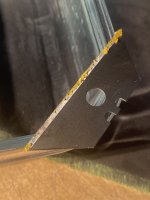
-I was expecting to see many clumps of crystals after the freeze precpipitation event, and although there were tiny specs visible in all of my attempts, it was assumed a failure the first two times. In reality, if I had just been patient enough to allow the evaporation a good 12-24 hours, the very slight film that encompassed these tiny specs would harden and scrape up into the marvelous wax seen on the razor blade in the first image below, weighing about 130mg. I was surprised what this very slight film that was almost invisible to the naked eye, scraped up into, and the resistance it provided against the razor blade was instantly recognizable. My conclusion, as far as AA goes using Cyb's tek, if there is no resistance felt when scraping, or the scraped up material is sandy/course/crystalline and not a dry amorphous substance, it's not dry enough and it will be impossible to compile much of it at all, unless there are huge deposits of it.

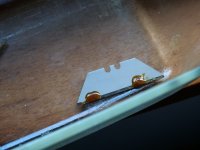
-Freeze precipitation clearly was working to some extent, but the end result was just 130mg after freeze precipitation from 100 grams of powder. I had evaporated the naptha considerably, but perhaps still not enough, or perhaps those who claim the FP should go for 48 hours are right, because the longest I ever performed was 16 hours (still learning patience). Regardless, I went the old barbaric route and evaporated the remnants of naptha from the freece precipitation event, and very quickly it started turning into the gooey goodness seen in the second image below. It looks at least 10 times more substantial than whatever the freece precipitation provided, I will guess about 1.5 grams, giving me a yield of about 1.6%, which is right in line with expectations. This is taking much longer to dry out though. A Re-x may be performed on this depending on its appearance compared to the FP yield.

-After pulling the xylene from the backsalt, some of the vinegar solution was inevitably taken with it. Since leaving that xylene in the jar, there is a small layer of vinegar solution at the bottom, which has since seemingly pulled an astronomical amount of alkaloids from the xylene. In fact, the xylene itself looks absolutely loaded with floating particulates. Likely these are just fats/impurities, and it would be safe to assume so given my yield seems to be in-line with expectations, but I will evaporate this xylene slowly over some days. I will then Re-x the leftovers using naptha and see what I'm left with, but I have a sneaky suspiscion there is a lot that wasn't pulled during the backsalt. In future, I will monitor the acid solution's PH level between subequent pulls to ensure it doesn't become too basified between pulls, assuming there is a considerable amount left in the xylene.

Happy days.

@Transform thanks for your help with my many questions

P1026086 - Copy.JPG
P1026087 - Copy.JPG
 
@_Aurelias congratulations!

I too have just successfully completed my first extraction with AA, using Cyb's Hybrid Salt A/B Tek, except utilizing xylene initially, backsalting and then pulling with naptha. I would consider my first two attempts with 50 grams of powdered bark a total failure, and most probably not because I didn't extract any of the spice, but because I just didn't know what to look for. My third attempt with 100 grams of bark has finally proved successful.

Some random thoughts below:

-I was expecting to see many clumps of crystals after the freeze precpipitation event, and although there were tiny specs visible in all of my attempts, it was assumed a failure the first two times. In reality, if I had just been patient enough to allow the evaporation a good 12-24 hours, the very slight film that encompassed these tiny specs would harden and scrape up into the marvelous wax seen on the razor blade in the first image below, weighing about 130mg. I was surprised what this very slight film that was almost invisible to the naked eye, scraped up into, and the resistance it provided against the razor blade was instantly recognizable. My conclusion, as far as AA goes using Cyb's tek, if there is no resistance felt when scraping, or the scraped up material is sandy/course/crystalline and not a dry amorphous substance, it's not dry enough and it will be impossible to compile much of it at all, unless there are huge deposits of it.

-Freeze precipitation clearly was working to some extent, but the end result was just 130mg after freeze precipitation from 100 grams of powder. I had evaporated the naptha considerably, but perhaps still not enough, or perhaps those who claim the FP should go for 48 hours are right, because the longest I ever performed was 16 hours (still learning patience). Regardless, I went the old barbaric route and evaporated the remnants of naptha from the freece precipitation event, and very quickly it started turning into the gooey goodness seen in the second image below. It looks at least 10 times more substantial than whatever the freece precipitation provided, I will guess about 1.5 grams, giving me a yield of about 1.6%, which is right in line with expectations. This is taking much longer to dry out though. A Re-x may be performed on this depending on its appearance compared to the FP yield.

-After pulling the xylene from the backsalt, some of the vinegar solution was inevitably taken with it. Since leaving that xylene in the jar, there is a small layer of vinegar solution at the bottom, which has since seemingly pulled an astronomical amount of alkaloids from the xylene. In fact, the xylene itself looks absolutely loaded with floating particulates. Likely these are just fats/impurities, and it would be safe to assume so given my yield seems to be in-line with expectations, but I will evaporate this xylene slowly over some days. I will then Re-x the leftovers using naptha and see what I'm left with, but I have a sneaky suspiscion there is a lot that wasn't pulled during the backsalt. In future, I will monitor the acid solution's PH level between subequent pulls to ensure it doesn't become too basified between pulls, assuming there is a considerable amount left in the xylene.

Happy days.

@Transform thanks for your help with my many questions

View attachment 109331
View attachment 109333

Awesome, I was only using shellite, ive heard its worse than xylene at carrying the dmt but just went with the closest thing to naptha I could find. Wonder if it has any affect at creating crystals over goo, if you'd like I can link you to the tek I used, cybs ATB is definitley a tried and true method though
 
Awesome, I was only using shellite, ive heard its worse than xylene at carrying the dmt but just went with the closest thing to naptha I could find. Wonder if it has any affect at creating crystals over goo, if you'd like I can link you to the tek I used, cybs ATB is definitley a tried and true method though
I was using shellite too, started calling it naptha unconciously along the way hahah.

Yeah that would be great if you could, I'd love some crystals like you got. Cheers.
 
I was using shellite too, started calling it naptha unconciously along the way hahah.

Yeah that would be great if you could, I'd love some crystals like you got. Cheers.
'Shellite' is merely a brand name for a mixture of hydrocarbons for which naphtha is but one of a plethora of possible alternative names. Several of these names work as catch-all terms for a more or less wide range of hydrocarbons, but there are numerous regional variations which make hydrocarbon nomenclature something of a minefield especially when other languages are involved.

Shellite will have a particular technical specification where the mixture must fall within a certain range for a number of different metrics, whereas the term "naphtha" could apply to a far wider range of compositions.
 
Back
Top Bottom