• Members of the previous forum can retrieve their temporary password here, (login and check your PM).

Acacia photo gallery

Migrated topic.
^^..haha, i was going to reply..but then i thought..is post#100 about to appear?:)

xantho..thank you!..Paperbark Thorn is a beautiful thing to behold over my morning Tea..:d

..i recall seeing a private GCMS of that species confirming DMT in the leaf, don't know about bark..

standing by for your next image xantho..!
 
acacian: I haven't had much of a chance to observe the tree in person so I'm not sure about the bark falling off but I'll let you know when I have a more definitive answer.

plantzafrica.com said:
It is a favourite nesting site for many birds - in valley bushveld areas, Pied and Crested Barbets make their nesting holes in this tree. Wood-hoopoes often scratch around under the loose bark for insects. Grey Hornbills crack the pods open and eat the seeds.

I really like your drawing idea! Haha thanks for the lively green comment, I would love to say that's just how it looks here but it's actually the 'vivid' color setting on my camera. Acacia world tour 2014? :p :d

nen: Thanks for the GCMS info! It certainly feels like a fascinating tree to explore. :)
 
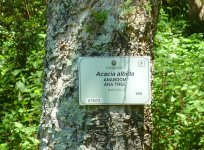
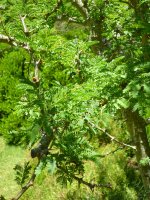
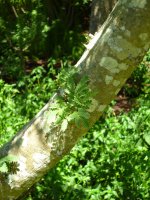
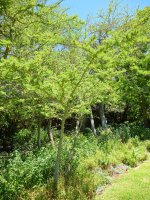
Next up: A. albida (now Faidherbia albida; The Ana tree).
 

Attachments

  • P1000818edit.JPG
    P1000818edit.JPG
    935.4 KB · Views: 0
  • P1000819edit.JPG
    P1000819edit.JPG
    1.9 MB · Views: 0
  • P1000820edit.JPG
    P1000820edit.JPG
    1.3 MB · Views: 0
  • P1000821edit.JPG
    P1000821edit.JPG
    3 MB · Views: 0
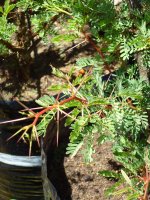
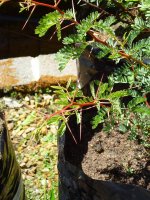
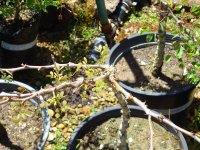
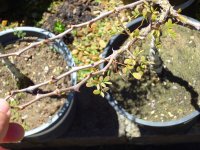
A. erioloba (Camel thorn tree) - pictures of a nursery youngster :)

A little about the Camel thorn:

Distribution

This species is widely distributed inland, from the Northern Cape through to Limpopo Province. It also extends to Namibia, Botswana, Zimbabwe and to central Africa.

Ecology

The camel thorn is a competitive species that can displace preferred vegetation. It has been assessed as potentially very highly invasive in Australia : climate predictions indicate that it could occupy large inland areas of northern Australia if allowed to spread. It is a long-lived plant that grows on sand in areas with an annual rainfall of less than 40 mm to 900 mm, and tolerates hot summer temperatures and severe frosts. In very dry areas Acacia erioloba occurs along watercourses or where underground water is present. The taproot can descend to 60m, providing access to deep ground water.

Uses

The pods are useful fodder for cattle and are favoured by wild animals in Africa , especially elephants who chew the pods and disperse the seed in their dung. The timber is strong and is highly prized for firewood.

Dry powdered pods can be used to treat ear infections. The gum can be used for the treatment of gonorrhoea and the pulverized, burned bark can be used to treat headaches. The root can be used to treat toothache. To treat tuberculosis, the root is boiled for a few minutes and the infusion is swirled around in the mouth and spat out.

It is believed that lightning will strike at the Acacia erioloba more readily than other trees. The seeds can be roasted and used as a substitute for coffee; the gum is also eaten by humans as well as animals. The root bark is used by the Bushmen to make quivers. Many wild animals love to eat the pods and will rest in the dense shade, in the heat of the African sun.

Source: PlantzAfrica

 

Attachments

  • P1000836edit.JPG
    P1000836edit.JPG
    1.4 MB · Views: 0
  • P1000835edit.JPG
    P1000835edit.JPG
    1.3 MB · Views: 0
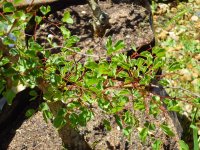
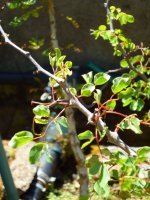
Another youngster from the nursery :) A. nigrescens (Knob thorn) - a deciduous, small to medium-sized tree which occurs in various savanna regions, often at low altitudes, and in rocky areas, on well drained soil. It is drought- and termite-resistant.

Distribution and habitat

Knob thorn is a species with a wide distribution range, occurring from Tanzania southwards to KwaZulu-Natal, often on deep, sandy soils and commonly in widely-spaced stands. It is a familiar sight to visitors to the Kruger National Park.

Ecology

Acacia nigrescens flowers are a dietary component for giraffes. Its flowers contain almost three times as much condensed tannin as leaves. Giraffes consume large quantities of flowers resulting in distinct browse lines on the trees.

Uses and cultural aspects

Knob thorn trees are the host of hole-nesting bird species and the larvae of the dusky charaxes butterfly. The wood is hard and drought- and termite-resistant but frost-tender; it has been used to make fence posts and mine props. The knob thorn yields good quality firewood producing lasting coals and severe heat. It also makes a good bonsai subject. It is not regularly used for furniture because it is difficult to cut. Knob thorn leaves and pods are included in the diet of elephant, giraffe, kudu, duiker, impala and steenbok.

Source: PlantzAfrica
 

Attachments

  • P1000838edit.JPG
    P1000838edit.JPG
    1.5 MB · Views: 0
  • P1000839edit.JPG
    P1000839edit.JPG
    964.8 KB · Views: 0
Open-source revelations power the bleeding edge of plant-human symbiosis :d

I looked down at my hands while doing push-ups last night and the understanding washed over me like a bucket of ice water - taking my breath away at first but soon leaving a warm, conscious glow...I'm a primate! (and not a dolphin :lol: so post more picture I shall!).

Which leads me to my next offering:

A. burkei (Black money thorn) - named after the English botanist Joseph Burke who collected this species in 1840 near the Magaliesberg.

Distribution and habitat

A medium-sized tree (6-12m) that may grow on a variety of soil types but prefers sandy soils and is often found on savannas, rocky slopes, low lying areas and along dry river beds. Range includes parts of north-eastern South Africa, south-eastern Botswana, south-eastern Zimbabwe, Mozambique and Swaziland.

Frost and drought hardy. It adjusts well to life indoors and is therefore rather popular as a bonsai specimen (wink wink - all you would-be cold weather acacia growers: magic emerges as process, not product).

Sources: Guide to the Acacias of South Africa - Nico Smit (1999) and PlantZone.
 

Attachments

  • P1000841edit.JPG
    P1000841edit.JPG
    1.3 MB · Views: 0
  • P1000842edit.JPG
    P1000842edit.JPG
    1.1 MB · Views: 0
I went for a bush walk again yesterday and came across a globular flowered Acacia that's flowering in December for some reason. Usually they flower in June.

vcuzxd.jpg


2rwqpme.jpg
 
looks interesting wage, a phyllodineae of some kind,


Much appreciated for your recent contributions xantho, has been great to follow :thumb_up:
 
Here's some more photos from yesterday.

- Mature Acacia Mearnsii

258ui40.jpg


- Acacia Mearnsii with green bark.

13yjomx.png


- Acacia Baileyana

sytc7l.png


- Acacia Baileyana

xnyw4h.png
 
- Unknown Acacia, possibly Acacia Longifolia.

dnezjd.png


- Similar species to the above.

2py2fq9.png


- White spots on Acacia Bark. Does anyone know what these are?

fel3qa.png


359b9ys.png


- Possibly Phalaris.

105yu85.png
 
nice pics. the last photo is not of Phalaris Aquatica though, i think it doesnt even belong to Phalaris species. The structure of the flower of Aquatica is similar to the Brachystachy flower buds, its just more elongated like this one. this one is too hairy and it doesnt have the same structure.
 
nice photos wage thanks for contributions... the unknown pic with the leathery phyllodes looks like it could be a young pycnantha? i'm not sure if the phyllodes stay like that when the stem gets that thick though so not quite sure. ...and you too xantho.. i echo Seldom's appreciation.. your doing good work mate! great to see lots of photos now by people other than myself I kinda felt like this was a bit of a lone thread for a while.. few to contribute for now... some acacia obtusifolia found growing in the mountains around the southern coast of NSW.. then some acacia maidenii found growing near royal national park near sydney as well as what i presume to be a coastal form of floribunda... some sophorae growing amongst beautiful rainbow gums.. and a very interesting silvery acacia found growing on the coast about an hr from newcastle which I would like to know the name of.. nen.. where are you? :)

Acacia Obtusifolia
img2347dv.jpg


img2348u.jpg


img2355ad.jpg


img2337f.jpg


Acacia Maidenii
img2427eo.jpg


img2432iz.jpg


img2438y.jpg


Acacia Floribunda

img2388du.jpg


Purple strain of Acacia Baileyana

img2370e.jpg


Acacia Sophorae

img2479lm.jpg


unknown..

img2469k.jpg


Acacia Implexa

img2499wq.jpg
 
went to dangars falls today.. got to admire some beautiful views as well as some Acacia Diphylla and Acacia Ingramii

Acacia Diphylla:

pc270030.jpg


pc270058j.jpg


Acacia Ingramii:

pc270073.jpg


pc270026.jpg


Ingramii and Diphylla

pc270037.jpg


Not sure here.. maybe Acacia Implexa?

pc270054.jpg
 
Acacia Pycnantha

29pywrp.jpg


29y031e.png


Possibly Acacia Longifolia

o6cz7p.png


Similar/Same species as the above photo, but with a vine changing its shape.

15frjp.jpg


Unknown, working on an ID.

s32elz.png


Acacia Oxycedrus

2qibpxd.png


Thistle

ppq3d.png
 
Back
Top Bottom