Jees, thank you so much for the feedback and tips and all the amazing work you have done with rue. Also, thanks for the salt amount tip during manske: I'll be careful to not undersalt.
A couple questions about the pressure cooker (PC),
1) Any concerns with
hydrolyzing harmine->harmol and harmaline->harmalol at high pressure/temp and low pH? Specific concern is hydrolyzing the methyl group, which has been alluded to before
by pitubo. Guess the yields speak for themselves (so no major concerns), but what pH and pressure and time do you run the PC at and still have high yields?
2) If using an aluminum PC, any concerns with Al contamination when running the PC with a low pH solution (I have a cheap Al PC for my mushroom growing hobby). Stainless pressure cooker would not be an issue.
Also, thanks for the video link, love seeing those famous blue gloved hands in action:d
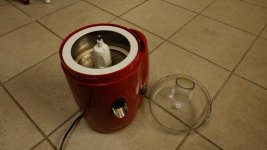
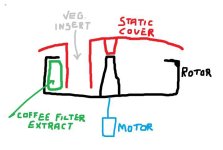
You've mentioned on other threads that you centrifuge the last manske crystals to drive salt down. What do you use as a centrifuge?
I read through the threads you posted (thanks again).
This was an interesting post. One theory to explain what was observed is that if ammonia basing does not precipitate harmalol (as
69ron mentioned). Therefore, harmalol happily stays in the water, and won't get in the way of harmine/harmaline precipitation. However, in NaOH basing, harmalol will try to leave the water (but with difficulty since it is so attracted to water) and get in the way, slowing down the precipitation. This harmalol theory is also compatible with the post manske NaOH basing observation, where NaOH precipitates harmaline/harmine easily because harmalol was removed, and is now the goo in the NaOH based manske (note that if this theory is true, the first manske will not produce goo if based with ammonia assuming no NaCl interaction, or if ammonia was used during the original post extraction basing - which is testable).
Another test for this theory would be to measure the yield on a 50/50 split extract treating each side of the split with NaOH basing/filtering/drying vs Ammonia basing/filtering/drying. There should be a drop in dry measured yield with ammonia. The higher yielding NaOH precipitate would be the crude full-spectrum stuff, with harmala/harmaline forcing (after some time and work) harmalol out in non-goo form. Maybe you have done this measurement already? Unfortunately, if the NaOH full spectrum product is washed with water, harmalol may be washed away. Fortunately said wash could be tested for goo at this point with a new NaOH (or sodium carbonate) basing, with a chance for crystals since NaCl has not been introduced yet (see next comment). However, this harmalol would be NaOH (or Na2CO3) contaminated.
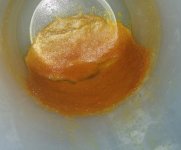
The isolated goo is very problematic. Maybe it is goo because of salts? I've seen crude salvinorin extract turn to goo in the presence of NaCl salt while trying to remove chlorophyll with salt water. I can't explain why salt would gooefy anything, just an observation (and it may be totally unrelated to our situation here).
Finally, you make an excellent point about the final evidence for harmalol. You are right that we would need outside confirmation. For now, we can see if the goo continues to behave like expected under the harmalol hypothesis. If so, we may be able to crystalize it if we put our minds together (it is supposed to be a "
tumeric yellow" crystal, maybe with 99% IPA which may help clean out the salt after drying?). I've attached a paper where some folks show some Rue TLC results so we could repeat that also if we get to that point. Beyond that we need a lab sample of harmalol as a TLC standard or to send the samples out. But I think there is fun work to be done before we get there.
PS: I use hop nylon bags, made for extracting hops during Homebrew. No seeds get to the centrifuge. Sorry that I did no mention that earlier.
PPS: Another interesting test would be to run the dissolved goo in a basic solution in a PC (or microwave?) with a methylating agent and catalyst, to see if we can synthesize harmaline from harmalol. The right reagents are difficult to come by (except for DMC) and handling them is beyond my abilities, but a hail mary using methylated vitamin B12 supplements (methylcobalamin) may be worth a try - would not be the first time
something is methylated with it.
Edit: Methylation is NOT recommended for the kitchen alchemist. It can be very dangerous. Thanks to pitubo for pointing this out. I will be more careful to point this out in the future.






 .
.