• Members of the previous forum can retrieve their temporary password here, (login and check your PM).

CITLO DMT Benzoate [A CISLO® experiment]

Migrated topic.
Oh wait, maybe I misunderstood. Is Brennendes Wasser suggesting that the molecule doesn't break apart when vaporized and is still DMT benzoate in vapor form? I'm confused.

Edit:
I sampled about 15mg dmt benzoate (9mg freebase equivalent) out of the volcano. I used loveall's temperature of 210c. It vaped very efficiently, producing a thick vapor right away and seemingly fully vaporized by the time the bag was half inflated. It was indeed smooth and tasteless. Although I'd normally be vaporizing 5x more of the freebase so it's not a totally fair comparison. Light effects, the hum and classic dmt cev's for about 5? minutes. Was still mostly aware of myself and mentally analyzing between short bursts of imagination. Probably the most pleasant light dose I've had though.
 
Last edited:
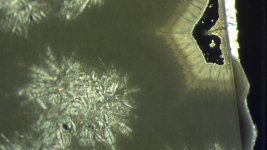
Does it make sense to find the melting point of a salt? I did a few MP tests with DMT benzoate and found that it sintered at 145c and melted at 150c. Repeated a few times with recrystallized crystals and with the crude powder. Both forms were consistent.

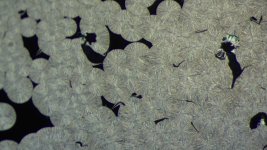
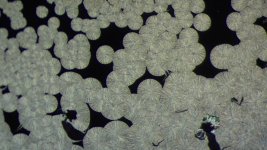
I went to prepare a melt slide and noticed in open air on the hot plate that within seconds of crossing the MP it was vaporizing. Is that expected of salts? As soon as DMT benzoate melts is it dissociated into DMT freebase and benzoic acid again?

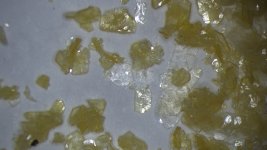
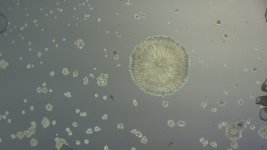
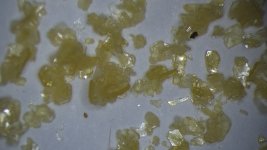
My recrystallized crystals were a mix of clear-yellow again, just like the freebase. This confuses me because the crude benzoate powder that crashes out during salting is pure white. I even washed it a few times with hexane and naphtha to remove any excess benzoic acid or freebase. To recrystallize DMT benzoate I dissolved it in warm distilled water. I tried to get as concentrated solution as possible so I added a little water at a time, at 65c, until everything dissolved. The solution was yellow.

Once the salt dissolves into water is it behaving similarly to when it's in its melt-liquid form? Dissociated? Even though the salt doesn't melt until 150, if the salt is dissolved in water at 65c, would that mean the dissociated freebase ions could react to its own melting point? Perhaps the re-x was yellow because the freebase in solution was 'melted' and started doing whatever it does that tints it yellow in freebase crystals?
 

Attachments

  • IMG_0098.jpg
    IMG_0098.jpg
    4.1 MB · Views: 3
  • IMG_0099.jpg
    IMG_0099.jpg
    4.2 MB · Views: 3
  • IMG_0101.jpg
    IMG_0101.jpg
    5.5 MB · Views: 3
  • IMG_0104.jpg
    IMG_0104.jpg
    5.9 MB · Views: 2
  • IMG_0105.jpg
    IMG_0105.jpg
    5.8 MB · Views: 2
  • IMG_0107.jpg
    IMG_0107.jpg
    6.2 MB · Views: 2
Last edited:
You might want to look into ionic liquids and deep eutectics.

As well, with both DMT and, especially, benzoic acid not being the strongest examples of acid and base respectively, there's fair reason for the salt to have a significant vapour pressure. This will cause the substance to vaporise on heating until the saturated vapour pressure is reached in the surrounding medium. If there is sufficient space for the vapours to diffuse away before this point is reached, all of the sample will end up vaporising. An additional factor comes into play if the local atmosphere is cool enough, or there is sufficient negative thermal flux - the vaporised salt will condese into suspended droplets or particles - an aerosol - which makes far less of a contribution to the vapour pressure, thus the heated sample continues to vaporise and appears to emit "smoke".

It should be possible to sublime DMT benzoate if the pressure is low enough. Apparatus exists for this type of operation, and is relatively easy for the dedicated handyperson to build out of standard lab glassware or even hardware store materials.
 
You might want to look into ionic liquids and deep eutectics.

As well, with both DMT and, especially, benzoic acid not being the strongest examples of acid and base respectively, there's fair reason for the salt to have a significant vapour pressure. This will cause the substance to vaporise on heating until the saturated vapour pressure is reached in the surrounding medium. If there is sufficient space for the vapours to diffuse away before this point is reached, all of the sample will end up vaporising. An additional factor comes into play if the local atmosphere is cool enough, or there is sufficient negative thermal flux - the vaporised salt will condese into suspended droplets or particles - an aerosol - which makes far less of a contribution to the vapour pressure, thus the heated sample continues to vaporise and appears to emit "smoke".

It should be possible to sublime DMT benzoate if the pressure is low enough. Apparatus exists for this type of operation, and is relatively easy for the dedicated handyperson to build out of standard lab glassware or even hardware store materials.
That's interesting. Sounds like my kind of project.

Besides it aerosolizing, I'm more curious about why it turned yellow, since my main reason for converting to benzoate was as a purification step to eliminate any polymers or whatever makes the spice yellow. But it seems whatever causes that can cause it to benzoate too.
 
That's interesting. Sounds like my kind of project.

Besides it aerosolizing, I'm more curious about why it turned yellow, since my main reason for converting to benzoate was as a purification step to eliminate any polymers or whatever makes the spice yellow. But it seems whatever causes that can cause it to benzoate too.
The yellow might just by a result of π-electron transfer between the indole and the benzoate benzene ring. It's not necessarily a sign of impurity.
 
Back
Top Bottom