Hello Nexus,
Has anyone encountered or worked with Claviceps Paspali and its host grass?
It's a kind of ergot fungus that grows on Paspalum Distichum, a cosmopolitan weed, probably from the tropical Americas.
It's quite invasive in some places and it should have a similar alkaloid profile to LSAs bearing plants, plus some tremorgenic indole-diterpene alkaloids, in a similar way to Phalaris species that contain gramine.
Similarly it induces staggers and tremors in cattle that eat too much of it, but if taken away from the infected pasture they recover in brief periods.
It contains paspalic acid too and it is used industrially for the production of ergometrine and lysergic acid amides.
Its life cycle has different stages, it infects the flowers and the seeds of the plant and it reproduces both sexually and asexually.
It is interesting because sexual reproduction happens through a sclerotium, like claviceps purpurea, spreading the spores in the ground for winter dormancy.
More interesting is the asexual reproduction, done by hijacking the flower and inducing it to produce a honeydew rich in sugars and conidia that attract insects to spread it.
In the honeydew stage it should be rich of ergolines too.
The questions that have been running in my head for a loooooong time are:
How clean is the alkaloid profile? It seems that it shouldn't bear the same risks of vasoconstiction and gangrene as C. purpurea?
Can LSAs be extracted like form morning glories?
Can it be used as it is since humans are not big ruminants and the dose should be a fraction of what an animal could eat in days of grazing?
Are paspalitremines active as tremorgens in humans or is it similar to gramine, that could be a stimulant?
Could a strain of the host or of the fungus be isolated to produce only the useful alkaloids?
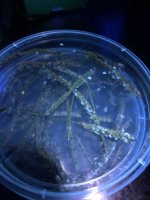
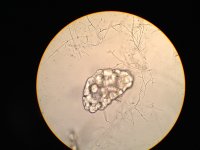
I've found some specimens and collected some samples, done some approach to bioassays too, as I suspect it is active, but I'd like if someone else would like to share some thoughts on it.
Thanks

Has anyone encountered or worked with Claviceps Paspali and its host grass?
It's a kind of ergot fungus that grows on Paspalum Distichum, a cosmopolitan weed, probably from the tropical Americas.
It's quite invasive in some places and it should have a similar alkaloid profile to LSAs bearing plants, plus some tremorgenic indole-diterpene alkaloids, in a similar way to Phalaris species that contain gramine.
Similarly it induces staggers and tremors in cattle that eat too much of it, but if taken away from the infected pasture they recover in brief periods.
It contains paspalic acid too and it is used industrially for the production of ergometrine and lysergic acid amides.
Its life cycle has different stages, it infects the flowers and the seeds of the plant and it reproduces both sexually and asexually.
It is interesting because sexual reproduction happens through a sclerotium, like claviceps purpurea, spreading the spores in the ground for winter dormancy.
More interesting is the asexual reproduction, done by hijacking the flower and inducing it to produce a honeydew rich in sugars and conidia that attract insects to spread it.
In the honeydew stage it should be rich of ergolines too.
The questions that have been running in my head for a loooooong time are:
How clean is the alkaloid profile? It seems that it shouldn't bear the same risks of vasoconstiction and gangrene as C. purpurea?
Can LSAs be extracted like form morning glories?
Can it be used as it is since humans are not big ruminants and the dose should be a fraction of what an animal could eat in days of grazing?
Are paspalitremines active as tremorgens in humans or is it similar to gramine, that could be a stimulant?
Could a strain of the host or of the fungus be isolated to produce only the useful alkaloids?
I've found some specimens and collected some samples, done some approach to bioassays too, as I suspect it is active, but I'd like if someone else would like to share some thoughts on it.
Thanks