• Members of the previous forum can retrieve their temporary password here, (login and check your PM).

DIY Sublimatory?

Icon

Titanium Teammate
Donator
Joined
Mar 9, 2012
Messages
679
Merits
1,170
I like the idea of sublimation for purification. It seems like the cold finger would have to be cleaned repeatedly to purify a moderate amount, though.

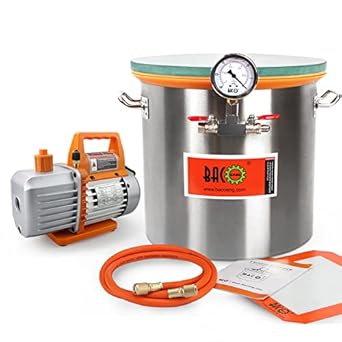
Could you make your own sublimation apparatus out of a stainless steel vacuum chamber kit like these:

410n+MdESLL._SX342_SY445_.jpg


I was thinking of drilling a large hole in the glass lid, and plugging it with a stainless steel bowl + gasket. Inside the bowl could be dry ice.

Alternatively, could replace the whole lid with a sheet of metal and cool the entire lid.

DMT in the bottom, pull vacuum, close valve, apply heat = sublimation? (Looking for the sublimation point if anyone knows).


I think it would work, but I'm wondering it there's a reason that lab-glass sublimatories are so small? Is it important to have a small distance between the solid and the coldfinger? Would a 3-5 gal pot be too large of a chamber?
 
In theory could this work in reverse? Instead of having the cold finger above the solids, could the entire vacuum chamber be submerged in an ice bath, with the dmt suspended from the glass lid? I'm thinking infrared light could be used from above the glass chamber lid to catalyze the sublimation. Then vapor drops and deposits on the walls and bottom of the chilled chamber.
 
Sublimation is optimised by minimising the distance between the impure starting material and the resublimation ("condensation") surface, otherwise too much product disappears out of the vacuum exhaust. Sublimator apparatus typically consists of a side-arm tube, with a fairly snugly-fitting cold finger. The vacuum chamber would be far too big to use in its entirety, but sublimation experiments have always appealed to me.

One further stumbling block is that DMT's melting point - or at least, some of its melting points - is/are rather on the low side for sublimation to be fully effective. Nothing wrong with a vacuum distillation, of course, although you may have to go with a Kugelrohr to avoid clogging up a condenser with solidified distillate.
 
Thanks for your help! I've since found more threads concluding it's practically impossible to sublimate dmt without a very deep vacuum, and even then I haven't seen any proof. My idea was to draw the vac and close the valve before applying heat. The chamber is capable of holding the vacuum without the pump running, but this pump+chamber setup wouldn't be strong enough anyway. I'm guessing the strongest vacuums have to run continuously to maintain deep vac, so I guess volume/distance would be an issue then.
 
Last edited:
I couldn't get this idea out of my head so I'm going to try it soon.

I have a vacuum chamber, cooler for it to sit in a cold bath, and an infrared heat lamp. I plan to tape a sheet of aluminum foil in suspension, across the chamber, near the lid. I'll sprinkle some DMT on the foil, place the lid, and pull a vacuum. Once the gauge maxes out I'll shut the valve on the chamber to maintain vacuum. Then I'll apply heat through the acrylic lid with the lamp. Idk if it will sublimate or melt first, but I think any vapor generated should condense or deposit in the cool, shaded bottom of the chamber.

I also wanted to try UV, thinking maybe the higher energy and absorption at those wavelengths could get the molecules moving. But idk what I could pull a vacuum in that passes UV besides quartz.

The vacuum chamber would be far too big to use in its entirety, but sublimation experiments have always appealed to me.

One further stumbling block is that DMT's melting point - or at least, some of its melting points - is/are rather on the low side for sublimation to be fully effective. Nothing wrong with a vacuum distillation, of course, although you may have to go with a Kugelrohr to avoid clogging up a condenser with solidified distillate.
I was reading today and got the impression that a lower melting point would be more likely to sublimate. But idk.

And I was wondering: If DMT can't sublimate, even at moderate vacuum, then it must have an incredibly low vapor pressure right? So what does it mean when people can smell it? How could that be possible if its vapor pressure is preventing sublimation.

I'm also wondering does the composition of the atmosphere affect sublimation? Maybe the natural atmosphere of nitrogen and oxygen creates a different triple point than say, a pentane vapor atmosphere?
 
Last edited:
I also wanted to try UV, thinking maybe the higher energy and absorption at those wavelengths could get the molecules moving.
UV seems likely to cause decomposition since it's absorbed through electron transitions between bonding and nonbonding or antibonding orbitals in the molecule. IR interacts at the scale of atomic motion, generally bending, flexing and stretching of bonds, so this is the energy band of the EM spectrum which tends to impart momentum directly to the molecules. Microwaves would impart a rotation to rotatable dipoles, so the NMe₂ group would be affected by that.

Sublimation occurs when the vapour pressure of the solid exceeds the local saturated partial pressure of the substance in the surrounding atmosphere.

I wonder if a warm argon stream would cause significant removal of DMT from a solid sample, for redeposition on a LN₂-cooled surface? But that's not really vacuum sublimation, even if this were to be carried out at below normal atmospheric pressure.
Maybe the natural atmosphere of nitrogen and oxygen creates a different triple point than say, a pentane vapor atmosphere?
Afaik, the triple point is the triple point, but use of a carrier gas (great idea, btw) may help. I'd suggest checking the literature on that, since it's starting to sound a bit like GC minus the column substrate. Playing with that might give you enough data for a research thesis ;)

If DMT can't sublimate, even at moderate vacuum, then it must have an incredibly low vapor pressure right? So what does it mean when people can smell it?
Very pure DMT is virtually odourless. The normal scent we associate with DMT comes from traces of indole and skatole, which smell sweet and floral at low concentrations, becoming more and more faecal as their levels increase.
 
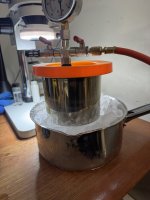
Well, I can confirm that sublimation is not possible. Nothing happened at room temp under -30 inHg, and when I heated the stainless steel chamber to flash off the moisture, it started melting.

Infrared was a total fail. The lid was hot, but I don't think I was able to get the lamp close enough to this lid with the gauge in the way. In a previous test the lamp had to be pretty much touching the lid to pass enough heat through. But I was hoping under vacuum it wouldn't need to be as close. Nothing melted, and the puddles that were already there actually started to recrystallize, so I don't think anything evaporated let alone sublimated. I even shined a red laser on a crystal + infrared to see if that would work, but no.

So I switched back to the heat gun, initially trying to push heat through the acrylic lid. But the lid started to melt before the crystals. I eventually went with heating the top half of the chamber, since that worked to melt it before, while keeping the bottom half on ice.
IMG_1191.jpeg

It was working to melt it, and I think I was seeing some very slow evaporation. I had the heat gun on full blast, the top half was untouchably hot and the bottom was ice cold. But I was having to change the ice every 10 minutes, and eventually the lid started to melt again. The rim of the steel chamber melted an impression into the lid, eventually cutting through the silicone gasket and compromising the vacuum. Also, it started to fume on the inside, acrylic fumes, contaminating the spice. The chamber got so hot a red ember spontaneously started eating away the label adhered to it.

Took a video of the crystals sintering and melting.

View attachment VID_0083.mp4

So yea, pretty big fail. In retrospect, now that I know most of the heat transferred through conduction, it might have worked better if I used more foil tape. And a glass lid. And a gauge not in the way of the infrared lamp. But at this point it's just vacuum distillation, so it's better off being done in lab glass.

edit: I deleted some pics because my prints were all over the foil
 
Last edited:
Back
Top Bottom