I wanted to provide a quick update.
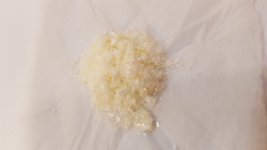
The experiment (freebase -> oxide -> freebase) did not work well - the yield was abysmal, 10% (40mg from 376mg) due to the following 7 mistakes made.
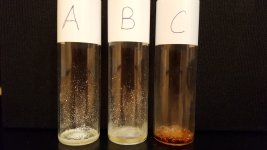
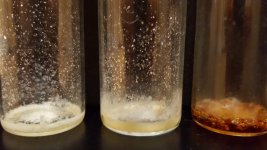
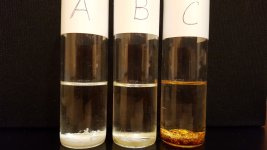
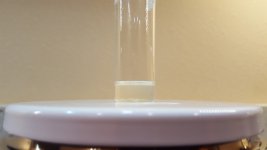
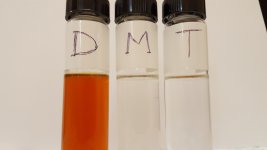
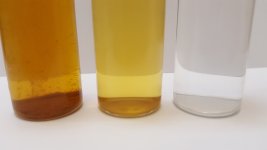
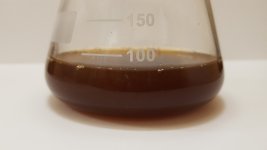
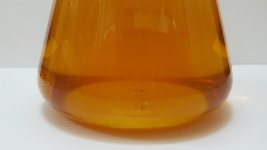
1. The first mistake may have been evaporating the unreacted peroxide and IPA. Near the end the peroxide concentration increase seemed to outpace the speed of evaporation, yet all the alcohol had already evaporated and could no longer protect the freebase from over-oxidation / polymerization. This time there was no strong smell of burned DMT, but the brown color was back again, and so were the large bubbles.
At the same time, it is possible that DMT was not burned - perhaps DMT-N-Oxide simply has that dark amber color, and the bubbles were large because the liquid became very viscous?
2. The second mistake may have been adding HCl before giving the residual DMT-Oxide oil enough time to completely dry up. If there were trace amounts of peroxide left in the solution, HCl would have reacted with H2O2 to form chlorine gas and HOCl - not good (chlorine is poisonous, HOCl reacts with NaOH to produce bleach).
3. The third mistake was eyeballing zinc and using too much. The suspension had to be filtered twice, possibly with some loss of DMT in the process.
4. The fourth mistake was stopping the HCl + Zn reaction after 2-3 hours. The intensive bubble formation had ceased but the reaction was probably still going on, albeit at a reduced rate. Perhaps letting diluted HCl evaporate a bit and then adding fresh acid, etc. would have kept the reaction going, and led to more DMT-Oxide getting converted to freebase.
5. The fifth mistake was not using enough NaOH to dissolve zinc hydroxide (the suggested ammonium hydroxide also causes the formation of Zn(OH)2 so it does not seem any better?). A bunch of zincates formed and did not dissolve. This was not a big hassle since the unreacted zinc dust had to be filtered off anyway, but the zincates tend to clog the filter paper, and the wet mess traps some liquid.
6. The sixth mistake was clumsy (and rushed) liquid-liquid extraction with hot heptane. One pull bumped upon opening the stopper (as the heptane boiling point dropped with the reduced pressure) leading to some DMT loss (thankfully, no injuries). Heptane is the least polar solvent so it should be great for pulling just the freebase w/o the oxide, but it requires multiple pulls, needs to remain hot, so it takes quite some skill and patience.
7. The seventh mistake was freeze precipitation and scraping. While it is great for extractions, scraping all the crystals off the evaporation dish is impossible so it leads to some DMT loss.
...
I believe the experiment should be re-done. I have a few ideas of how to perform it using no heat, no evaporation, and no filtration - trying to keep it as kitchen-friendly as possible.
This time, I am considering the following plan:
1. Convert DMT freebase to DMT Oxide.
Dissolve 376mg freebase in a vial with 5ml of 5% vinegar and add 15ml of 30% hydrogen peroxide. The acetic acid is used instead of alcohol to avoid having to evaporate it.
I assume that without evaporation DMT dissolved in alcohol will be impossible to pull with a non-polar solvent later
I have no idea how fast this reaction is. Perhaps it happens instantly, but waiting a day or two should not hurt.
2. Make ALL the hydrogen peroxide decompose.
Add a tiny (catalytic) amount of manganese(iv) oxide to the vial and observe O2 bubbles. Once they stop, repeat until adding more catalyst no longer makes any difference.
Test if all the H2O2 is gone by taking a sample and dropping it into an indicator solution - like KMnO4 dissolved in a strong acid.
Can (and should) KMnO4 be added to the DMT solution directly - can it perhaps replace MnO2 altogether as both an oxidizing agent and self-indicator? Will it react with DMT? Will it be too slow to change its color in the weak (acetic) acid environment?
Another option for the catalyst is potassium iodide. The benefit is that KI is soluble in water. I assume that in acidic conditions it will precipitate out as iodine, however.
3. Add Zn and HCl to convert the DMT Oxide to DMT (chloride).
Pour the test vial into a 250 ml flask. Add 35ml of 2M HCl and begin stirring continuously on a magnetic stirrer.
If MnO2 was used in the previous step and not filtered off, HCl will produce chlorine (gas). HCl would not react with KI.
Slowly add zinc mesh until the zinc is no longer reacting/disappearing. Once it stops reacting, and add a touch of fresh HCl to make zinc disappear so that there is no zinc dust to filter off. After that procedure the solution should be slightly acidic and mainly contain H+, Zn++, DMT+, Cl-, CH3COOH- ions, and OH- groups.
4. Basify the solution to convert the DMT chloride to DMT freebase.
Keep adding NaOH until all the Zn(OH)2 turns into Zn(OH)4, which dissolves completely. Again the solution should be mostly clear, with pH above 13.
MnCl2 will produce Mn(OH)2, which will not dissolve. Again, KI wins by not reacting with NaOH, it seems..
5. Extract the DMT freebase with a highly non-polar solvent.
Do multiple pulls with hot heptane (unless there are better alternatives?), evaporate the heptane down to an amount that can be poured into a small dish that is light enough for weighing on a milligram scale. Weigh the dish while empty and again after all the heptane evaporates, subtract the weights to calculate the yield.
6. Bioassay the product to make sure it is DMT freebase and not something else.