
• Members of the previous forum can retrieve their temporary password here, (login and check your PM).

Experimental: Extracting mescaline carbonate bubbling CO2

The salt was formed from a tea with zero alcohol. The issue that may have happened is the pka of carbonic acid is too low to be 'freed' by the hcl. I just checked and the other mescaline hcl that is from my recycled salting experiments was also carbonate salt so two instances that show hcl doesn't replace the carbonate. I considered the pka to be 6.35 but anhydrous is lower.

The alcohol is the experiment I'm gonna test since seems that the salt is also insoluble in ethanol 96%. Even now after 2 hours it didn't dissolve. Unless it is a question of purity? The salt from from the tea using co2 is the expected amount of mescaline I get after the iso99 washes to remove color. IME the 'pure mescaline' has represented 25-35% of the total alkaloids (ONLY once did it represent nearly entire alkaloid content for me and might have just been error on my end)
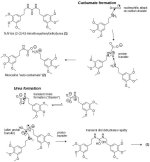
Ah, OK - I've drawn out the possible mechanisms, regardless :)
mescaline - carbon dioxide adducts - mechanisms.jpg

Maybe the "carbonate" has at least been the carbamate all along, if not the urea. Consider how unsubstituted or monosubstituted tryptamines readily form carbamates with CO2, as in the separation methods for NMT.
 
Ah, OK - I've drawn out the possible mechanisms, regardless :)
View attachment 102257

Maybe the "carbonate" has at least been the carbamate all along, if not the urea. Consider how unsubstituted or monosubstituted tryptamines readily form carbamates with CO2, as in the separation methods for NMT.
Ohh seeing this ... I think it was your work... did anyone ever test your h2o2 harmala idea in the wiki?
I was gonna try but started getting more projects going. Which salt was it to which resulting salt? IDK if my red harmine citrate will work since completely different to when I precipitated with titillation.

I have very little understanding on these especially how they attach and replacing. I read a lot of the science madness forums but most goes over my head. I would love to start experimenting to replace more dangerous or unavailable reagents to do the same thing but seems like years of work just to have a good grasp.
 
Ohh seeing this ... I think it was your work... did anyone ever test your h2o2 harmala idea in the wiki?
I was gonna try but started getting more projects going. Which salt was it to which resulting salt? IDK if my red harmine citrate will work since completely different to when I precipitated with titillation.

I have very little understanding on these especially how they attach and replacing. I read a lot of the science madness forums but most goes over my head. I would love to start experimenting to replace more dangerous or unavailable reagents to do the same thing but seems like years of work just to have a good grasp.
Well, I've about forty years of chemistry under my belt, and it's a constant learning process. Give it fifteen years to get good at it as a layperson
:eek:

The H2O2 idea was originally @professor8's, AFAIK. I just like drawing diagrams ;)
 
Posted already in another thread so I'll just link. The mescaline carbonate or carbanate is completely insoluble which may affect the activity... VERY strange to me. I'll test the activity next time I make some. Also I had trouble dissolving even in very high ph lye water. I'm gonna leave it for a day to hopefully freebase and recover.

 
So incase this is a carbamate it seems it can be higher bioavailable but potentially a toxic.

"Carbamates exhibit desirable chemical attributes,
including stability in both conformation and metabolism,
coupled with the capability to traverse cell membranes.
Notably, certain carbamates can even breach the blood-
brain barrier (BBB), a significant feat, indicating that
they may exert therapeutic activity in the Central Nervous
System (CNS). Scientific investigation has demonstrated
that introducing a carbamate moiety augments the biological
efficacy of various natural or synthetic compounds featuring
active pharmacophores."

Lol in that paper shows some drugs being 12-50 time stronger. So I'll dose at 20mg for my first test and not use any maoi.
 
So incase this is a carbamate it seems it can be higher bioavailable but potentially a toxic.

"Carbamates exhibit desirable chemical attributes,
including stability in both conformation and metabolism,
coupled with the capability to traverse cell membranes.
Notably, certain carbamates can even breach the blood-
brain barrier (BBB), a significant feat, indicating that
they may exert therapeutic activity in the Central Nervous
System (CNS). Scientific investigation has demonstrated
that introducing a carbamate moiety augments the biological
efficacy of various natural or synthetic compounds featuring
active pharmacophores."

Lol in that paper shows some drugs being 12-50 time stronger. So I'll dose at 20mg for my first test and not use any maoi.
It's generally carbamate esters that have the toxicity issue, not ionic carbamate salts like we're considering here. (Carbamate esters are their own whole class of pesticides.)

Not that this should detract from your precautionary approach with testing the compound - enhanced bioavailability could lead to some surprises, although the (somewhat disturbing) paper you linked to does exclusively deal with the esters.
 
It's generally carbamate esters that have the toxicity issue, not ionic carbamate salts like we're considering here. (Carbamate esters are their own whole class of pesticides.)

Not that this should detract from your precautionary approach with testing the compound - enhanced bioavailability could lead to some surprises, although the (somewhat disturbing) paper you linked to does exclusively deal with the esters.
I didn't read much of it just a quick scan.

Thinking about my experience and the fact that my washed mescaline hcl had insoluble salts similar to the carbamate (idk if they form naturally without adding co2) I tested my doses of 50mg with 200 harmala and the "other salts" at 100mg 200 harmala and the experiences were noticeably different. IDK if placebo effect is strong enough to affect duration and euphoria so strongly.

This is a large jump but I can only assume that some of the washed mescaline has mescaline carbamate with it which indeed is more bioavalible. I'll obviously repeat this starting lower without maoi.

Hopefully others can experiment with it since atleast for me the very well washed hcl had much higher euphoria and visuals while 300mg of only the soluble salts had little visuals in comparison but a very nice introspective experience. With tea I assume there are various different salts with different affinities. I always wondered if 'salting' with a fatty acid like Oleic Acid or another. I assumed it would have bioavailability but IDK since how would I test objectively?
 
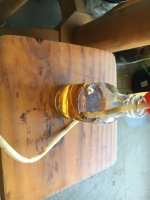
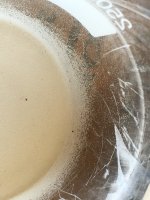
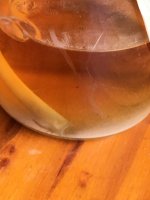
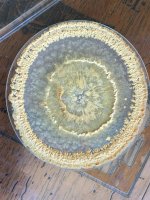
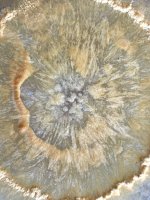
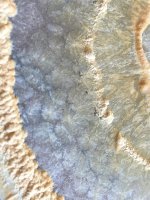
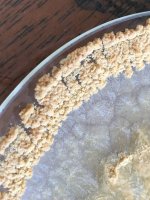
I am currently doing a second attempt at using CO2 bubbling to precipitate the mescaline carbonate. This time I used around 50% ethanol solution to pull the freebase from 1.9g dirty kash extraction (unwashed red/brown crystals). I added calcium hydroxide and some activated charcoal and used vacuum filter to pull the solution. I then bubbled CO2 and it became opaque solution. I then added to freezer overnight and got tiny amount of precipitate which indicated a failure HOWEVER I decided to test ph and it was still over 7 so I bubbled more CO2 and more precipitate formed. Got tired of making CO2 via sodium carbonate and citric acid for fast production so made a yeast generator again I'll leave it bubbling for a few days and check again. CO2 cartridge or dry ice would be really nice to test for those that have access.

No pictures of the precipitate but I'll share in a few days when done. I should have close to 1g-1.9g as the carbonate precipitate. This is considering losses from impurities and the process.

I think it is carbonate rather than carbamate since I am doing it in water solution so carbonaic acid forms.
 
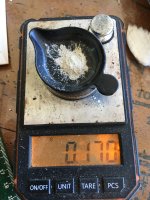
So after bubbling co2 overnight I got more precipitate but only yielded about 10% expected weight since I started with 1.9g

The decanted vodka has co2 still bubbling but no more precipitate formed. Either not viable method or solubility is higher than I expected.

Vodka is about 25% so idk if higher would be better but need water for carbonic acid to form.

The precipitate is most likely mescaline carbonate since calcium bicarbonate is very soluble but not impossible it is calcium bi/carbonate just unlikely IMO.

Any ideas? The vodka should still contain over a gram of mescaline so I’ll keep it bubbling to see and maybe evaporate more to test solubility. I know it the carbonate was even insoluble in HCl and other solvents.

Maybe I’ll try freezing again to see now that it is clear and well carbonated.
 

Attachments

  • 8BE05012-07CB-47A0-BEE0-F8296C8285D8.jpeg
    8BE05012-07CB-47A0-BEE0-F8296C8285D8.jpeg
    747.3 KB · Views: 1
  • B7B621C4-033A-4564-9A4F-B1A7919C8B52.jpeg
    B7B621C4-033A-4564-9A4F-B1A7919C8B52.jpeg
    1.2 MB · Views: 1
  • AA2D9A7A-BFEC-4C2D-B469-AA5FC035D48B.jpeg
    AA2D9A7A-BFEC-4C2D-B469-AA5FC035D48B.jpeg
    1.2 MB · Views: 1
  • 5A506085-C3BF-4C90-B88D-6092E162E88A.jpeg
    5A506085-C3BF-4C90-B88D-6092E162E88A.jpeg
    2.1 MB · Views: 1
  • 6594A824-FC51-4FB7-B721-589658E6810E.jpeg
    6594A824-FC51-4FB7-B721-589658E6810E.jpeg
    1.5 MB · Views: 1
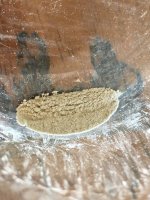
considering that after reducing volume a proportional amount of precipitate didn't form I think it is possibly calcium or another impurity?
 
It's likely that the stability field for calcium bicarbonate in aqueous ethanol differs from that of a purely aqueous solution, possibly meaning that precipitated carbonate doesn't redissolve.

A simple test for the precipitate would be to add a drop of acetic acid and observe for fizzing. If that occurs, you should be able to use IPA (if you have some) to produce a calcium acetate gel. Ethanol should also work, but you'd have to check up on the necessary specifics - namely, %ABV.

Calcium should produce a brick red coloration in the bunsen flame, although the presence of even a relatively small amount of sodium will mask this.

Glad to hear of your ongoing experiments as ever (y)
 
So with a comment I got it gave me a new idea on why it may not be working. I’m looking at this using carbonic acid as the way to salt but in older documentations on carbonate from Freebase it’s co2 from the air and doesn’t involve water.

New idea I’ll test in the future is drying the solvent (xylene) with sodium sulfate or appropriate drying agent. Then bubbling dry co2 by passing thru sílica bottle. The Freebase mescaline will hopefully precipitate as carbonate? I’ll try drying some ethanol and trying to use it.
 
So with a comment I got it gave me a new idea on why it may not be working. I’m looking at this using carbonic acid as the way to salt but in older documentations on carbonate from Freebase it’s co2 from the air and doesn’t involve water.

New idea I’ll test in the future is drying the solvent (xylene) with sodium sulfate or appropriate drying agent. Then bubbling dry co2 by passing thru sílica bottle. The Freebase mescaline will hopefully precipitate as carbonate? I’ll try drying some ethanol and trying to use it.
There would need to be some moisture present in order for a carbonate to form. Otherwise you'd be looking at the possible formation of what I'd refer to as the auto- (or ipso-, perhaps) carbamate, in a manner analogous to that with the CO₂ treatment of NMT, or, very much at a push, the corresponding 1,3-disubstituted urea.

This is something I've mentioned before, but I've never managed to find any convincing data regarding mescaline carbonate, nor can I say my search has been anything like exhaustive, however. The reports were always that the liquid freebase would solidify as the carbonate on open exposure to the atmosphere. It does make sense that this property would be beneficial for the cactus with its nocturnal absorption of CO₂ as a crucial part of the CAM process though.

So, we have "Note: Mescaline freebase will form mescaline carbonate upon prolonged exposure to air." And then there's "If the extracted mescaline is not converted to a salt and the solvent is evaporated, it can readily form a salt with the carbon dioxide in the air, forming Mescaline carbonate (molecular weight unknown?)" from erowid.


I mean, it's that or trudging through C19th texts written in German.
 
My very first carbonate was from evaporating IPA 99 as freebase. At the very last ml it becomes a goo that doesn't evaporate and after enough time forms come sand like crystal.
after formed I didn't have any success dissolving it. I'll remaking it via evaporating ethanol as freebase and testing the solubility more.

Again maybe placebo but carbonate has been stronger than salts of equal amounts and would like to test that more. Other than freebase I also got it via h2o2 to breakdown mescaline oxalate to freebase then carbonate? (co2 released) but with ethanol the oxalate didn't form as with ipa 70%. I guess the polarity is too high... but also ethanol is 25% too much water maybe?

There would need to be some moisture present in order for a carbonate to form. Otherwise you'd be looking at the possible formation of what I'd refer to as the auto- (or ipso-, perhaps) carbamate, in a manner analogous to that with the CO₂ treatment of NMT, or, very much at a push, the corresponding 1,3-disubstituted urea.

This is something I've mentioned before, but I've never managed to find any convincing data regarding mescaline carbonate, nor can I say my search has been anything like exhaustive, however. The reports were always that the liquid freebase would solidify as the carbonate on open exposure to the atmosphere. It does make sense that this property would be beneficial for the cactus with its nocturnal absorption of CO₂ as a crucial part of the CAM process though.

I mean, it's that or trudging through C19th texts written in German.

deepL app I used to convert PDF of older german and russian papers with fairly good results.

Maybe the auto- or ipso- carbonate form makes it stronger by absorbing differently? Even after HCL it returns to the carbonate IME so maybe it bypass some barrier? IDK really and need others to test the salt to see if stronger for them too.

Guess this idea ill require another attempt in the future I think dry ethanol (not anhydrous) and bubbling co2 is a good approach if not I'll probably abandon this idea since I mainly ant to make it ithout using smelly solvents.
 
Maybe the auto- or ipso- carbonate form makes it stronger by absorbing differently?
That, or it being a carbamate means it has a slightly higher proportion of mesc than would be suggest by calculations for the carbonate, lacking as it does one molar equivalent of H₂O.

If you find anything at all that goes into any definitive analytical detail rearding the composition of mescaline carbonate, I'd be very interested in hearing it. While something undoubtedly forms through absorption of CO₂ from the atmosphere by mesc freebase, I remain yet to be convinced that the substance formed is the simple carbonate. Citing an analogy in support of my scepticism here, we only need to look at ammonium (bi)carbonate, which is known to consist of a notable proportion of ammonium carbamate, being the direct analogue of my proposed "auto (or ipso)carbamate", where we also have NMT's ipsocarbamate to further support the hypothesis.
Consider:
  • ammonia + CO₂ → ammonium carbamate plus a little ammonium bicarbonate in proportion to any moisture present
  • in the case of NMT -
    secondary amine + CO₂ → secondary ammonium carbamate
  • so for mesc, by analogy -
    primary amine + CO₂ → primary ammonium carbamate (likely containing a little of the bicarbonate as per moisture content previously mentioned).
[It seems likely that heating the amine/CO₂ adduct in a sealed tube would lead to the formation of the symmetrical disubstituted urea derivative.]

One more approach worth trying would be to attempt the production of the bicarbonate by bubbling CO₂ into an aqueous solution of the freebase, followed by chilling. With a little luck [if it behaves like ammonia does], this should precipitate mescaline bicarbonate - or did you test something like that already?
 
Back
Top Bottom