• Members of the previous forum can retrieve their temporary password here, (login and check your PM).

Geometry of DMT crystals

Migrated topic.
View attachment VID_0003.mp4
IMG_0831.jpeg
IMG_0833.jpeg
IMG_0001.jpg
IMG_0007.jpg
IMG_0006.jpg

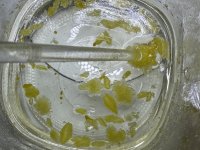
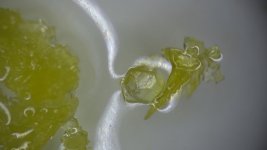
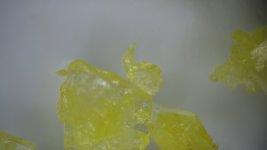
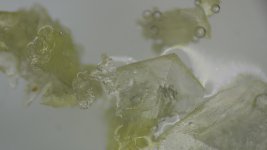
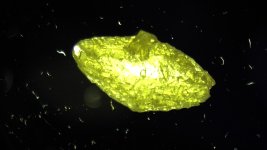
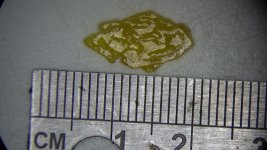
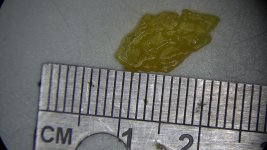
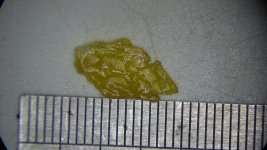
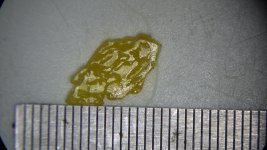
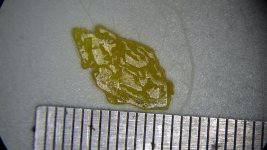
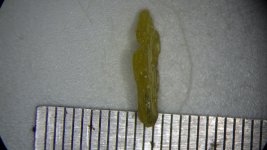
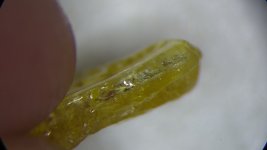
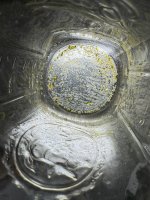
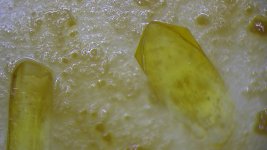
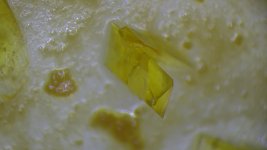
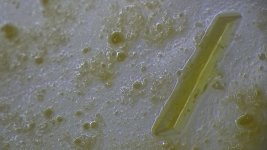
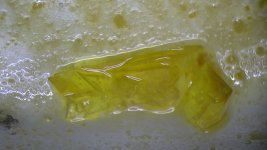
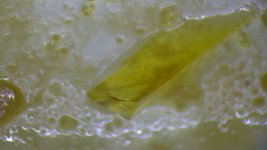
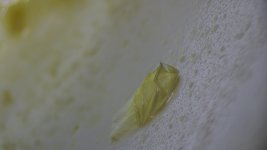
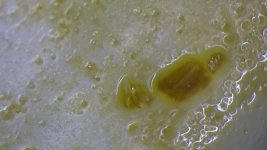
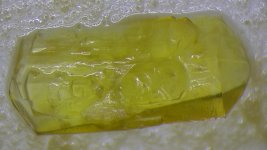
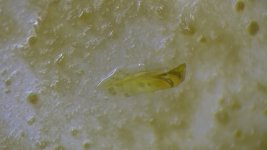
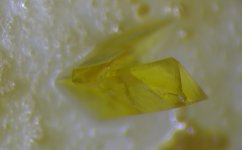
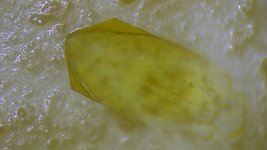
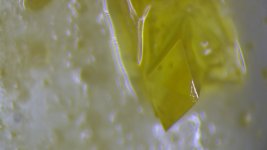
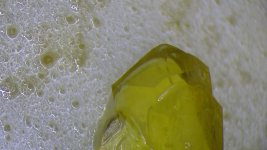
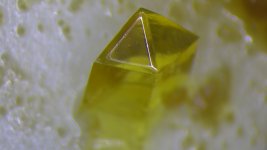
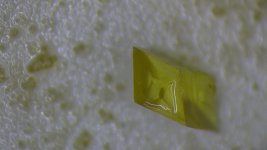
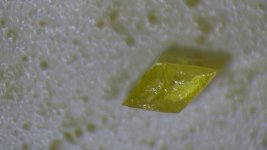
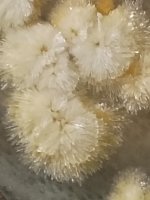
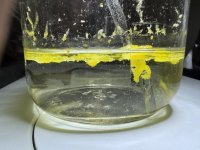
I think I got some! Not really sure. I haven't crushed them but they won't dissolve in distilled water or hexane. They formed at the boundary between hexane and alkaline water, out of an oil that precipitated after a mini-A/B with HCl and NaOH. My second guess is these are NaCl, but they won't dissolve in water... maybe because they're covered in DMT oil, making them hydrophobic? With concentrated solutions is it possible to precipitate NaCl by mixing HCl and NaOH?

Idk if these are the same as what Captain Future got, but I see a strong resemblance with Truthone's diamonds from the previous page. Specifically a double-terminated four-sided pyramid with a flat square tip. (Maybe the Egyptians were on to something?) I see a few of those in Truthone's and my crystals.

Some people were commenting on pressure. While these formed in 24 hours in open-air conditions, they formed floating between hexane and water - I would consider that a form of pressure since the oil was hydrophobic but the hexane was oversaturated. It was pretty much stuck being highly concentrated in one spot. Not sure how relevant it is though since Captain and Truthone mentioned them forming on the glass.

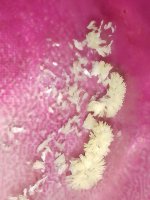
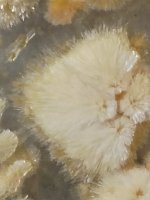
A couple comments were about polymorphism. I specifically did a mini-A/B on this DMT because I got some strange results that I suspect are related to polymorphism. In a previous mini-A/B, I stirred the alkaline water and oily dmt layer vigorously with a power drill and stirring paddle. Previously, I was getting light yellow hexane pulls from gentle stirring and salting out with benzoic acid. After power-stirring, the hexane was deep yellow but would not let go of the spice; suddenly benzoic acid couldn't precipitate anything. My running theory is hard mixing on the concentrated DMT oil physically whipped it into a polymer. I've heard you can break down polymers in the acid phase so that's why I repeated the A/B. And it worked, the deep yellow hexane transferred its color to the HCl solution, then back to an intermediate oil layer after adding lye solution. I was able to gently pull some of the oil with hexane and salt it out again. These pictures are of the leftover oil that crystallized overnight while the solvent sandwich was left open at room temp. Idk if power stirring actually caused polymerization, or whether its past as that polymer influenced its crystal habit, but thought I'd mention it.

Someone was curious about age of bark and I'll say mine has been in a box for years in powder form. FWIW I also did the q21q21 lime tek.

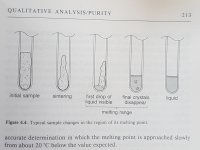
Happy to provide more info. I'll do a melting point test eventually but at the moment one shard is refusing to melt while sitting directly on a 60c hotplate.
 
Last edited:
With concentrated solutions is it possible to precipitate NaCl by mixing HCl and NaOH?
Yes - both HCl and NaOH have a far higher solubility than NaCl, and thus mixing them will produce a supersaturated solution of the latter, even when taking into account both the ~50% mutual dilution from the mixing and the 1:1 molar equivalent of water formed by the neutralisation reaction.


one shard is refusing to melt while sitting directly on a 60c hotplate
I have a figure of ca. 72°C sat in my head for another, higher-melting polymorph which I'm pretty confident about. It's easy enough to verify that information anyhow. Is your hotplate calibrated? How do you know it's definitely at 60°C thereon the surface?

The next thing would be to ramp up the temperature very slowly, and attempt to get a reasonable estimation of the melting point. This might be easier with a water bath and some melting-point tubes.
Previously, I was getting light yellow hexane pulls from gentle stirring and salting out with benzoic acid. After power-stirring, the hexane was deep yellow but would not let go of the spice; suddenly benzoic acid couldn't precipitate anything.
Some more details on this might help throw some light on the situation. Was the hexane DMT-saturated or not? I'd like to eliminate the possibility that you may have isolated some 2-MTHBC. I'm pretty sure no-one has much of an idea how the benzoate of that might behave.
hard mixing on the concentrated DMT oil physically whipped it into a polymer
While mechanochemical effects can't be entirely discounted - indeed, mechanochemistry/tribochemistry is something of a hot topic at the moment - it seems far more likely that atmospheric oxygen is the culprit in this. Then again, the flexibility of the dimethylaminoethyl side chain appears to be responsible for the polymorphic behaviour, and hard whipping would be quite "chaotogenic" in that respect.

All in all, great post and thanks for sharing the pictures too.
 
View attachment IMG_0842.mp4
I got some capillary tubes and twist tied them to a thermometer suspended in a beaker of water. I crushed up the least yellow (left) and most yellow (right). Did the test twice with the same results.

The video is sped up 2x

Idk when to consider it starting to melt. 66?

I guess this isn't NaCl then 🤯 I didn't think I'd accomplish the diamond mission by accident haha.
 
20250711_141836.jpg20250711_142524.jpg

Sintering started at around 64°C, although your rate of heating may have been a bit fast. I'd put this at around 66 - 69°C.

It wouldn't hurt to do another test using slower heating now that you have a rough figure to aim for. An oil bath would prevent those air bubbles from forming on the tube, if we were to get really perfectionist about it. I think it was the Gaujac et al. paper (one link here, but the whole thread's definitely of interest to you) that tabulated all the various reported melting points for DMT.

20250711_141302.jpg
 
To get large single crystals you need to grow them slowly and you also need to minimize the number of nucleation points. Filter out any dust or other insoluble contaminates and cover your solution with cling wrap or something else. It can also help to plant a "seed crystal" and to periodically remove any crystals that are about to grow in to one another.
 
To get large single crystals you need to grow them slowly and you also need to minimize the number of nucleation points. Filter out any dust or other insoluble contaminates and cover your solution with cling wrap or something else. It can also help to plant a "seed crystal" and to periodically remove any crystals that are about to grow in to one another.
Great tips. Slow evaporation is considered one of the best ways to grow large crystals, being rather simpler than rigging up slow cooling.

Ostwald ripening is another useful point of reference as a means of preferentially growing larger crystals while shrinking smaller ones.
 
View attachment 103826View attachment 103827

Sintering started at around 64°C, although your rate of heating may have been a bit fast. I'd put this at around 66 - 69°C.

It wouldn't hurt to do another test using slower heating now that you have a rough figure to aim for. An oil bath would prevent those air bubbles from forming on the tube, if we were to get really perfectionist about it. I think it was the Gaujac et al. paper (one link here, but the whole thread's definitely of interest to you) that tabulated all the various reported melting points for DMT.

View attachment 103824
Thanks for the tips! I like perfection. I'll test again, slower with oil. It's kind of fun to do, the validation is satisfying. I read that if the MP range is less than 2 degrees it's considered relatively pure, so I slept well last night knowing I'm close.

Great tips. Slow evaporation is considered one of the best ways to grow large crystals, being rather simpler than rigging up slow cooling.

Ostwald ripening is another useful point of reference as a means of preferentially growing larger crystals while shrinking smaller ones.
Do you think it would work to do a localized Ostwald? Instead of sifting by size, could you just take a syringe of hot solvent and carefully target the crystals you want to redissolve? Or if a gem starts branching, just target the branch instead of peeling the entire surface area ?
 
Last edited:
IMG_0068.jpg
Cross polarized light. Glows, except when looking down the long axis. Not sure if that's significant but there wasn't any other optical activity. It's a little suspicious to me after seeing how it looks between a slide.

Amorphous crystals will glow evenly from every angle, because of the millions of cryptocrystalline faces creating an average appearance from every angle. For example, quartz is anisotropic and will have optical activity under polarized light. But another formation of silica, chalcedony, is amorphous. Chalcedony can still be transparent, but won't have the same optical properties as quartz, a proper macro crystal of silica. Idk if that applies to DMT crystals, but in DMT slides I've seen both anisotropic (crystalline) and amorphous looking precipitations. This one looks crystalline, but I was expecting anisotropic activity. 🤔

IMG_0080.jpgIMG_0082.jpgIMG_0083.jpgIMG_0084.jpgIMG_0091.jpgIMG_0086.jpgIMG_0094.jpg

I'm not sure whether to consider this a single crystal or call it an aggregate of crystals.
It survived a Coca-Cola incident, which might have rounded it a bit and affected the surface texture.
It's so yellow, yet so clear, which actually makes it kind of hard to look at.
It has so many defects, yet there is clearly underlying symmetry, and facets that seem to line up with each other. There aren't any stray facets facing random directions.
View attachment Diamond.mp4

I think we're seeing some twinning, and what I'm calling skeletal structure, which happens to actually be a thing crystals do under certain conditions. It's pretty wild. The growing crystal senses it's running out of compatible molecules in its vicinity for full-face growth, so it consolidates its growth into a spike extending out of an edge, searching for greener pastures. I've seen it throw spikes in slides, but this might be another dimension of that, where edges race ahead of faces. Now that I think about it, this might have something to do with why DMT frequently fans out as acicular blades vs solid gems.
 
Last edited:
View attachment Adamantine.mp4

No agglomerates. Just individual 1mm prisms. It's satisfyingly beautiful; worth the effort to make and see in person.
These are growing at room temp from a solution of hexane. It had started to crystallize prisms a few days ago very slowly, but after a dry ice wash, NaOH wash, and filter through 0.22 micron PTFE membrane, it seems to be crystallizing relatively quickly. Idk which thing I did is making a difference, or how, but the solution is much more readily crystallizing now. They're so small though. Very sparkly, I can't wait to handle them dry. I'm going to let it keep going and eventually freeze it. Hopefully some of the prisms grow larger because the bottom is starting to run out of space. It doesn't seem interested in forming agglomerates though, so I'm curious how it will compromise.

Edit: Are videos playing okay for other people? I seem to get limited by buffering. every. time. Even after the entire video is fully buffered it doesn't seem to be able to play it smoothly.
 
Last edited:
View attachment VID_0056.mp4
I'm trying to take shorter videos. Here's a nice crystal under the polariscope. When the crystal axis is rotated in cross polarized light, the transmitted light goes extinct every 90 degrees. It's a common property any anisotropic crystal has. Just a nice visual confirmation that this is indeed one whole crystal, with every molecule aligned.
 
Back
Top Bottom