
• Members of the previous forum can retrieve their temporary password here, (login and check your PM).

Gleditsia triacanthos (Honey locust) is indeed entheogenic.

I'm not really the most appropriate person to go into this topic, since I know nothing about chemistry. But I imagine I can perform extraction procedures similar to those used for mhrb. I have everything I need for an extraction, but I haven't done one yet (waiting for the holidays). For now, I've found this material, which I'm leaving here, in case it's useful for those who know more than me:

Some simple tryptamines - Trout and friends - Second edition
It says there that: "...Positive assay (in roots) co-tlc by Appleseed. Plant reactedbadly to root sampling (stopped producing any leaves for18 months) so a second sample was never taken.Lespedeza bicolor “Bush clover”Positive tlc assays in seeds, seed pods, stem-bark and roots.co-tlc by AppleseedSeeds/seed-pods showed same alkaloids as stem-bark butdarker and with 3-7 additional bands. (Seeds & pods har-vested summer 1994) August stem-bark showed light band.[Successful bioassay of 30 gm of red fall leaves reportedby Wyrm; pers. comm.]Roots harvested in December showed a positive for DMT andlighter for two other bands. tlc by Appleseed 1994-1995Some of these results used Ehrlichs spray and there may beconfusion with 5-MeO-DMT in seeds and seeds/seed-pods...".
Thanks for providing the info!

I'll haul one of those chopped branches out of the bushes if I can and see what I can do with it. I have a feeling the seasonal variation may be dependant on local climactic conditions. We've had a very hot, dry spell lately so I'm rather hoping there may be some kind of analogy in alkaloid levels in drought-stricken acacias.

Best of luck when it comes to the extraction!
 
I have edited the post because there was accidentally information mixed with data on Lespedeza bicolor. It is at the root that we must investigate.
 
I have edited the post because there was accidentally information mixed with data on Lespedeza bicolor. It is at the root that we must investigate.
No worries, I'll be taking a look at Trout's (or should I say, @Keeper Trout's) work and thereafter will attempt to dig up any relevant references. I'm not sure how simple it will be for me to access roots and I'm not prepared to harm a tree in that way unless it's encroaching on agricultural land (which may yet turn out to be the case as I'll doing some hedge boundary maintenance this winter).
 
Be aware that aerial parts are known to contain mainly another alkaloid, triacanthine, which is regarded as toxic, as well as tyramine and N-methylphenethylamine, so be wary of brewing up aerial parts as an aya analogue. We need much better analysis on this species to clarify what it contains in different parts. Newman treated Trout's TLC result as solid proof, but as we know TLC is a promising indicator but not proof. His bioassays (ie. by himself and with some of his friends) suggest the TLC was accurate, but it would be good to have this corroborated beyond taking Mr Newman's word for it, and would be good to find out if the roots contain anything we should be concerned about in higher doses. It doesn't grow near me, but if someone out there can dig some up and send an extract in for analysis you'd be doing everyone a favour.

In Australia where this is an invasive weed in some places, nurseries generally only sell a less-invasive spineless (or more or less spineless) form; on top of that, I was told by a nursery worker that they are grafted onto Robinia roots, so buying such a plant for its roots is clearly not going to work.
 
It doesn't grow near me, but if someone out there can dig some up and send an extract in for analysis you'd be doing everyone a favour.
This species is every where not far from me. I could harvest (with no harm) root bark, trunk bark, stem bark, leaves, and pods and send them in for analysis, but send to whom and where?
 
This species is every where not far from me. I could harvest (with no harm) root bark, trunk bark, stem bark, leaves, and pods and send them in for analysis, but send to whom and where?
Kykeon Analytics: Anonymous Drug Checking and Harm Reduction Is able to do the analysis, but although very reasonably priced is not free. An alternative option is to extract first and test with TLC or even reagents to see if there’s anything worth doing a paid test for.

Ow and great to have you here, exploring new plants and experimenting is a key part of the nexus, so you’re very much welcome here.
 
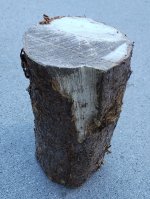
From a recently dead gleditsia triacanthos v inermis (i.e. thornless variety), I harvested root (8" dia x 1'), trunk (16" dia x 1') and stem (2" dia x 3') all with bark intact. How do I remove the bark for extraction testing? And how deep? Grind the bark into powder using a coffee grinder? Do I need to let the bark dry first?
 
From a recently dead gleditsia triacanthos v inermis (i.e. thornless variety), I harvested root (8" dia x 1'), trunk (16" dia x 1') and stem (2" dia x 3') all with bark intact. How do I remove the bark for extraction testing? And how deep? Grind the bark into powder using a coffee grinder? Do I need to let the bark dry first?
Wow that is great, okay to remove the bark make a cut along the length of the trunk or root until you get to the wood, from there you can start to peel it off. Depending upon how long the tree has been felled it can take considerable effort to peel it off. A vice and some screwdrivers can help. Then you can chop it up a bit and dry it before powdering it in a coffee grinder. If you’re feeling fancy you can also separate the inner bark from the outer by peeling it and splitting it off.

From there on you can try an STB or AB, in that last case you could probably also use the undried bark that you schred.

Good luck with your experiment and great to see you getting involved.

 
Wow that is great, okay to remove the bark make a cut along the length of the trunk or root until you get to the wood, from there you can start to peel it off. Depending upon how long the tree has been felled it can take considerable effort to peel it off. A vice and some screwdrivers can help. Then you can chop it up a bit and dry it before powdering it in a coffee grinder. If you’re feeling fancy you can also separate the inner bark from the outer by peeling it and splitting it off.
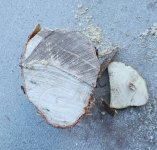
The tree is very recently felled. So the root bark does not peel off easily at all.
I can't tell what is the "inner" bark versus the "outer" bark. Presumably I should be harvesting the outer bark?
Any suggestions on drying out this foot long root bark log/stump besides leaving it out in the sun to dry?
 

Attachments

  • root bark.jpg
    root bark.jpg
    1.4 MB · Views: 11
  • root bark peel.jpg
    root bark peel.jpg
    1.9 MB · Views: 12
Last edited:
Well I don’t have any personal experience with this species so I’m not sure if can advise you any other than to just peel it off or use a planer to shave it off, especially a handheld electric planer will make short work of this job. Then just leave it to dry out in a window sill or outside depending upon the weather. If you want to speed it up I would try an oven at low heat with the door on a tiny crack and leave it for an day.

On the separation I would leave it for now, if you find this to be a good source for dmt you can always try and find a way to separate them and see if that helps with increasing your yield.

Good luck and great to see this! 👍
 
On the separation ...

Good luck and great to see this! 👍
So, inner, not outer bark. Yea, I'd have to refine that technique later.
*All* of this psychonaut stuff is new to me. I have never extracted before. While reading the process, it seems fairly technical: equipment, ratios, mixing, heating, timing, cooling, etc. It's not completely daunting, but presents as an art and a fairly significant expense of time and resources. I'm not expecting fairy dust any time soon. 🫤
 
Well it seems quite daunting at first but see it as baking an apple pie, you weight the ingredients mix them and then bake, it’s not that different from extracting. The main difference would be you need a good pair of safety glasses while cooking😉

Take care
 
I'm thinking of experimenting with honey locust. Although it's winter and I'm a bit afraid if alkaloid profile in root would be changed. Of coure start first low dose without maoi, then higher, then maoi etc.

While trying to find info on triacanthine I found this.


"Triacanthine has a low toxicity, since its LD50 is of the order of 30 mg / kg, against 60 mg / kg for caffeine, another classic purine base. Triacanthine exerts a tonicardial action in animals, described by O. Foussard-Blanpin et al., French Pharmaceutical Annals vol. 27, p. 257-259 (April 1969) ). "

"The leaves and pods contain about 100 mg / kg of triacanthine per kg of dry plant."

So if I understand correctly me being 70kg would need to eat 21kg of leaves to have a 50% chance of dying? (Or is my calculation wrong?)

I was mainly concerned that triacanthine would descend to roots but even if they have it regularly it may not be a problem for ayahuasca analogue? Greater problem would be tyramine if it goes to roots when plants go dormant? Idk I don't know metabolism of plants but I hope that wouldn't be the issue and I can experiment soon.
 
So if I understand correctly me being 70kg would need to eat 21kg of leaves to have a 50% chance of dying?
Maybe if you're a rat, or whatever lab creature that figure was determined using. You may possibly also be overlooking other compounds - don't ask me which - that could be more toxic than triacanthine, not to mention synergestic effects. The tannins/tyramine/N-MePEA alone would probably get you.
 
Well the link I posted is about some cosmetics idk. I was just scared the most from triacanthine. I'm aware of other compounds especially tyramine would be bad with maoi. So start with low dosage without maoi first.

I just wanted to post this info on triacanthine as it doesn't look so scary now but not to be disrespected either.

"The leaves of the honey locust tree have been used to treat gastric and duodenal ulcer, colitis and cholecystitis in Bulgaria (Ivancheva & Stantcheva, 2009)." From Functional food property of honey locust (Gleditsia triacanthos) flowers

And leaves should be highest with trichianthine.
 
Honey Locust is common around here. My mom told me that she would eat the sweet pods as a child. I will follow this thread & keep an eye out for Honey Locust trees nearby.
My neighbour brought me a bunch of pods last summer but I didn't get to try them before Mrs T chucked them in the compost. Maybe this year :D
 
I'm eagerly awaiting P.D. Newman's book that's set to be released in March. It's called "Tripping the Trail of Ghosts" and I suspect that it will contain more information about the entheogenic use of honey locust. It would be neat if someone collected the roots in spring, and in fall, and had them powdered and analyzed with GCMS.
 
Last edited:
I don't have GCMS or anything of that sort nor do I know how to work with it. Best I can do is bioassay and hope not to die 😂
TLC and presumptive colour reagents should be within reach for most people, although A/B with naphtha + freeze precipitation should be fairly selective. Check the scientific literature thoroughly, and play it safe when experimenting with relatively unknown plants.
 
Back
Top Bottom