I'm relatively new to isoxazole-containing species of mushrooms—wanted to share what I've recently discovered, and will continue to add to this post as I explore these magical fungi.
Prior experiences with Amanita muscaria var. guessowii involved ID confirmation from a trustworthy source. Effects produced by caps boiled in neutral water included a sense of great understanding, followed by forgetting everything mere moments later.
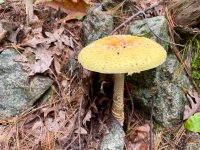
After ~10 years of foraging, I finally worked up the courage to properly identify some Amanita muscaria var. guessowii without assistance. All were growing near a small pond, some under Smilax vines, and one that was not too far from a delicious cluster of young maitake (first and second images). These were large caps.
The guide that I followed was for preparing an alcohol tincture, and its author was claiming something like 70-90% of ibotenic acid would be converted once sufficiently heated. I dehydrated the caps at 150F for many hours (4-6)—so as to prevent sweating at higher temperatures—and then heated them in the oven at 80C (176F) for an hour. The idea was that this high temperature burst would lead to a reasonable increase in muscimol. I then powdered all my material (32.4g) before adding 324ml of 50% ethanol (ibotenic acid and muscimol are water-soluble). The tincture was filtered after ~14 days, leaving a reddish liquid with an aroma reminiscent of coffee or chocolate (third image). I added a little 99% ethanol to wash the thick layer of tan sludge that settled on my qualitative filter paper.
I naively began titrating before bed in order to see how sleep might be impacted. Every single night was uncomfortable and restless. Noticeable effects gave the impression of being poisoned during brief moments after waking; something was very wrong.
Folks online recommended heating at a pH of ~2.5, because that theoretically leads to better conversion. An old patent is often cited to back this assertion. There is little to no information about shelf life after doing so. I hesitantly proceeded to heat 10ml citric acid solution to 80C (rough calculations were performed to guarantee a pH below three). Drops of tincture instantly transformed from red to yellow. This solution was kept heated for three hours, which is common practice when making tea. The ~30ml of tincture reduced back to ~20ml—color remained the same shade of yellow. I suddenly remembered Hamilton Morris saying that ibotenic acid is partially responsible for red pigmentation in the cap (S2.E7 "A Fungal Fairy Tale"). How might this relate to conversion?
The new formulation—now preserved by citric acid—has profoundly improved effects on both mood and sleep. The qualities are difficult to describe without venturing into a fantastical lexicon.
Excited to take this further in the near future.
Attachments


Last edited: