• Members of the previous forum can retrieve their temporary password here, (login and check your PM).

Research Haphazard Oral Administration Thread (Salvine Tek)

Research done by (or for) the DMT-Nexus community
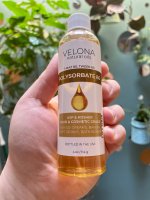
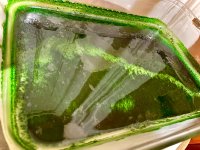
Had this idea for a while now, but I'm testing a "full-spectrum" extraction with 95% ethanol AND phosphatidylcholine (first attachment shows PC dissolving in alcohol). I won't explain the entire process at the moment—it could end up being in the Salvine "Pharma" tek.

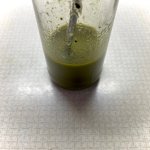
Look at that emerald green! (second attachment)
Compared to prior "full-spectrum" extracts, the chlorophyl isn't oxidizing olive / brown like it usually does (see previous extraction).
Oxidized leaf powder still produced effects when used in the crude tek—who knows if the rich green actually means anything good other than PC slowing magnesium displacement. Still gotta look into the effects of air exposure on salvinorin A.

I also ordered bile, as effects for all pharma tests have been significantly stronger when consumed right before—or after—a large meal. It's possible that the salvia "matcha" used in my crude tek has been predictable BECAUSE the bitter taste triggers bile release. Bile salts would have an additive effect when combined with PC, and my sorta successful tests with EVOO likely demonstrate how triggering bile release with monounsaturated fats will cause a low-level experience. Perhaps consuming tiny capsules prevent enough bile production from occurring?

Unfortunately—if ox bile supplements do work—then I'll likely end up adding bile salts to my evaporation tray :sick: I'll also need to find a low-volume vegan alternative. Taurocholic acid is unfortunately derived from cattle bile. Synthesized TUDCA? Any thoughts?
 

Attachments

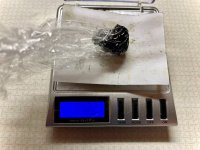
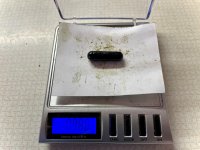
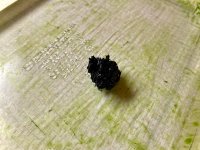
Extracting with 95% ethanol and PC is rough—it's like oil paint (first and second images). I do not have the patience to dry it. I'll use microcrystalline cellulose or silicon dioxide in the future when necessary. Managed to get one "threshold" dose into a capsule (third image—equivalent of ~4g S. divinorum leaf). I subtracted the weight of the plastic wrap and capsule; don't worry.

This is my current logic tree for how to proceed with the next four doses, and it's based off a strong experience I had after taking half my previous "full-spectrum" pharma dose (~2g leaf, 50% water + 50% solvent extraction, 250mg PC) when taken 30 minutes after consuming 1tsp turmeric (supposedly inhibits CES1 and PLA2) and right before eating a fatty meal (bile salt mimetic):

1. Take one capsule far away from any meal and without CES1 or PLA2 inhibitors. If this doesn't work, then either bile salts, CES1 inhibition, and/or PLA2 inhibition are essential (S. divinorum leaf powder may naturally contain CES1 and PLA2 inhibitors). Took the capsule today 3-4 hours after a meal and felt nothing—not even placebo. Consumed food and yerba mate and hour after and still had no noticeable effects.

2. Take one capsule 30 minutes after consuming 1tsp turmeric. If that works, then it definitely seems to be related to CES1 / PLA2 inhibition or bile release caused by the bitter taste. If it doesn't work, then still proceed.

3. Take one capsule with 500mg ox bile and no CES1 or PLA2 inhibitors. If that works, then bile salts are the key. If this didn't work, but the turmeric did work, then return to the previous full-spectrum extract (50% water + 50% solvent—easier to process) and combine with PC and ox bile. If neither worked, then proceed.

4. Take the final dose with 4g spent salvia powder (already extracted) and no meals, ox bile, inhibitors, etc. If this works, then reassess the extraction process. If it doesn't, then proceed.

5. Take 4g of spent salvia powder (salvinorin A removed) with PC, and without extract, meals, ox bile, inhibitors, etc. If this works, then I might have to take a long break from this research because that wouldn't make any sense to me. Phospholipids increasing the absorption of some random hydrophilic compound would seem insane.

Final random thought before I forget:

Could tannins be contributing in some meaningful way? Are they inhibitors? Do they meaningfully saturate esterases? What's a reasonable tannin to take as a supplement if future tests become necessary? Or, could quercetin be part of the bitter taste in S. divinorum leaves that potentiates the crude ROA? Does betulinic acid inhibit both CES1 and PLA2, and does it make sense to extract that myself instead of buying quercetin supplements? Just read that Omega-3 fatty acids are PLA2 inhibitors—could fish oil potentiate Salvine?

And, are there actually any vegan alternatives to ox bile?!
 

Attachments

  • IMG_7327.jpg
    IMG_7327.jpg
    1.7 MB · Views: 1
  • IMG_7329.jpg
    IMG_7329.jpg
    1.5 MB · Views: 1
  • IMG_7331.jpg
    IMG_7331.jpg
    1.2 MB · Views: 1
Last edited:
I don't usually do two tests back-to-back—as I'm afraid tolerance could mess with results—but I wanted to take advantage of days I have off due to the severe weather. I'm also less concerned about tolerance because yesterday didn't involve any perceptible salviaic sensations.

2. Take one capsule 30 minutes after consuming 1tsp turmeric. If that works, then it definitely seems to be related to CES1 / PLA2 inhibition or bile release caused by the bitter taste. If it doesn't work, then still proceed. Ended up ingesting 2tsp turmeric 3 hours after a meal because research led me to believe it wouldn't be enough CES1 / PLA2 inhibition anyway. Took the capsule thirty minutes later. Eventually felt the tiniest perceptible salvia buzz for an hour. Consumed a handful of chocolate and food, then felt it slightly more. A "nearly placebo" experience.

This test—and clues from previous attempts—makes me believe bile is essential. Ingesting a threshold dose using the crude method (4g of S. divinorum powder "matcha" and 2g of lecithin) likely causes enough bile salt release to provide a necessary cumulative effect; that just isn't happening with liposome capsules. I've already got an Ox Bile supplement on order to test.
 
3. Take one capsule with 500mg ox bile and no CES1 or PLA2 inhibitors. If that works, then bile salts are the key. If this didn't work, but the turmeric did work, then return to the previous full-spectrum extract (50% water + 50% solvent—easier to process) and combine with PC and ox bile. If neither worked, then proceed. This did not work well enough to consider it a success. I'm actually going to return to my full-spectrum extract regardless. Either Salvia divinorum contains potent and hydrophilic CES1 / PLA2 inhibitors—perhaps compounds that haven't been documented yet—or, extracting with solvent and PC preemptively encapsulated the wrong lipophilic compounds.

I'm still going to recommend folks consume a small snack or meal before taking crude Salvine; some people are struggling to achieve a decent experience without food. As for myself and a few others, the current tek works consistently and reliably with only lecithin and Salvia divinorum powder. Next test is to combine full-spectrum soft extract with ox bile and PC to determine whether or not bile salts are contributing anything to the experience.

Hopefully that combination will fit into the capsules I have.
Otherwise, I'll be swallowing a small ball of lipid matrix ⚫
 
I took a capsule of the discard Salvia divinorum powder with—from my PC + solvent extraction—with 500mg PC to see if I would feel anything. I did not.

I may try taking more on Wednesday just to be absolutely sure that all of the salvinorin A was successfully pulled out of it. Primarily doing this to prove that the extraction was not a fluke, and that that full-spectrum extract works better than any single component will on its own.
 
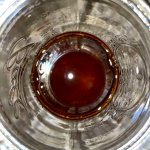
The fact that full-spectrum extracts have lead to the only active pharma tests is making me rethink the importance of bile. What if oxidization is relevant—specifically polyphenols oxidizing into quinones (potentially potent esterase inhibitors)? Maybe eating is simply a way to cause more potent oxidization in the stomach? I’m genuinely starting to believe that there is some truth to this. My 50% solvent + 50% water extract always fades to brown and does work (attached image), whereas extract with ethanol and PC remains green and doesn’t work. I guess it’s time to learn more about quinones.
 

Attachments

  • IMG_7363.jpeg
    IMG_7363.jpeg
    1.1 MB · Views: 2
V01.03 is up: drive.proton.me/urls/68T4189B5C#V0nKAtza2BRT

Major changes include:
- a better description on the cover
- added 1tbs of EVOO as a necessary ingredient to stimulate bile, intestinal blood flow, lymphatic absorption, and chylomicron transport
- new steps for preparing "Crude" Salvine, and a few optional ingredients that may potentiate the experience
- recommended taking Salvine with a meal, as this has helped some folks achieve stronger salviaic sensations
- added a couple testimonials (hopefully more to come)

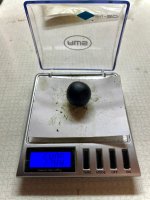
I was sick the last many days, but was able to scrape up a new batch of full-spectrum phytosome (first image ⚫). Did a lot of researching and microdose tests with both PC80 (second image) and C8 MCT oil. There was a noticeable decline in potency when adding these ingredients—turns out surfactants and MCTs actually increase absorption into the portal vein, which then delivers salvinorin A directly to the liver (bad). I need to focus on lymphatic absorption (good). My primary goal has been to bypass esterases instead of inhibit them. C8 MCT oil might become useful later when testing CBD as an inhibitor (maybe).

Next tests:

I have been wondering if my somewhat regular consumption of Scutellaria lateriflora (skullcap) tea has been contributing to the experience. I had naively assumed that this plant doesn't contain any relevant compounds—like enzyme inhinitors—but there are also neurological agonists and inhibitors (could intensify things).

I now have four doses of threshold phytosome. The first test should involve using it in crude salvine (as opposed to focusing on pharma). If this works, then I might be looking into infusing Salvia divinorum powder into a mix of EVOO, PC, ethanol, and ox bile. It will be interesting to see how much I'll be able to reduce the volume. Initial versions of "Pharma" Salvine might end up more like bitter cough syrup.
 

Attachments

  • IMG_7402.jpg
    IMG_7402.jpg
    1.2 MB · Views: 1
  • IMG_7401.jpg
    IMG_7401.jpg
    1.6 MB · Views: 1
Did a small update to V01.04: drive.proton.me/urls/68T4189B5C#V0nKAtza2BRT

I keep reading more that is convincing me to strongly recommend consuming after a meal, and it turns out 2tbs of EVOO can be more effective for triggering bile and chylocmicron production (fish / soybean oil might even be better options). I'll continue self-testing as often as possible until I figure out the best method.

I also left a disclaimer since a few people have struggled to feel it so far. It is important to make sure folks know this is a work in progress. Hurdles will be tackled as they come up.

Seems like—with the possibility of using up to 3tbs of oil to maximize potency—I may start infusing salvia powder in a mixture of PC, EVOO, and ethanol.
 
Tested 1.35g of full-spectrum phytosome (equivalent to ~4g leaf powder extracted + 500mg PC) emulsified with EVOO and a little water (first image). I let this rest for ~30 minutes, stirred, then swallowed. That was maybe an hour after eating rice and tinned fish, as I had read that chylomicron production can be more effective when fatty foods are eaten over a period of time.

The effect was there, but noticeably less intense than 4g of leaf powder with 500mg PC. Either I consumed a meal too far in advance to take full advantage of increased bile and chylomicron production, or something else is going on. I had planned on taking it directly with food; the timing didn't work out. I suppose it's data regardless.

Next, I will test directly with a fatty meal and no EVOO. If that works, then directly with a fatty meal and EVOO just to see if added dietary fats are somehow impeding lymphatic absorption (doubtful). If consuming with a meal doesn't work—even though it has once in the past with a full-spectrum extract test / repeatedly while microdosing—then I'll move to testing my other theory about Scutellaria lateriflora tea influencing the experience without my being aware. There's still no documented reason that I can find for skullcap being responsible, so I'm also thinking that tolerance might be a factor. There's limited documentation about tolerance related to prolonged KOR agonism.

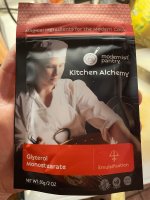
Eventually I'll try incorporating glycerol monostearate (GMS) to further increase lymphatic absorption (second image). Suppose I could also venture back into CES1 inhibition if nothing else seems to be working for reducing volume.
 

Attachments

  • IMG_7442.jpg
    IMG_7442.jpg
    797.2 KB · Views: 2
  • IMG_7451.jpg
    IMG_7451.jpg
    1.6 MB · Views: 2
Last edited:
Back
Top Bottom