• Members of the previous forum can retrieve their temporary password here, (login and check your PM).

Research Has anyone tried quidding phyllodium pulchellum?

Research done by (or for) the DMT-Nexus community
Migrated topic.

Herbaldreams

Rising Star
Joined
Jun 6, 2013
Messages
81
Merits
42
Phyllodium pulchellum has been reported to have a 5-Meo-DMT content of 0.2-0.3%. That means 2 grams of plant material should contain 4-6mg of 5-Meo-DMT, enough for a sublingual dose. I figure 2 grams sounds like a good place to start. Even if you end up having to double the dose 4 grams is still quiddable.

I'm just curious if anyone's tried it. I don't have any plant material to experiment with myself, but I do have a few seeds so hopefully I'll be able to start experimenting in the near future.
 
Constituents
- Study yielded a new glycoside, the 1-glucosylrhamnoside of physcion from the seeds of D pulchellum.
- Contains tryptamines.
- Roots yield betulin, a-amyrin, and ß-sitosterol.
- Study yielded fifteen simple indolic bases (I-XV) with three broad structural types, viz., indole-3-alkylamine, ß-carboline, and tetrahydro-ß-carboline. Fruits showed the major accumulation of Nb-oxides while the roots localized the quarternary bases.


so there's apparently also ß-carboline, and tetrahydro-ß-carboline

i am interested in where you found seeds, perhaps you could pm me.
 
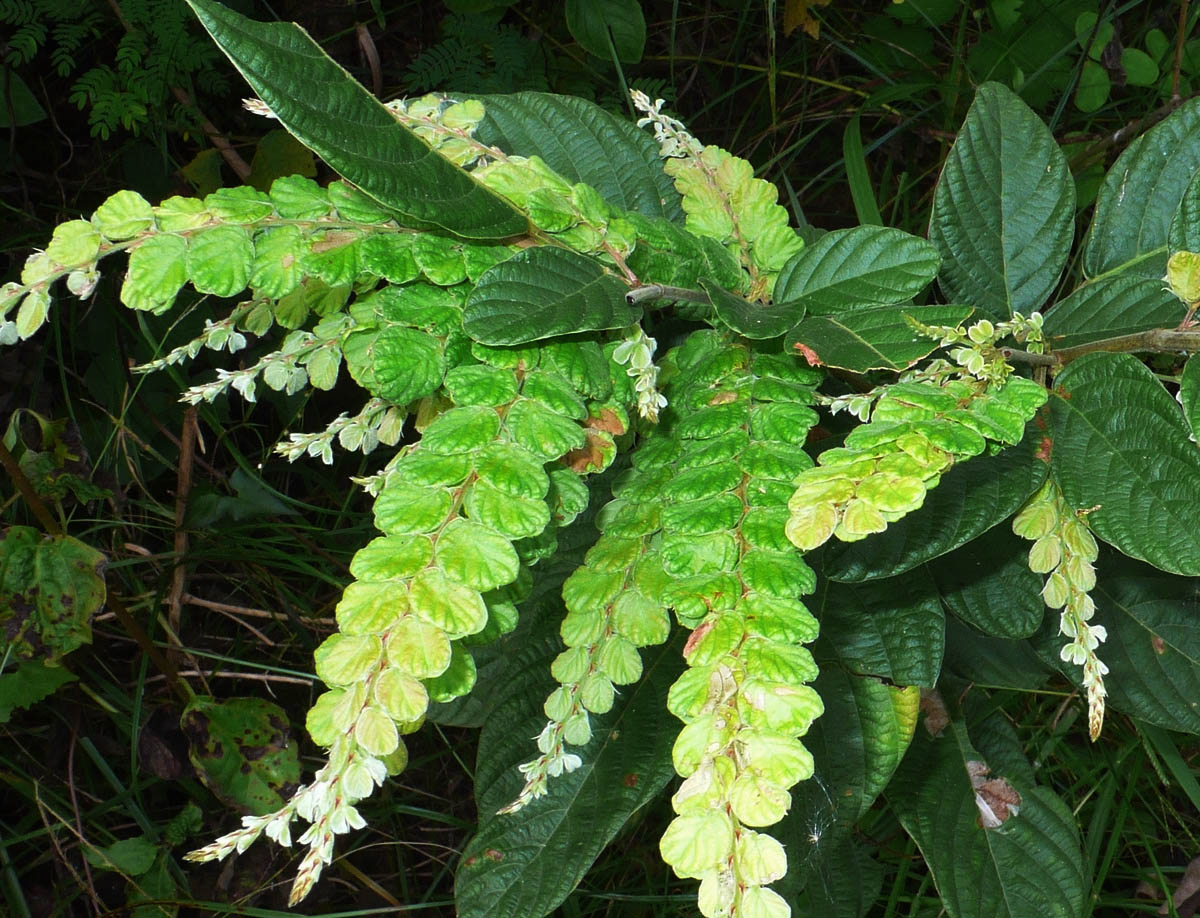
LOL I've just collected a bunch of seeds in Southern Thailand, and spent an evening identifying the plant. (I collected them simply because it's a very interesting-looking little bush.) So it ended up being Phyllodium pulchellum :surprised
 
Set17213.jpg


:want: itIS very pretty, and unusual looking. The first i ever heard of this. Thanks for sharing!
 
Yes, it has 2 types of leaves. The small leaves provide a sort of hood over the flowers and fruits. The flower shoots can get very long, around 1 meter each, drooping. I was attracted to this plant purely for its decorative appeal. It's only after I identified it that I saw all the information on its tryptamine content. I can share seeds with people interested in serious experimentation.
 
I found no reference to it in the Encyclopedia of Psychoactive Plants but Garden of Eden has some on it, as Desmodium. There's some on the alkaloid content...
 
Om yah i would love to grow some of those and experiment!
:love:
That is very considerate of you to offer so iam sending a pm.
 
D. pulchellum whole plant from India has yielded 0.3% alkaloids in
one test [including, as % of plant, 0.2-0.25% 5-MeO-DMT, and 0.0018%
of combined DMT, DMT N-oxide and bufotenine] (Ghosal & Mukherjee
1964); another test also found 0.0004% 5-MeO-DMT N-oxide, 5-MeO-
NMT and gramine (Ghosal & Mukherjee 1966). The root of the young
seedling has yielded c.0.27% DMT, 0.011% DMT N-oxide, 0.041%
DMT N-methylcation, 0.022% N-methyl-serotonin, traces of 5-MeO-
NMT, 0.026% adrenoglomerulotropin and traces of 6-MeO-N-methyl-
-carbolinium salt; root of mature plants yielded 0.067-0.451% DMT,
0.012-0.121% DMT N-oxide, 0.022-0.132% 5-MeO-DMT, 0.013% N-
methyl-serotonin, 0.0015% 3-alkylindole, 0.001% 5-OH-3-alkylindole,
and traces of bufotenine, bufotenine N-oxide and 2-methyl-pinoline. Stem
and leaf of mature plants yielded 0.294% DMT, 0.07% DMT N-oxide,
0.476% 5-MeO-DMT, 0.154% 5-MeO-tryptamine, 0.112% bufotenine and
traces of bufotenine N-oxide. Green fruits and ripe seeds yielded 0.001%
DMT, up to 0.007% DMT N-oxide and c.0.002% each of 5-MeO-DMT
and 5-MeO-tryptamine; harman, tetrahydroharman and pinoline were also
found in seeds, harman also in fruits (Ghosal 1972; Ghosal et al. 1972c).
The plant has also yielded hordenine, norharman, 2-methyl-THC, 2-me-
thyl--carbolinium quaternary salt, 1,2-dimethyl-6-MeO-THC, melino-
nine F, and canavanine. In dogs, the stem-leaf alkaloids [0.1mg/kg i.v.]
caused initial respiratory stimulation, followed by hypotension and severe
bronchoconstriction, which resulted in death in some cases; cardiac de-
pression was also observed. Alkaloids of the green fruits and seeds inhib-
ited cholinesterase (Bell et al. 1978; Ghosal 1972; Ghosal & Mukherjee
1966; Ghosal et al. 1970b, 1972c; Harborne et al. ed. 1971; Shulgin &
Shulgin 1997).

From Garden of Eden

 
In dogs, the stem-leaf alkaloids [0.1mg/kg i.v.]
caused initial respiratory stimulation, followed by hypotension and severe
bronchoconstriction, which resulted in death in some cases; cardiac de-
pression was also observed. Alkaloids of the green fruits and seeds inhib-
ited cholinesterase

Dog biochemistry is, of course, different from that of humans, but this makes me concerned. An easily quiddable source of substituted tryptamines would be very nice, but I wouldn't want to put anything in my mouth that I thought might be poisonous.

Tripping while suffocating from bronchoconstriction doesn't sound like a good time.

Blessings
~ND
 
So I'm probably still a a few months away from testing this but would the quidding be done on its own or taking harmalas before hand? I take around 100mg of harmala caapi tea many days and likely enough to activate dmt orally which I plan to test low 1-5 mg doses in the future.

I'll likely start at 1g and work up by a gram until I feel something. I also want to do an extraction in the future but still small seedlings since only months old.

Anyone ever follow up or experiment with this?
 
So I'm probably still a a few months away from testing this but would the quidding be done on its own or taking harmalas before hand? I take around 100mg of harmala caapi tea many days and likely enough to activate dmt orally which I plan to test low 1-5 mg doses in the future.

I'll likely start at 1g and work up by a gram until I feel something. I also want to do an extraction in the future but still small seedlings since only months old.

Anyone ever follow up or experiment with this?
This would be highly experimental; all I've heard of was laybe one report of a mild experience with a phyllodium tea.

Since this is a 5-MeO plant it's not advised to combine with harmalas. Check the 5 guide for details in that respect.
 
Back
Top Bottom