• Members of the previous forum can retrieve their temporary password here, (login and check your PM).

Hippophae - sea-buckthorns

Migrated topic.
downwardsfromzero said:
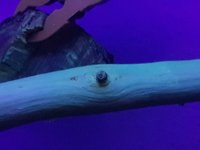
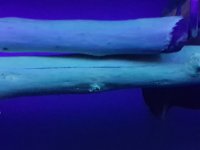
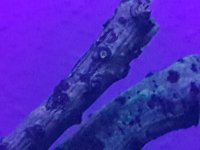
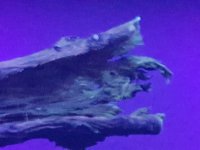
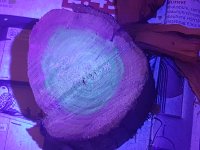
Seems the content can be quite variable within the plant. Sometimes the bast and the wood can have a fair content of something fluorescent. Extraction and chromatography to follow, funky pics attached.

I'm stoked for the results! It would be striking to add this plant to the list of Eurasian plants with funky alkaloids
 
the red squirrel said:
downwardsfromzero said:
Seems the content can be quite variable within the plant. Sometimes the bast and the wood can have a fair content of something fluorescent. Extraction and chromatography to follow, funky pics attached.

I'm stoked for the results! It would be striking to add this plant to the list of Eurasian plants with funky alkaloids
Well, this has been known for decades; my own project here has been 30 years in the making, counting from when I first read about sea buckthorn in Ott's "Ayahuasca Analogues".

First I had to find somewhere to plant my own tree, and that took at least ten years since there has to be a certain committed stability for tree cultivation. Then the tree has to grow big enough for regular cropping - obviously it would be better to have a whole patch of the stuff and I did plant more than just the one tree that ended up surviving. I still plan to plant a few more somewhere.

This may seem like a whole lot of rigmarole to go through when there are sizeable areas of endemic sea buckthorn throughout my region. My intention was to have some kind of relationship with the plant rather than turning up as a Johnny-come-lately and hacking bits off wild specimens - and this before I'd ever heard of the Nexus attitude! 😉

In hindsight, I could perhaps have found a nice spot in a sea buckthorn patch for years of regular meditation, etc., but this plant is scrubby and the thorns are vicious so who knows?

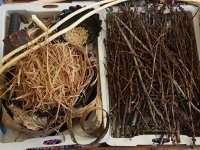
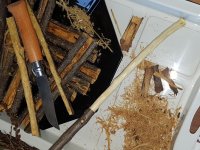
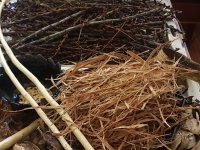
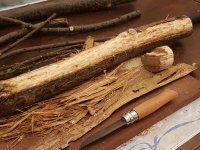
Peeling the bark and separating the bast has also been quite time consuming so far and I would therefore advise anyone who might be interested in working with this plant to enlist the help of an assistant or two. My fingers were getting sore and I was reminded of the former task of prisoners, picking oakum. My fingertips did become reassuringly fluorescent, but I wouldn't put it at more than a tenth of the amount we'd get from rue.

With all that considered, it's hard to accept that this would ever work at scale. Sea buckthorn won't usurp Syrian rue or caapi any time soon, but it might possibly serve as a once-a-year sacrament for a (group of?) dedicated phytonaut(s). Use it alongside its berries, which are typically harvested by cutting off the branches anyhow.

Over the coming days there should be a few crude results from bark, bast and wood extractions. If enough solid extract can be obtained I'll be having a play with some chromatograpy :)

One thing that particularly intrigues me here is the way alkaloids get concentrated into the heartwood. When compared with the apparent wicking of the alkaloids out of the ends of cut branches when left to dry, it leads to the inference that there is some kind of net flow of moisture into and through the heartwood which then suffuses the plant throughout its branches out to the very tips of the twigs. Considering this as a whole - and I would refer you to Goethe's notion of "exact sensorial imagination" here - it gives a distinctly pleasing sense of the living spirit of the tree, I feel.

 

Attachments

  • 20240201_165936.jpg
    20240201_165936.jpg
    3.5 MB · Views: 2
  • 20240127_135558.jpg
    20240127_135558.jpg
    3.6 MB · Views: 2
  • 20240127_194928.jpg
    20240127_194928.jpg
    1.4 MB · Views: 1
  • 20240127_210955.jpg
    20240127_210955.jpg
    1.9 MB · Views: 0
  • 20240129_234921.jpg
    20240129_234921.jpg
    2 MB · Views: 0
  • 20240130_005524.jpg
    20240130_005524.jpg
    2.1 MB · Views: 0
  • 20240130_005805.jpg
    20240130_005805.jpg
    2.1 MB · Views: 0
  • 20240201_170009.jpg
    20240201_170009.jpg
    3.6 MB · Views: 2
There is no successful report of elaeagnus or hippophae bark used to replace rue or caapi in an Ayahuasca analogue. It is very precious for other reasons; I mix it with rue.
 
dithyramb said:
There is no successful report of elaeagnus or hippophae bark used to replace rue or caapi in an Ayahuasca analogue. It is very precious for other reasons; I mix it with rue.
Are you willing to share a few details on this? It's certainly precious in the amount of effort required to obtain any significant amount of bark and bast alone!

I'm intrigued to see how it'll combine with rue now that you've mentioned it. What parts of the bark/bast do you use? And from which parts of the plant?

Here's a pic of the results of a solid hour and a half's work, attached.
 

Attachments

  • 20240201_233125.jpg
    20240201_233125.jpg
    3.3 MB · Views: 2
Sure. It gives a centeredness to the energy, a focus on actual power. Rue without elaeagnus is so floating and ungrounded and ethereal for me. Elaeagnus becomes the bridge between the ethereal realm and the physical imminent reality and adds a sort of intelligence to the brew with it's centered channeling nature. And the centeredness extends to the afterglow which is exactly what I need. Pulling off Elaeagnus angustifolia bark is actually very easy. I don't know about hippophae, but Elaeagnus' mature bark is very loose. I dont bother with immature bark. And the amount needed to mix in with rue is ridiculously small; my ratio is about a quarter gram per dose of rue, and that is very good because mature bark is a resource that is produced over decades and not produced annually in infinite abundance like rue seeds or phragmites biomass. Respect to the plant and ecological sustainability are priorities for me.
 
Ah, thanks for sharing - I somehow overlooked your mention of eleagnus so it's nice to know I'll be complimenting things here with the use of hippophae (and I always felt that name is a kind of counterpart to peganum: horse vs. pegasus makes the sense of grounding seem intuitive…)

I've been falling in love with hippophae here after spending several more hours stripping of the bark. I just tried burning a small strip of bast and the scent to me is quite enchanting, even though my family say it smells like burnt toast. There do seem to be a lot of sugars in the bast, which would explain their observation if not mine. To me it's highly reminiscent of a certain aspect of Nepalese incense minus the perfumey notes. And there's a sweet, malty smell given off by the "eyes" of shoots in the stem when scraped that I find simply gorgeous.

BTW, to any of you considering exploring sea buckthorn, watch out - even the bast will give you splinters!
 
So, I brewed a bit of bark and bast, 5g in all, with a pinch of ascorbic acid to make up for the alkaline water here. The first pull was simmered for about 20mins to produce a pleasant smelling yellow-brown tea, fluorescing yellow under blacklight UV. The taste was also pleasant but the brew had a strong astringency - unsurprisingly, given its origin. Indeed, I'd say much of the initial blue fluorescence seen on freshly peeled hippophae wood and large areas of the freshly exposed bast is due to caffeic acid and related compounds. The moist bast discolours rapidly on exposure to air, and the wood gains a yellowish hue while losing this blue fluorescence in exchange for a more harmala-reminiscent yellow-green. The bark will undoubtedly be a rich source of depside tannins. I shall be reviewing the literature over the coming weeks in order to make up for all this guesswork. As time and extraction results permit, I'll see what information can be gleaned with chromatography. If it proves possible to produce a large enough sample I would hope to send that for professional analysis

After straining off the initial brew, the plant material was covered with fresh boiled water and left to soak in a covered pan for about nine hours. After straining, this brew fluoresced with more of a greenish tinge. It retained a pleasant flavour, with cinnamon-like hints and barely any astringency. Indeed, with a little sweetener and carbonation it would make a veny pleasant soda!

While I did drink the first brew, I would be reluctant to do so again since I'd rather avoid turning my bowels into leather. It's hard to comment on any subjective effects both because I was rather sleep-deprived by that point and because I added a shot of what was labelled "phalaris tincture" even though I'm fairly sure it's a mislabelled phragmites root tincture (go, science!) My subsequent sleep did seem to be even more dream-filled than usual, which is not something I'd specifically noted from the graminaceous tincture in absence of hippophae brew. I do feel healthy and refreshed afterwards and a portion of the minor stomach discomfort experienced can be ascribed simply to being hungry.

Bringing this forward, I think I'll focus on leaching the tannins out in weakly alkaline solution, followed by an acidic brew to pull out any alkaloids. There are way too many astringent phenolics in hippophae bark for it to be suitable for consumption in unprocessed form on even a semi-regular basis, IMO. I do still love its aroma notes though and I'd like to know how to separate the sap sugars from the tannins. A hippophae tonic water would be seriously delicious.
 
Last edited by a moderator:
Oils. Berry oil and seed oil. I will occasionally rub oil into skin and more frequently use it in soap I shower with. It helps tend to my skin issues. I have one type of orange bar soap that contains Sea Buckthorn and Tea tree oils that is very medicinal for me.
 
It's that time of year again, where the chainsaw comes out to play at Transform Towers!

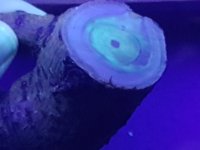
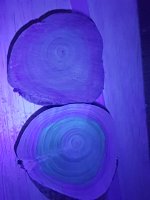
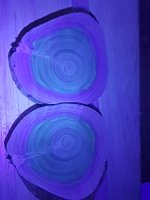
Sea buckthorn wood has such a tantalisingly fluorescent core - and notice how it connects to the branch point at the upper right:
20250201_191852.jpg
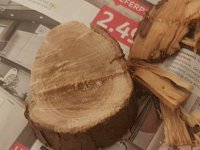
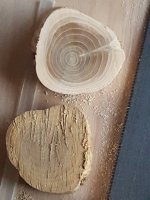
Here's a shot of the piece in normal light, to show the handsome, dark heartwood:
20250201_191756.jpg
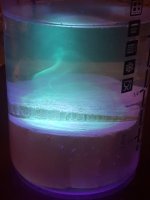
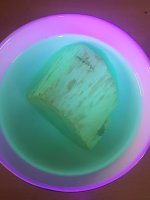
The wood is surprisingly dense and absolutely does not float. Immersed in water, the alkaloids start to diffuse out of the heartwood:
20250201_195324.jpg
After soaking overnight, an appreciable level of fluorescent material has diffused into the water:
20250202_162801.jpg
Last night's tea made with about a tablespoon of shredded inner bark (bast) took a while to drink, but there was some kind of harmala-ish effect that carried more than a hint of harmine to it. There was none of the auditory twang of harmaline, but I did bump into the doorframe a couple of times.

It would be particularly interesting to compare the alkaloidal profile of the bast with that of the heartwood. It's an fascinating puzzle to consider why the plant distributes the alkaloids in this characteristic fashion.
 
Please do share your findings if you compare the bast with the heartwood. It would be an exception if the heartwood has significant alkaloid content as plants are known to concentrate their alkaloids on their surfaces. I don't recall any data on that in the rare studies of elaeagnus+hippophae alkaloids.

Most importantly, if you find a way of preparation that makes it not block psychedelic activity that would be a sort of holy grail.
 
Please do share your findings if you compare the bast with the heartwood. It would be an exception if the heartwood has significant alkaloid content as plants are known to concentrate their alkaloids on their surfaces. I don't recall any data on that in the rare studies of elaeagnus+hippophae alkaloids.

Most importantly, if you find a way of preparation that makes it not block psychedelic activity that would be a sort of holy grail.
There was definitely something to it - a hundred or so grams of whole trunk (as per the pictures) would seem to provide at least five doses of some kind of medicine. Purely on an intuitive basis, it's feeling to me like there's a strong anxiolytic component - at a guess, tetrahydroharman which, as you rightly point out, does indeed appear to counteract any more psychedelic side that this plant might otherwise present.

I just hope it helps me keep my… stuff together enough that I can finally start making some progress with an actual analysis alongside developing a separation method if tests confirm that H. rhamnoides shares the anti-psychedelic properties of Elaeagnus spp.
 
I should add, my subjective testing in vivo indicates to me the presence of steroidal saponins as well as the depside tannins previously mentioned. Buckwheat honey helped some of the astringent component to precipitate as a fine, pale tan powder on cooling, but the boiled tapwater used will not have been entirely free from calcium and magnesium ions either. [This powder may in fact be calcium oxalate - it would seem prudent to precipitate the oxalic acid before consuming too much of this plant.]

There are tons of references I need to go through on this (along with the TRPV/citric acid question - will sea buckthorn's acidic juice come into play here as well? Quercetin,too.)
 
Your experience report was about bast tea, so I guess you have tested the whole trunk tea as well?

Caapi is one exception to the pattern of accumulating alkaloids on the surface, and the similarities between the plants - woody stems using same class of alkaloids for self defence - increase the likelihood of the wood being active or perhaps even superior to bark. Completely hypothetical postulation here.

Has it been proven that it is tetrahydroharman that is the anti-psychedelic component?

BTW, what is the reason for doing the chainsaw activity and experimentation in this season? I'm pretty certain the plant will be much more active in the spring.

And it would be nice to hear about the specific healing you get, more than acute effects, if possible.
 
Last edited:
Your experience report was about bast tea, so I guess you have tested the whole trunk tea as well?

Caapi is one exception to the pattern of accumulating alkaloids on the surface, and the similarities between the plants - woody stems using same class of alkaloids for self defence - increases the likelihood of the wood being active or perhaps even superior to bark. Completely theoretical postulation here.

Has it been proven that it is tetrahydroharman that is the anti-psychedelic component?

BTW, what is the reason for doing the chainsaw activity and experimentation in this season? I'm pretty certain the plant will be much more active in the spring.

And it would be nice to hear about the specific healing you get, more than acute effects, if possible.
The plant may be more active in the spring, it's simply that now's the season for tree surgery - I was limbering up for some more extensive work on a hedgerow before the season's over.

I've seen some reports on the benzodiazepine-like activity of the harman derivatives but it'll take a wee search to dig up the particulars on that.

There are definite plans afoot for extracting the heartwood in particular, which will involve splitting and quartering pieces of trunk to prepare chippings, followed by Soxhletting with methanol. It will be nice to run this stuff in the chroma setup that's been hanging around for over a year!

The whole trunkwood CWE was quite pleasant after one hour's soak but the full day's soak has yet to be tested.
 
I call it hyperpresence. Elaeagnus (and it seems Hippophae) is the medicine of presence.

I will try the inner wood when I get the opportunity.

I would like to reiterate my question about the anti-psychedelic component. Have we identified what it is? This is a very crucial question.
 
Last edited:
The cold soaks draw out both the fluorescence and the dark coloration from the heartwood - what might the connection be?
20250203_171032.jpg20250203_171238.jpg
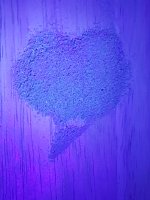
The sawdust might provide a particularly accessible form of the alkaloids:
20250203_171339.jpg
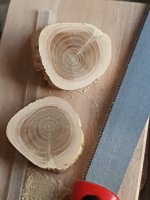
Drilling lengthways into the heartwood would probably be easiest, although the polished wood is really beautiful. The cross-cut surface with a fine Japanese saw is already gorgeous to behold:
20250203_171106.jpg20250203_171220.jpg
 
Yes, chopping up wood would pose a challenge that needs a creative solution.

I would like to reiterate my question about the anti-psychedelic component, as I believe it to be very crucial. Have we identified what it is?
 
Back
Top Bottom