• Members of the previous forum can retrieve their temporary password here, (login and check your PM).

official extraction help thread

Migrated topic.
Hmm I think i will add water to the nps, drain the nps (will be easier with water sine plant material will go to the bottom), put it in the freezer (in case theres any dmt in it). Then I will keep on working with the acacia the normal A/B way.
I aim for crystals/powder since my pipe won't handle goo very well. But since you can crystallize any dmt in goo, goo will be fine too. Tbh i just want one full trip right now, no need for big amounts right now.
I freezed and thawed the acrb before, though I don't really think it helps much since it wasn't shredded finely then.
As for the base stage, I thought it was in base in the plant right?
I also heard people extracting without the freeze/thaw thing.
I just think that since plant cells have little "holes" to allow juice to flow (or whatever you call it in english) the nps can get there and solve the dmt.
I think I'll wait another day. I really don't have that much privacy to cook something for 4 hours if you know what I mean, that's why i came up with this longer but less engaging method if you can call it that.
Thanks for help.
 
urdi said:
Hmm I think i will add water to the nps, drain the nps (will be easier with water sine plant material will go to the bottom), put it in the freezer (in case theres any dmt in it). Then I will keep on working with the acacia the normal A/B way.
I aim for crystals/powder since my pipe won't handle goo very well. But since you can crystallize any dmt in goo, goo will be fine too. Tbh i just want one full trip right now, no need for big amounts right now.
I freezed and thawed the acrb before, though I don't really think it helps much since it wasn't shredded finely then.
As for the base stage, I thought it was in base in the plant right?
I also heard people extracting without the freeze/thaw thing.
I just think that since plant cells have little "holes" to allow juice to flow (or whatever you call it in english) the nps can get there and solve the dmt.
I think I'll wait another day. I really don't have that much privacy to cook something for 4 hours if you know what I mean, that's why i came up with this longer but less engaging method if you can call it that.
Thanks for help.

hey there, please have a read through the FAQ as this explains pretty much explains all the mechanisms behind extracting. If extracting DMT was a simple as pouring a NPS onto rootbark, there probably wouldn't be a need for all these teks we have here at the Nexus.

DMT is actually in salt form when still contained in the plant material. DMT needs to be in basic solution in order for the NPS to "pick it up." There are no shortcuts when it comes to extracting and stealth cooks/extractions are not encouraged here either. It is a dangerous game to play when using solvents and bases around people who are unaware of what is happening.

If you want a method that doesn't require a long acid boil, look into "STB" teks which stands for "straight to base." A list of all extraction teks can be found in the wiki. These are tried and true methods. While experimenting is highly encouraged around here, it is important to fully understand the chemistry behind what you are doing before straying from the beaten path.

Good luck with whatever you do.
 
Entropymancer said:
Solvents

A solvent is a liquid in which other molecules can be dissolved. In the case of extractions, we're interested in dissolving DMT. For our purposes, there are two types of solvents: polar solvents, and nonpolar solvents. In polar solvents (like water and ethanol), polar compounds like salts and ions tend to be highly soluble (that is, they dissolve easily), while less polar compounds like hydrocarbons and neutral organic molecules (like DMT freebase) tend to be relatively insoluble (that is, they tend not to dissolve). In nonpolar solvents (like naphtha and dichloromethane) polar compounds tend to be insoluble, while less polar compounds tend to be more soluble. When polar and nonpolar solvents are mixed together, they typically stay seperated as two seperate layers, or "phases". Oil and water is the classic example of this phenomenon.

This is a simplified explanation, but it'll serve well enough to explain the basic principles of the process.


Now let's bring it all back home with respect to extracting DMT:

In acidic water, DMT exists predominantly in its protonated form, either as a cation or a salt. Since the protonated form of DMT is relatively polar, DMT is quite soluble in acidic water. In alkaline water, DMT exists predominantly in its freebase form. While the freebase is not particularly soluble in water, it's not so insoluble that it falls out of solution or forms a seperate layer. But if we were to mix an alkaline solution of DMT with a nonpolar solvent, since the DMT freebase is much more soluble in the nonpolar solvent, much of it will migrate from the polar solvent to the nonpolar solvent.

This is the basis of almost every DMT extraction.

From here:
DMT Extraction Overview by Entropymancer
 
Yeah but the other guy who was studying chem said that dmt salt also has non-polar part to it, so that it actually dissolves in nps too. Or mb it's not that well-soluble (excuse for my english) to work.
 
Endlessness said:
When an alkaloid is in freebase form it will generally be soluble in non-polar solvents (naphtha/limonene/etc) and not soluble in water. When it is in salt form it will generally be soluble in water and not in non-polar solvents.

Salt vs. Freebase vs. Fumarate Chemistry - Welcome discussion - Welcome to the DMT-Nexus

There are, of course, exceptions to the rule but I won't go into that at the moment.

Simply adding a NPS to bark is not an efficient way to extract DMT. The freebase form of DMT is quite soluble in a non-polar solvent which is why we base it before "pulling" it out of the solution with NPS.
 
Okay so I did an A/B extraction (mixed petrol with xylene which was probably stupid), put the yellow colored solvent in freezen for a day but I'm left with something brown in the jar, no crystals except for the tiny bit that was already there before. P-xylene has a high melting point, mb that's the problem?
What am I supposed to do? Evap it instead?
 
My guess would be that the brown stuff is microscopic bits of plant material and droplets of basic liquid that were suspended in the xylene/petrol and slowly dropped out and coagulated while standing in the freezer. You may want to decant the xylene from the brown bits before further processing it. You can dry the brown stuff and check if it has any actives by taking a little bit and evaporating it on a piece of aluminum foil. Just enough to check the smell and to see if it evaporates at all. Don't inhale larger quantities of unknown substance fumes.

Evaporating the xylene sound like a not so great idea, because you will also be concentrating any impurities that were in the xylene you used. Did you do an evaporation test to check the purity of the xylene beforehand? It is perhaps better to try a FASA or FASI tek, or to wash the actives out of the xylene with a few vinegar washes and then to base and extract the vinegar washes with a naphtha that you can freeze precipitate from.
 
Some help with Acacia A/B Extraction (A.Acuminata)

Method:
• 200g dried phylodes and small twigs shredded to powder in a grinder and frozen overnight.
• Thawed powder pressure cooked in 1.5 litres of acidic water @ pH 3.5 (using ascorbic acid) for 30 minutes
• Pressure cooking repeated three times with resulting liquid strained and added to cooking pot each time with overall liquid volume (4.5 lt) eventually reduced to 1.5 litres.
• After 15 minutes cooling time, this liquid placed in large jar while still hot
• 100g of Lye (%98 Sodium Hydroxide) dissolved in water added to warm this still warm liquid (to get pH of approx. 13)
• 200 ml of Shellite added immediately and contents gently agitated
• After 10 minutes separation time, Shellite pulled with glass baster and placed on plate.
• Shellite pulls repeated 3 times and added to plate
• Contents left to evaporate overnight in dark, dry area.

Results:
Shellite pulls were very cloudy revealing milky white clouds in the solvent when breathed on.
After evaporation crystal formation was visible but when scraped quickly turned to oil.
Final yield was 1.7 grams of sticky opaque honey like material.
Amongst the final product was what also appeared for all intents and purposes to be water (highly unlikely); clear and non-viscous.

(Bioassay on final product forthcoming)

Questions:
• What is this watery substance?
• Would a pre-base defat with Xylene and/or acid wash help to yield better crystal formation?
• What are the merits of distilled water over say tap-water (other than a more even pH)?
• Would pre-base salting help increase yield?

many thanks in advance
 
Ok, apologies for the redundancy of question 2 & 4; of course this will help. I’m just keen to get some feedback on this …and the imperative of aiming for crystals is to both vindicate the steps above (which follow Elf-Spice’s complete Acacia Extraction) and confirm that any trace of impurities have been removed.

So, while the honey-wax-goo proved gentle yet powerful, the smoke carries a certain ‘solventy’ taste that seems to saturate the experience somewhat, leaving a bit of a gnawing feeling in the stomach and lungs. Would this be some trace Lye carried over? (It feels as though the amount of Lye used could be reduced)

Next attempt will eliminate the powdering to reduce the possibility of fine particles entering the mix (even though thorough care was taken in straining).

Pre-heating Shellite before pulls – or heat-bathing the basified bark tea has not been attempted yet as while this is said to increase yield, it sounds as though it also carries over more oil/fat?

Also when a pre-base, non-polar defat has been performed previously, the Xylene rapidly takes up what is clearly fats but then these settle to an emulsion layer after a while. Is it best to decant this fat soaked Xylene before or after it settles?

Any advice or feedback greatly appreciated
 
The 200 milligram plant material and 100 milligram lye used is a writing mistake I presume?

It is not entirely clear from your description, but did you evaporate all of the solvent or did you use freeze precipitation and evaporated only the last bits of solvent wetting the precipitated crystals? If you simply evaporated all the solvent, your residue will be less pure than what results from freeze precipitation. In fact, it will also concentrate any solvent impurities into your product. Unless you used analytical grade solvents (unlikely), you cannot assume the solvent to be without impurities. This, and not lye contamination, could well account for the tainted taste that you report.

Crystals are more likely to result when a plant contains a relatively pure alkaloid profile. If the alkaloids present are a mixture of tryptamines, an amorphous goo is a likely result.
 
Oh yes of course, that is indeed 200 & 100 grams. (I'll edit that for clarity) Thanks Pitubo

I merely evaporated the solvent on a plate under a cool fan, no freeze involved ..so any concentration of potential solvent impurities (Digger's brand Shellite was used) could account for the strange taste as it is easy to smoke and does not burn harshly like one would expect Lye to.

There sure feels like N-MT in the mix as there is quite a bit of residual after effects (say 1 hour of heightened visual clarity) and Acuminata has been reported as containing B-Carbolines too.

So with the pre-base de-fat, let the fats settle or take the Xylene out when visibly mixed with the fat ?
 
So 300 grams of Acuminata phyllodes and twigs were processed and this time Final result was 3 grams of waxy, honey like oil (very nice too 😁 )

Changes Made

Defatted 4 times with Xylene and lastly with Shellite, with seemingly negligible effect.
120 grams of salt was also added prior to basifying.
After 5 pulls of Shellite, the solvent was still visibly cloudy when breathed on.
Pulls 4 & 5 were frozen (with airtight cling-wrap)

Questions

• Is there a ratio for how much salt to use (per volume of liquid or amount of raw material perhaps)?
• Why would the tea have gotten progressively (and noticeably) darker with each solvent pull?
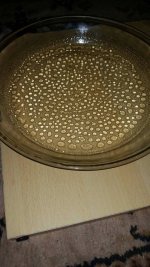
• How the hell is water ending up in the solvent? (great care was taken to carry over no traces of tea and an evaporation test on the Shellite leaves no residue). This water seems to form around the lumps of oil-crystals that settle on the plate (as shown in the photo). Pulls 4 & 5 formed ‘ice’ exactly where this substance was (though also visibly cloudy) and when evaporated left what appears to be 'salt' that smells somewhat like spice when burned …possibly some DMT acetate?
 

Attachments

  • 13084174_10205686624397682_2090724429_n.jpg
    13084174_10205686624397682_2090724429_n.jpg
    77.2 KB · Views: 1
hi everone,

as i am just doing my first extraction i got a quick question
once the lye is added to my MHRB and it did cool of, do i need to worry about preassure?
should i keep the lid of my jar closed or slightly open so preassure can escape?

thank you for your help
 
It never hurts to open the lid to let off pressure. You don't need to keep it open all the time. Especially when shaking the jar, the lid should be closed tightly. Most food type jars will not build up significant pressure and will let overpressure escape. These jars are designed to keep a vacuum better than overpressure.

BTW, I like to dissolve the lye into the water first, then let the lye solution cool down a bit before adding the plant material to it. Adding lye to a suspension of plant material in water somehow seems to give a less pure product.
 
First time syrian rue extraction here, and didn't want to clutter up the forums with my own thread.

I'm attempting a 'no reduce-no filter' Syrian Rue extraction, but have already run into some problems. Namely, because it seems I based way too much, and now I need to know how to proceed.

Story so far:

-Boiled seeds 3 times, kept tea, discarded seeds.

-Based immediately after each boil with Sodium carbonate. Unfortunately, I continued to add multiple teaspoons of Sodium carb to my solution after it had changed colour, because I could still see solids falling out every time I added more. Eventually, I have no idea how many teaspoons I added. At this point I didn't realise I had already made mistakes.

-I left the solution in the fridge to settle for a day, and then that evening poured off as much of the liquid as possible without disturbing my solids.

-To this, I added vinegar to make the solid dissolve. I continued to add vinegar until it was no long foaming or reacting. Then I put it in the fridge overnight for the unwanted solids to settle.

-In the morning, I noticed a very significant amount of settlement - and started to question my process.

After talking to a few others on the chat, I realised I had added too much base. Adding further vinegar and stirring did not achieve anything. It reeks of vinegar, not base.

I'm going to buy some pH strips, but then I still really need to work out how to proceed.

A) Treat it like basified liquid, and the settled matter as harmaloids. Remove as much liquid as possible, wash many, many times, and start over again, rebasing and acidifying. I'm just very concerned there would be some dissolved harmaloids in the liquid.

B) Discontinue using vinegar, buy a stronger acid (such as?), and try to continue from where I left off. Perhaps even separating my current liquid as much as a can from my solids, and trying to further acidify my solids to dissolve, but treat my current liquids as successfully acidified and continue the process with them.

C) Heat up the solution, and try and reduce it, possibly bringing the pH level down, by evaporating the water out of it?

I'm lost, feel foolish, and totally clueless, and any help would be greatly appreciated.

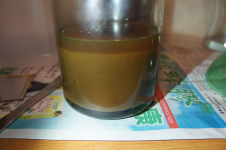
Picture attached: This is how much sediment I have, with the liquid decanted out of it.
 

Attachments

  • Rue+batch_2.png
    Rue+batch_2.png
    3.5 MB · Views: 0
Update:

I bought some pH strips - they are for swimming pools, so only read from 6.2 to 9.0. I tested my chilled solution with the murky sediment in the bottom and the pH level didn't change even a bit, which tells me that I am essentially testing vinegar, and acids that low aren't going to register on the strip.

This being said, it also tests for 'alkalinity' which it tells me is extremely high: at 240.

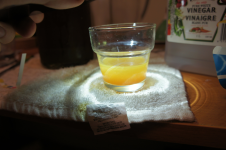
I spooned off about 30-40mls of my solution, without disturbing the sediment, and put it in a shot glass. Then I added vinegar, a little at a time. No reaction whatsoever.

I spooned off another 30-40mls in a fresh shot glass. This time I made a separate solution of water and Sodium carbonate and added this solution, a few drops at a time. It immediately started precipitating, and turning very yellow. I tested the pH: 9.0 (the maximum on the stip so it could have potentially been higher). In no time at all, solids had begun to fall out of the solution and settle.

This tells me that the solution in my large jar is acidic, and that my liquid is full of alkaloids.

So the question is:
what on earth is all the sediment at the bottom?? Seems like an awful lot of unwanted matter?

The plan from here:
Decant all the liquid, and keep the solids. Rebasify the liquid.

Anyone have any ideas on what I should do with this sediment? Is there any real chance there are harmalas in there?
 

Attachments

  • mini+shot.png
    mini+shot.png
    3.1 MB · Views: 0
Back
Top Bottom