• Members of the previous forum can retrieve their temporary password here, (login and check your PM).

official extraction help thread

Migrated topic.
Why is that?
Likely from slight deprotonation at the pyrrole (indole) nitrogen. The resulting negatively charged heterocycle becomes more susceptible to oxidation by electron acceptors such as atmospheric oxygen, since it gives up its negative charge more readily than the neutral molecule. I would hypothesise that these resulting radicals begin to initiate polymerisation. The protonation equilibrium lies strongly on the side of indole, which gives a fair bit of leeway.
 
Is vinegar necessary, I see some extractions use it and others do not?
vinegar, besides being very common, forms EXTREMELY water soluble salts with things like DMT. theres also the added benefit of, if circumstances require, it can be evaporated away. It also doesnt react with steel cookware, meaning you can boil in normal stainless steel cookware. It wont trash your oven either so, if for whatever reason you want to bake your bark that works too.
Other organic acids form problematic double-salts, where under circumstances, youll get either multiple base (e.g sodium) to a single acid (e.g trisodium phosphate), or, it goes the other way and you get multiple acids to a single base (e.g i think sodium difumarate), depending on if the pKa is more, or less than your DMT salt, this can cause problematic buffering where nothing happens without a huge excess, or, adding too concentrated an acid or base can result in localized brines or precipitation of the multi-salt. acetic doesnt do this, at least not readily i think, but unlike phosphoric or citric its not something you have to really think about.

In short vinegar is just convenient and already perfect. and chemical breakdown of bark is better done with bases than acids, but even more so, better by freeze-thawing or pressure cooking, or both. if an ultra-effective alternative existed everyone would go raving mad for it and then thats what everyone would do, but the biggest/recent development was probably just, FASA and similar methods of acetone/alcohol to NPS, and, the understanding that what was thought to be oxide, was actually just DMT polymer pretty much all the time.
 
vinegar, besides being very common, forms EXTREMELY water soluble salts with things like DMT. theres also the added benefit of, if circumstances require, it can be evaporated away. It also doesnt react with steel cookware, meaning you can boil in normal stainless steel cookware. It wont trash your oven either so, if for whatever reason you want to bake your bark that works too.
Other organic acids form problematic double-salts, where under circumstances, youll get either multiple base (e.g sodium) to a single acid (e.g trisodium phosphate), or, it goes the other way and you get multiple acids to a single base (e.g i think sodium difumarate), depending on if the pKa is more, or less than your DMT salt, this can cause problematic buffering where nothing happens without a huge excess, or, adding too concentrated an acid or base can result in localized brines or precipitation of the multi-salt. acetic doesnt do this, at least not readily i think, but unlike phosphoric or citric its not something you have to really think about.

In short vinegar is just convenient and already perfect. and chemical breakdown of bark is better done with bases than acids, but even more so, better by freeze-thawing or pressure cooking, or both. if an ultra-effective alternative existed everyone would go raving mad for it and then thats what everyone would do, but the biggest/recent development was probably just, FASA and similar methods of acetone/alcohol to NPS, and, the understanding that what was thought to be oxide, was actually just DMT polymer pretty much all the time.
Excellent post, thank you so much.
 
Other organic acids form problematic double-salts, where under circumstances, youll get either multiple base (e.g sodium) to a single acid (e.g trisodium phosphate), or, it goes the other way and you get multiple acids to a single base (e.g i think sodium difumarate), depending on if the pKa is more, or less than your DMT salt, this can cause problematic buffering where nothing happens without a huge excess, or, adding too concentrated an acid or base can result in localized brines or precipitation of the multi-salt. acetic doesnt do this, at least not readily i think, but unlike phosphoric or citric its not something you have to really think about
The sentiment is broadly correct, notwithstanding the formation of hydrogen bonded diacetates, the sodium salt of which gets used in food flavouring. It would still be better to distinguish between monobasic and polybasic acids independently of whether they're organic, like acetic or formic versus fumaric, malic or citric acids, and inorganic, such as hydrochloric versus sulfuric or phosphoric.

The choice of monobasic inorganic acids for home extraction chemistry is essentially limited to hydrochloric by any sensible measure, [even though there's a few pharmaceuticals having the hydrobromide as the preferred salt (hyoscine, dextromethorphan etc.)].
 
Sorry this is my fist time doing anything except reading the nexus, so if I’m asking in the wrong place please forgive and I’ll gladly except direction.

Okay from being in a hurry and having to little lye, one of my jars didn’t quite get a high enough ph and so I ended up with a defatting process that I would rather of not had happen, how do I fix this? Drain of naphtha layer, strain out the lumps and just start over. i.e. rewarm basify (with meter this time) and add new naphtha?
 
fats dont respond to acids, so a mini A/B wont clean up the naptha. you can remove DMT from it sure, but the naptha is probably buggered, maybe if lucky strong HCl wash might do something and remove enough you can reuse again for another defat.
ideally your defat should be done with a cheaper, disposable solvent, because depending on the oils, it might not even be possible to totally reclaim again via distillation since some fats/oils are also volatile, i wouldnt use distilled toluene that was used for defatting, for example. DCM is great for defatting since it falls to the bottom of your sep funnel along with sediments and emulsion, you drain it out, then can basify and pull without a transfer, plus it boils too low for contaminants to distill with it.

If your source of naptha is not cheap enough for you, look up local cleaning chem stores, browse their inventory for things like "gun wash" or solvents that are just named letters and numbers like "X55". im not saying gunwash and X55 are actually useable just that, they are examples. then open up the MSDS and find out what they are made of. most of those formulations like X55 are pretty much just customized napthas with a specific ratio of heavy vs light stuff, some are hexane free heptane based ones you you want light petroleum distillates, hexane, heptane, or C6-C8, and no mention of boiling points higher than 120, maybe 130 at worst, absolutely not 150 since thats diesel or kerosene, same with the C number. lower than 6 is fine thats pentanes and whatever, but C9 things get spooky.
ideally some of these custom degreaser/naptha formulations should be entirely hexane free and just heptane alone.
the difference between these and "naptha" is that naptha, or shellite, or petroleum ether/spirits is a multi-purpose distillate used for washing, thinning and also, burning. These could be more pure, or less pure, depending on the intended purpose.
Sometimes they are really expensive, other times, really cheap. I can get heptane from something like, exxsol, i think, which costs $45 for a 5L bottle, now that isomerically pure heptane has been pulled from the shelves, afaik, heptane isomers like methylhexane, might be less selective pulling spice at lower temps, but, they wont mess with crystalization during evaporation at least, since n-heptane, the best one, also boils last.


TLDR; go to cleaning shop if you cant find cheap naptha, many "degreasers" or generic "solvent" are just different formulas of what is, for our purposes, naptha. they will have funny made up names, or numbers and letters.
 
Last edited:
fats dont respond to acids, so a mini A/B wont clean up the naptha. you can remove DMT from it sure, but the naptha is probably buggered, maybe if lucky strong HCl wash might do something and remove enough you can reuse again for another defat.
ideally your defat should be done with a cheaper, disposable solvent, because depending on the oils, it might not even be possible to totally reclaim again via distillation since some fats/oils are also volatile, i wouldnt use distilled toluene that was used for defatting, for example. DCM is great for defatting since it falls to the bottom of your sep funnel along with sediments and emulsion, you drain it out, then can basify and pull without a transfer, plus it boils too low for contaminants to distill with it.

If your source of naptha is not cheap enough for you, look up local cleaning chem stores, browse their inventory for things like "gun wash" or solvents that are just named letters and numbers like "X55". im not saying gunwash and X55 are actually useable just that, they are examples. then open up the MSDS and find out what they are made of. most of those formulations like X55 are pretty much just customized napthas with a specific ratio of heavy vs light stuff, some are hexane free heptane based ones you you want light petroleum distillates, hexane, heptane, or C6-C8, and no mention of boiling points higher than 120, maybe 130 at worst, absolutely not 150 since thats diesel or kerosene, same with the C number. lower than 6 is fine thats pentanes and whatever, but C9 things get spooky.
ideally some of these custom degreaser/naptha formulations should be entirely hexane free and just heptane alone.
the difference between these and "naptha" is that naptha, or shellite, or petroleum ether/spirits is a multi-purpose distillate used for washing, thinning and also, burning. These could be more pure, or less pure, depending on the intended purpose.
Sometimes they are really expensive, other times, really cheap. I can get heptane from something like, exxsol, i think, which costs $45 for a 5L bottle, now that isomerically pure heptane has been pulled from the shelves, afaik, heptane isomers like methylhexane, might be less selective pulling spice at lower temps, but, they wont mess with crystalization during evaporation at least, since n-heptane, the best one, also boils last.


TLDR; go to cleaning shop if you cant find cheap naptha, many "degreasers" or generic "solvent" are just different formulas of what is, for our purposes, naptha. they will have funny made up names, or numbers and letters.
Good tips.

So is my naphtha from the defatting process now contaminated with bad actors and needs discarded or is there a way to be able to reuse?
@RichardPuller - You might be able to clean up greasy used naphtha with a few doses of decolourising charcoal. Then again, if it was MHRB you were using and you've followed the advice just to add more lye solution this won't even be an issue. You can just carry on and use that naphtha as though it was new.

It may still be best to remove the product from it using mini A/B and pull back into fresh naphtha, especially if you were using acacia of some kind.
 
Am I thinking of backsalting then? I'll be honest, I've just been reusing solvent and the re-xing with clean solvent.

If I was off, thank you for the correction @drpotato

One love
If you were (re-)using 'oily' naphtha for pulls, there would come a point where backsalting might become preferable.
 
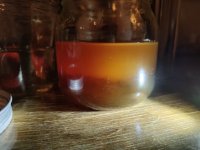
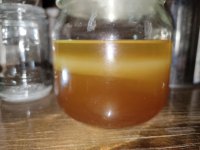
I'm halfway through my first extraction following Big Leisurely A/B. I'm doing 4A, so pouring drops of FASI in my limonene. I'm just really unsure if it's normal to have the whole thing in layers now, so here's a photo. From the moment of starting to put the FASI in there was a cloud forming just on the top. I can see some stuff on the bottom as well that I guess could be DMT precipitating?
 

Attachments

  • IMG_20251005_200143708.jpg
    IMG_20251005_200143708.jpg
    3.3 MB · Views: 6
  • IMG_20251005_205322816.jpg
    IMG_20251005_205322816.jpg
    3.1 MB · Views: 6
I'm halfway through my first extraction following Big Leisurely A/B. I'm doing 4A, so pouring drops of FASI in my limonene. I'm just really unsure if it's normal to have the whole thing in layers now, so here's a photo. From the moment of starting to put the FASI in there was a cloud forming just on the top. I can see some stuff on the bottom as well that I guess could be DMT precipitating?
Yes, that's pretty normal - IPA will float on top of limonene to some extent and diffuse into it slowly. You can gently swirl the container to encourage mixing. The DMT fumarate will settle to the bottom on standing, given some patience.

Once the clouding has settled out, add another drop of FASI and observe for further clouding. Repeat the overall process until a test drop shows no further sign of precipitate forming.

How do you plan to use or further process your fumarate?
 
Yes, that's pretty normal - IPA will float on top of limonene to some extent and diffuse into it slowly. You can gently swirl the container to encourage mixing. The DMT fumarate will settle to the bottom on standing, given some patience.

Once the clouding has settled out, add another drop of FASI and observe for further clouding. Repeat the overall process until a test drop shows no further sign of precipitate forming.

How do you plan to use or further process your fumarate?
Amazing, thank you for the reply!

I have been planning to try and convert the fumarates (at least some of it) to freebase according to the same tek using sodium carbonate...

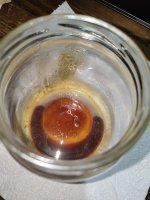
I just poured off the limo into another container and was left with something that I think is both crystals and goo but I'm definitely not sure about any of it. I'm adding a photo again if someone wants to give their opinion and advice. Sorry for posting questions in every turn, I just really don't wish to mess anything up here :D

If this is both crystals and goo it's best to mix it with little water and let it evaporate?
 

Attachments

  • IMG_20251006_221815463.jpg
    IMG_20251006_221815463.jpg
    2.9 MB · Views: 5
Here is what to expect from saturated carbonate to a strong fumarate solution.
I need to run TLC to confirm but in my case i couldnt get crystalization to occur due to the huge NMT proportion.

Previously i had some experience with goo-amine seperation, i found that if one were to use a spray bottle of dry IPA on a plate of goo settled and hardened on a petri dish, the mist would evenly coat the goo, and immediately saturate, i then pipetted it off and repeated getting around 10 different fractions, of which iirc 2-3 were totally inactive, and about 3 were excellent, just oil, one almost crystalized, wound up like when honey goes crystaline, it got the closest any of these batches ive collected from acuminata have gotten.

Anyway, point is though, you can sometimes seperate A from B using a solvent that dissolves both, as long as it seems to seperate one distinctly more than the other, and you are careful about its application. It can help tip the scales enough that crystalization drives everything away too the sides. in the specific case of that petri dish of dry goo, it formed droplets of clear viscous liquid surrounded by dirty more colorful goo, as youd expect from a crop of crystals, but without any actual crystalization occuring, but seperation of the materials still did.

Another thing that works the same is doing that in reverse with cold naptha, incrementally allowing some precipitate, then transferring to a new plate. i have loads of glass petris though so its easy for me.
 

Attachments

  • PXL_20250213_071610150.TS_1280x720.mp4
    11.7 MB
Amazing, thank you for the reply!

I have been planning to try and convert the fumarates (at least some of it) to freebase according to the same tek using sodium carbonate...

I just poured off the limo into another container and was left with something that I think is both crystals and goo but I'm definitely not sure about any of it. I'm adding a photo again if someone wants to give their opinion and advice. Sorry for posting questions in every turn, I just really don't wish to mess anything up here :D

If this is both crystals and goo it's best to mix it with little water and let it evaporate?
Okay so many thanks to the help I got so far with this extraction and from this community overall. I have been in a rabbit hole for the last days going through the posts in this forum and as someone with no chemistry knowledge at all it can be a "bit" daunting sometimes, lol. The process is super interesting though and can't wait to experiment and learn more in the future.

Some questions that I still have

1. After mixing the gooey liquid I got from my limo-FASI with some water and evaporating it in the oven with door open on really low heat with fan on (50°-70°), I'm left with a really very sticky amber/brown goo that's been under a regular fan for a day and a half. What I'm wondering is, if I want to try and convert it to freebase anyway, do I have to wait it to crystallise or can I just try to turn the goo to freebase with sodium carbonate or another method I saw that included acetone? ...haha.
Also my head is full of info that I don't understand at this point but there is also a way to use acetates to try crystallise the goo?
/I will add that the goo that I have doesn't seem like it would dry up in this lifetime, or maybe I'm just impatient. Also it smells really good, like the real thing and maybe tiny little bit of oranges

2. I read in some thread that Jimjam fumarate Will never be anything else than gooey because of the limonene. But I don't know if that is so because I have understood that many people successfully are getting fumarate crystals with limo-FASI method. Any insight on this?

3. I'm seeing some more precipitation on the bottom of my limo pulls that were left from the goo, but this time it's looking very white, which is making me surprised and confused. Just wondering about that and why is it. Also why some people get crystals and some people get goo :D or is it a mystery? I was trying to drop the drops of FASI into my limo really slowly because BLAB mentioned that it could lessen some impurities.

Thanks a million if anyone finds time to answer any of my questions! Otherwise I will try and scrape up all the info I can get and go from there :D
 
Last edited:
Okay so many thanks to the help I got so far with this extraction and from this community overall. I have been in a rabbit hole for the last days going through the posts in this forum and as someone with no chemistry knowledge at all it can be a "bit" daunting sometimes, lol. The process is super interesting though and can't wait to experiment and learn more in the future.

Some questions that I still have

1. After mixing the gooey liquid I got from my limo-FASI with some water and evaporating it in the oven with door open on really low heat with fan on (50°-70°), I'm left with a really very sticky amber/brown goo that's been under a regular fan for a day and a half. What I'm wondering is, if I want to try and convert it to freebase anyway, do I have to wait it to crystallise or can I just try to turn the goo to freebase with sodium carbonate or another method I saw that included acetates? ...haha.
Also my head is full of info that I don't understand at this point but there is also a way to use acetates to try crystallise the goo?

2. I read in some thread that Jimjam fumarate Will never be anything else than gooey because of the limonene. But I don't know if that is so because I have understood that many people successfully are getting fumarate crystals with limo-FASI method. Any insight on this?

3. I'm seeing some more precipitation on the bottom of my limo pulls that were left from the goo, but this time it's looking very white, which is making me surprised and confused. Just wondering about that and why is it. Also why some people get crystals and some people get goo :D or is it a mystery? I was trying to drop the drops of FASI into my limo really slowly because BLAB mentioned that it could lessen some impurities.

4. This might be a very dumb question but I started to think that if I ever get to that point I would like to try to make some changa too. A local shop here sells Damiana leafs which I think should be nice to mix it with but I was wondering if it has to be some kind of special leaf for smoking? Or this Damiana herb would probably be okay for smoking?

Thanks a million if anyone finds time to answer any of my questions! Otherwise I will try and scrape up all the info I can get and go from there :D
FASI or other fumarate isolation methods work really well on amines, not just the dimethyl tripto-variety, so what you get, if your source contains loads of different amines, is pure mixed amines. specifically tho its not because they are amines, but what i mean is you get the entire spectrum of alkaloids here, so in this case its pretty much just all available amine compounds.

DMT wont crystalize well in the presence of other DMT derivatives. DMTs crystal formation is incredibly easy to disrupt
acuminata is like 2:3 DMT:NMT and because of that, even the slightest additional impurity totally inhibits solidification. If by jimjam i am to understand this is a full spectrum pull, it could just be a consequence of diversity that your isolate has trouble seperating. the presence of moisture can also be a hindrance here. it might be oil when moist but crystalizes from an anhydrous solvent, though also just not as the fumarate. My fumarate also never solidified, and i used EXTREMELY thorough methods to ensure my acetone was dry, but not so dry it had undergone aldol condensation (dry acetone can condense on itself into diacetone and water). it also still smelled strongly of amines, which is not characteristic of DMT fumarate which should have little to no odor, but other jungle spice fumarates, perhaps. if it was unreacted spice, solvent would have been able to rinse it off, it did not, so there exists spice that is so unwilling to crystalize, even as a fumarate it wont solidify 🤣

once you have it, try naptha crystalization theres no waste fraction at this point. like i mentioned before, try leeching it into a solvent. if you have a molten free-flowing blob of goo in naptha of sufficient temperature to dissolve all of it, what you can do is VERY gently swirl it, until its mostly dissolved, then decant off most of the warm naptha. lets say, go for 4/5ths dissolved. then boil that naptha down and attempt crystalization as normal. do the same with the remaining 1/5th, dissolve then precip and see what happens though the impurities here should almost always be less soluble than DMT.
done slowly enough and through diffusion with only minimal mechanical encouragement, there should be a distinct ordering of solvency, its important that the solvent, in this case naptha, barely be able to dissolve it at all for maximum effect, so its constantly leeching through a saturated brine on the goo blobs surface. placing it inside a thimble or 5-10ml beaker/vessel, submerged in the naptha, might actualy work best and wont require such careful decanting as you can just lift the vessel out.
done slowly enough, eventually with enough repititions, one will get a substantial shift in purity. if you have TLC plates and nice fine capillary tubes, you can check the status of the fractionation without having to first try to crystalize it to see that it can crystalize.

the fact it was precipitated from limonene wont change the activity of the fumarate. what is likely the case is just that limonene, with its high af BP, is probably difficult to totally seperate from the fumarate, and it might need a good rinse after its filtered out of solution, perhaps with something that isnt limonene. the only OTHER explanation is that the limonene, if too concentrated, could just be housing a bunch of oils that could leave enough non polar residues to cause trouble.

what i mentioned before about fractionally dissolving the freebase, also applies to freebasing itself. the pKa of the fumarate salts differs slightly, meaning, if you slowly add carbonate, and solvent extract only portions at a time, your organic phase fractions will also contain triptamines in order of their acidity/alkalinity as a fumarate salt. i dont know which one is more acidic, lets say its NMT, in principle, adding DMT fumarate, to NMT freebase, and mixing well enough would liberate DMT freebase and NMT fumarate, though it might also require heating and actually pretty extreme stirring. using a buffered base like an alkaline phosphate that is more basic than DMT could possibly do the trick for a super slow addition that liberates your freebases in sequential order with some degree of purity. this is the premise too of some goo-teks, using incomplete pulls because the goo-forming jungle spices are harder to dissolve in a weak acid than the DMT, so a really unthorough acid pull generally yields less, but also cleaner DMT, and a second strong acid pull still yields spice appropriate for oral use so its not a total waste.
My TLC plates finally arrived, ill try and write up a tek for what im describing here once i find a reproduceable method that hopefully doesnt also require chromatography to complete.

I researched this stuff a LOT because i thought i was making some sort of mistake to yield goo all the time, but it turned out the standard methods just didnt work on my particular bark with its particular alkaloid profile, though partial extraction teks would have worked, but i rejected the premise of it and figured it must be better to try cleaning up a full spectrum pull. In hindsight, it might have been better to sacrifice yield for a crystaline product.
 
Back
Top Bottom