• Members of the previous forum can retrieve their temporary password here, (login and check your PM).

Pelecyphora aselliformis, Aztekium riterii, Mammillaria micromaris Alkaloid Profile

Migrated topic.

hostilis

Rising Star
OG Pioneer
I was choosing some new cacti to grow looking through Cacti: The Illustrated Dictionary and came across the genus pelecyphora. I really wanted to grow this plant because it is beautiful just like the other plants in this genus. Then I ran into some information stating that it contains Hordenine, anhalidine, pellotine, 3-demethyltrichocereine, mescaline, 3,4-dimethoxy-β -phenethylamine, N-monomethyl derivatives of mescaline and 3,4-dimethoxy-β -phenethylamine. Then after some research I ran into some info about A. riterii and M. micromeris alkaloids. Here is a pretty good paper on these three Mexican cacti.

Alkaloid profile of 3 "Peyote" cacti
Pelecyphora aselliformis alkaloids

Does anyone have knowledge on the subject? Maybe they've been bio-assayed. I understand they have pretty small amounts, but it would be interesting to hear of any experience (who in the world would eat an aztekium riterii though??!) Would be cool to find out if they're active. Although not very practical since they grow so damn slow.


Pelecyphora aseliformis
Pelecyphora_asseliformis_20070526.jpg


In habitat.
Pelecyphora_aselliformis.jpg


Crested clone A (Thin form)
images.jpg


Crested clone B (Wide form)
Pelecyphora_aselliformis_cristata_clone_B_810.jpg


Aztekium riterii
index.jpg


Huge grafted specimen
Aztekium_ritteri_Pavlichek.jpg


Crested form
Aztekium_ritterii_line_crest_540.jpg


In habitat
Aztekium_ritterii_habitat_810.jpg


Mammillaria micromeris
fgs.jpg

Epithelantha_micromeris_fr_810.jpg


In habitat
Cactus_micromeris_var_greggii_13637_l.jpg
 
Read Trout's 2013 Cactus Chemistry by Species, pdf is online, for more information. The alkaloid content of these species is rather low despite being interesting.
 
Cool, I'll check it out albertkloyd. I'm just interested in these as an ornamental plant. I have Aztekium riterii and hintonii growing from seed right now, but as you might know, they take FOREVER to get to a workable size for grafting even. Like 8 months just to get it to .5cm.
 
I also want to get some pelecyphora aselliformis. In The Encyclopedia of Psychoactive Plants it says "A powder of the cactus was formerly sold in Paris under the name poudre de peyote, "peyote powder"" and "One cactus, eaten fresh, is said to produce peyote-like effects (cf. Lophophora williamsii). Although the effects are not as dramatic, they do include the typical visual changes and phenomena (William Emboden, oers. comm.)."

In the pdf you attached it looked like the concentration of alkaloids was pretty low, but I still think this plant might deserve some further research. I plan on trying to get some seeds to grow out and probably graft a few.

I'd also like to start growing aztekium riterii just because it's a cool looking plant.

I think several mammillaria are supposed to be psychoactive. I don't know too much more thatn that, but I'd like to learn more.
 
They grow ridiculously slow. A lot slower than peyote does (pelecyphora and aztekium) I have some growing from seed right now and it's very very slow. I'm in no hurry though. I may graft a few of them. I did successfully graft an aztekium seedling that I grew out but it died after a few months of growing. I'm definitely not going to eat any of them though. Hehe. They're my babies.

Just remember if you grow them and graft them it wont be an accurate measurement of the alkaloid concentration since they will be a lot lower with the increased growth rate.

It seems like a lot of the small mexican cacti have phenethylamine alkaloids, not a lot have active levels though.
 
I have all of these species in my collection. I think ´Mammillaria micromeris´ has now been placed in Epithelantha micromeris by the International Cactaceae Systematics Group - who pontificate on these things.
Pelecyphora asseliformis is certainly a slower grower than Lophophora williamsii, as are many of the other species I have. Aztekium ritteri is possibly the slowest growing cactus (plant, even?) of all - and is one of the very few I have on a graft in my collection.
Hostilis, I love the cristate form of Aztekium ritteri that you posted !!! Is it yours? is it for sale - or trade?? Hey I see it is on ´cactus-art´ so I guess not ( and I see now that all of your pics have been taken from there - nothing of your own then) !!!!
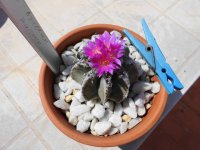
Aztekium hintonii is a lot faster growing - mine came into flower last week - pic attached (taken by me of my own plant).
 

Attachments

  • Aztekium+hintonii.JPG
    Aztekium+hintonii.JPG
    64.8 KB · Views: 0
Back
Top Bottom