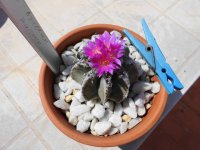
I was choosing some new cacti to grow looking through Cacti: The Illustrated Dictionary and came across the genus pelecyphora. I really wanted to grow this plant because it is beautiful just like the other plants in this genus. Then I ran into some information stating that it contains Hordenine, anhalidine, pellotine, 3-demethyltrichocereine, mescaline, 3,4-dimethoxy-β -phenethylamine, N-monomethyl derivatives of mescaline and 3,4-dimethoxy-β -phenethylamine. Then after some research I ran into some info about A. riterii and M. micromeris alkaloids. Here is a pretty good paper on these three Mexican cacti.
Alkaloid profile of 3 "Peyote" cacti
Pelecyphora aselliformis alkaloids
Does anyone have knowledge on the subject? Maybe they've been bio-assayed. I understand they have pretty small amounts, but it would be interesting to hear of any experience (who in the world would eat an aztekium riterii though??!) Would be cool to find out if they're active. Although not very practical since they grow so damn slow.
Pelecyphora aseliformis

In habitat.

Crested clone A (Thin form)

Crested clone B (Wide form)

Aztekium riterii

Huge grafted specimen

Crested form

In habitat

Mammillaria micromeris


In habitat

Alkaloid profile of 3 "Peyote" cacti
Pelecyphora aselliformis alkaloids
Does anyone have knowledge on the subject? Maybe they've been bio-assayed. I understand they have pretty small amounts, but it would be interesting to hear of any experience (who in the world would eat an aztekium riterii though??!) Would be cool to find out if they're active. Although not very practical since they grow so damn slow.
Pelecyphora aseliformis
In habitat.
Crested clone A (Thin form)
Crested clone B (Wide form)
Aztekium riterii
Huge grafted specimen
Crested form
In habitat
Mammillaria micromeris
In habitat