STRESSING
Alkaloids in phalarii can be increased with stressing. Stressing, on the other hand, slows the growth and decreases the total yield. I will refer to any action that increases the total alkaloid-yield by stressing. These methods work for both P. arundinacea and aquatica. There are three basic methods in stressing: clipping, shading and moisture control.
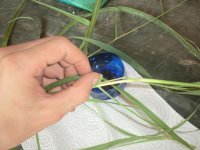
Clipping is relatively easy. Take clean scissors into your right hand, hold the plant still with your left hand, and SNIP, your plant just got stressed. But simply clipping the plants shorter will decrease your total yield. Wait until the plant is about 10 or 20 cm (1/2') high. Cut right above the leaf. Wait until you get another leaf, above which to cut, could be two days or two weeks. Clipping increases tryptamine content by 50 % to even 400%. The amount of betacarbolines is roughly doubled.
Shading is quite controversial issue. Shading slows the growth, and seems to affect different strains different ways. I will try to shed some light into shadows. First of all, you will probably grow your plants indoors, and if these plants are not on the windowsill, they will not be receiving anything near the light plants outdoors do, where all the studies are made. Forget shading. If you grow yours outdoors/near good light source, shading might be useful. Shade the plants for their last 1/4th or 1/5th of the growing-period.
In practice, placing a sheet of glass/plexiglass or a thin net between the plants and the light source should work. Glass eats anything from couple to 20% (dirty) of the light.
Amount of shading is quite troublesome, too. General mean value would be maybe 5 to 15%. Arundinacea responds to smaller shifts, halve the figures. Shading increases the tryptamine content by 20 to 30%.
Moisture-stressing is also quite easy. You don't water for a week or so. Interestingly, plants droughted for a long time produce some unknown alkaloid. Young plants respond better to drought, whereas older (+30d) may not show any response in respect to the alkaloid content. Regrowths grown from droughted plants (which did not show response) had a higher alkaloid content. If you wilt, wilt young plants. No water for a period of 5 to 10 days. If any damage (brown leaf tips etc.) begins to show, stop wilting. Note that although the plants cannot be rotted to death with overwatering, it slows the growth. Let the soil dry out every now and then. Phalaris likes lots of water, and overwatering of it means LOTS of water if you compare to average houseplant. Moisture stress may as much as double the alkaloid content.
To get high leaf mass, your plant needs high amounts of water, light, and nutrients. Nutrients, on the other hand, have been shown to have a negative effect on the alkaloid content - adequate fertilization may in fact lower the total alkaloid content. And stressing decreases the leaf mass. So you must walk the fine line between these two. Make a growing program, divided in 4 to 8 parts. During certain parts you maximise the leaf mass. And during certain parts you maximise the alkaloid content.
Example:
Simon Sez grows Phalaris aquatica. 1st period goes almost entirely to germination, as the seeds dry out a bit, "Whatta dumb mistake," Simon thinks, as third of the seeds won't germinate anymore.
2nd and 3rd period Simon has dedicated for growth. Simon gives the plants nutrients; during 2nd period complete, well balanced N-P-K (nitrogen, phosphorus, potassium) and micronutrient (Zn,B,Cu, Fe, Mn, etc.) fertilizer, and during 3rd only natural nitrogen. Every now and then he snips the top off 'em.
4th period is about fasting - Simon gives plants no water.
During the 5th Simon begins to feel sorry for the plants and after giving them adequate, but not too much!, watering, lets them grow.
And at the beginning of the 6th period, Simon thinks that its time to chill out a bit, so he sneaks the plants into large fridge his friend has (after giving it a dose of nitrogen fertilization). Just for a night. Its always above 0 C, but below 6 C.
Last days the plants get to grow normally. Then Simon strips the leaves, and lets the plants do their own thing for a while, as he tries to put together the wheat grass juicer he got without any instructions. That would theoretically make 200% for the clipping, 25% for the 4th, 10-200% for the 6th. But in reality the increase in tryptamines cannot be calculated so easily. But lot anyhow. Simon smiles happily.
The period length is also important - alkaloid content rises steadily as the plant grows, and is highest at 30 to 50 days. Simon had 7 day periods =).
Fertilizers - problematic. Don't use good, rich soil - if the plants get enough of micronutrients, alkaloid content is diminished. Mix regular gradening soil with sand and rocks to get a good mix (for example 1/3rd of each). When the plant is young, ensure adequate nutrition with liquid fertilizers, then move to only nitrogen fertilization, and finally give only water (for example first quarter, second quarter and last half, resp.). This makes plants grow fast, big and finally tryptish. Phalaris can use fairly large amounts of fertilizers, but stick to the instructions of the manufacturer until you know what you are doing. Urine is an excellent excellent nitrogen fertilizer - add about half an desiliter (2 oz) per liter of water (1/5gallon?) - fully organic and very soluable.
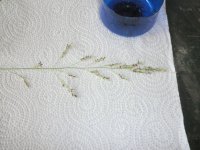
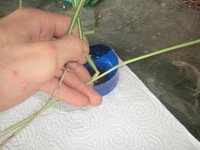
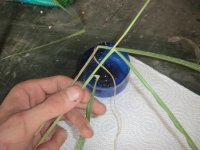
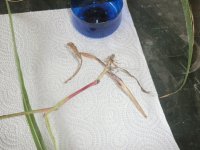
Cloning - an easy way to get more plants. First pick your best plant - healthy, big and high in alkaloids. Wait till you harvest, and then cut the whole stem off, place it underwater, glass or a bucket does fine, cut in small pieces, add small amounts of seaweed(-extract) and wait couple of days. After that place pieces in pots, and keep humid. It might take as long as 3 weeks for first signs of life, but try to keep the soil relatively humid - not wet, humid. Excess water may attract molds and fungi. You can also take part of the rhizome (root) and do the same thing. Simply divide the rhizome and place the pieces in soil. Water with light seaweed-extract-solution. Wait. Leaves are of no use here, they will only rot away.
Harvesting the fruits of labor is very easy. Simply cut out the leaves. If you like you can leave one leaf/stem to speed up the regrowth. Remove parts of the stem above the leaf. Plant will continue growing for a long time. Repotting the plant or dividing the rhizomes often gives plant new vigour. Repot at least once a year.
Time of the day has no effect on the tryptamine content if you are growing indoors or in an greenhouse. Outside, morning harvest may rise alkaloid content.
If you are producing seeds - don't clip, have at least four of such plants, all from different sources, and of good strain. Let these grow, and when the seed production has started, place a clear bag over the flower. Bags made of loose nylon mesh are best. Plants produced from seed often have more energy than plants that have been cloned from a clone (and so-on). Produce seeds at least once in two years to ensure the vigour of your plants.