• Members of the previous forum can retrieve their temporary password here, (login and check your PM).

~Phalaris = The Way Of The Future~

Migrated topic.
Actually around the end of last summer I have smoked dried 10 days old seedlings of aquatica fertilized with kelp extract and it was active as a joint. Smoke smelled like vaporised DMT.

It's really not as complicated as you might think. You just have to find the right strain.


We have isolated at least three wild accessions of aquatica that was found to contain mainly DMT through TLC. One of them was especially clean. I suggest you read up my last few posts on this thread for more details.

I have seen few reports on emulations with fresh leaves extractions but I haven't encountered this issue personally. Fats didn't seem as obstacle to me. At least not when using dichloromethane or chloroform for pulling. As detailed in my last post, no defatting step is required with grasses. Just give the basified tea a little time to react so most fats will saponify under high high alkaline conditions and it will precipitate as fine particles. This saponified sedimentation will still float on top of DCM and chloroform.


I'm happy to announce that phalaris breeding programme has finally kick-started 😉 we'll be posting the TLC results on that thread from now on. See you guys there.
so what would you say the ideal Tek is?
im assuming through all of yours and grasshoppers research has shown a better extraction tek to adapt for using a grass and to deal with the other alkaloids
 
so what would you say the ideal Tek is?
im assuming through all of yours and grasshoppers research has shown a better extraction tek to adapt for using a grass and to deal with the other alkaloids
A standard acid base extraction works fine for harvest batches in the range of 300 to 600g fresh.. when you increase the amount of biomass per cook (especially when you reduce the tea to higher concentrations) some issues may arise like emulsions from the higher ratio of fatty acids in the crude tea which can also obstruct the extraction of actives into the solvent.

Smaller harvest batches have consistently yielded better in my experience. Drying leaves also helps with yield and reduces the time needed for cooking. Powderizing may not be necessary. 1h cooking for dry leaves is enough.
 
A standard acid base extraction works fine for harvest batches in the range of 300 to 600g fresh.. when you increase the amount of biomass per cook (especially when you reduce the tea to higher concentrations) some issues may arise like emulsions from the higher ratio of fatty acids in the crude tea which can also obstruct the extraction of actives into the solvent.

Smaller harvest batches have consistently yielded better in my experience. Drying leaves also helps with yield and reduces the time needed for cooking. Powderizing may not be necessary. 1h cooking for dry leaves is enough.
Wdym cook? and tea?
can you give a crash course step by step from gathering to yield
 
Cook = simmer in (acidified?) water
Tea = resulting solution after straining
Straining = the use of mesh or another form of perforated barrier to separate coarse solid material from a liquid. See also: filtering

mb i really meant abt the tea bit but yeah i got it just an acidic solution to get rid of chlorophyll right?
anyway to not make it simmer for 2 hours
 
mb i really meant abt the tea bit but yeah i got it just an acidic solution to get rid of chlorophyll right?
anyway to not make it simmer for 2 hours
Long boils/simmers are considered superfluous in this instance - I've seen a claim that a far shorter boil is optimal and may help minimise hordenine/gramine concentrations (iirc). Longer boils for woody material (which grass, of course, is not) make sense in terms of it taking longer for the water to penetrate the material, and longer for the alkaloids to diffuse out. They are also apparently used by some cactus brew practitioners to amend the properties of the cactus brew by reducing slime and, possibly, destroying certain secondary alkaloids for a smoother effect. None of this really applies to grasses.

Beyond that, you'll have to put more effort into formulating comprehensible and targetted questions in order to obtain the information you require. Doing more background reading should help you with this.
 
mb i really meant abt the tea bit but yeah i got it just an acidic solution to get rid of chlorophyll right?
anyway to not make it simmer for 2

Long boils/simmers are considered superfluous in this instance - I've seen a claim that a far shorter boil is optimal and may help minimise hordenine/gramine concentrations (iirc). Longer boils for woody material (which grass, of course, is not) make sense in terms of it taking longer for the water to penetrate the material, and longer for the alkaloids to diffuse out. They are also apparently used by some cactus brew practitioners to amend the properties of the cactus brew by reducing slime and, possibly, destroying certain secondary alkaloids for a smoother effect. None of this really applies to grasses.

Beyond that, you'll have to put more effort into formulating comprehensible and targetted questions in order to obtain the information you require. Doing more background reading should help you with this.
For extraction I would say 1 hour hard boil is better for maximum yield and tyramine will not get carried up in an acid base extraction. For oral consumption i wouldn't recommend aquatica to begin with.
 
I've been growing Phalaris grass with the goal of selecting or breeding, extracting at analytical scale and analyzing by HPLC-UV. As described in my post history, that's been mostly unsuccessful; but my plants are already strong enough that the tiny quantity I've grown is enough for several doses.

I've therefore extracted that. My method is nothing special, but I've analyzed at each step. So these numbers might be of interest to someone attempting more serious method development.

I harvested 49 g fresh weight of a Phalaris brachystachys variety known to contain 5-MeO-DMT as the primary alkaloid. I froze it overnight, then chopped it coarsely with scissors to pack better, and placed it in a beaker with 150 mL water and 500 mg citric acid, just covering it. I sonicated for 10 min at 50 C, squeezed the grass by hand and decanted the liquid, and repeated for a total of three pulls, 411 mL in all. I combined and reduced to 50 mL at a low boil, then let that extract settle for three days in the fridge.

I decanted and filtered under vacuum through medium paper; it slowed but didn't clog. I made the water basic with an excess (about 7.5 mL) of concentrated ammonia, then extracted with 30 mL ethyl acetate, then 22 mL, then 22 mL again.

I combined the solvent pulls and evaporated on a 50 C water bath (my ultrasonic cleaner) under an air stream, yielding 70 mg of a brown oil or wax. I redissolved this in 1.7 mL water with 100 mg citric acid, with some difficulty but sonication worked, finally yielding a dark brown liquid suitable for sublingual use. It should also work as a nasal spray, though more purification would be required to avoid deadening one's sense of smell. That product has expected effects, with threshold around 100 uL. (I personally dislike inhaled drugs, and I'm in the habit of dosing sublingually from my experiments with kanna. Ott describes his experiences with sublingual 5-MeO-DMT, and I find it comfortable and effective.)

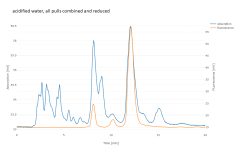
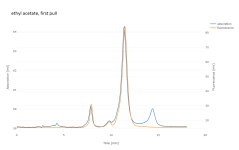
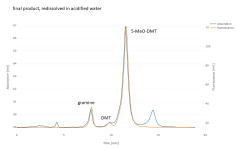
I've attached some chromatograms, by UV absorption and fluorescence as described in my earlier posts. Samples were simply diluted into mobile phase, by either 1000x (the final product) or 100x (everything else). Using purchased synthetic 5-MeO-DMT (purity unknown, but >95% by UV absorption area) as a standard and scaling by fluorescence area, the three aqueous pulls yielded 25.2 mg, 8.3 mg, and 3.8 mg 5-MeO-DMT. I believe sonication (or stirring) will extract all the alkaloids from Phalaris grass, and that more aggressive treatment (blending, maceration, etc.) just increases the risk of clogged filters or emulsions. I tried bead beating on my analytical samples, and yielded no more than sonication. My preparative yield here agrees with my analytical samples. I don't know whether the freezing step is actually beneficial, but I always do it for consistency.

I think I used way more citric acid than I needed. pH started around 2.5, rising no higher than 3.2 after sonication on the first pull, less on subsequent pulls. This probably doesn't hurt, though.

After combining and reducing the aqueous pulls, I yielded 42.0 mg. The three ethyl acetate pulls yielded 35.9 mg, 1.6 mg, and 3.6 mg. (I shook the separatory funnel vigorously, and got a few mL of foamy emulsion on the first pull; but I didn't notice that immediately, so I later put it back in the funnel with the third pull. I believe that's why the third pull yielded more than the second.) Final yield after evaporating and redissolving was 39.6 mg.

Gramine was also present, at roughly 15% the area (roughly same for fluorescence and absorption) of the 5-MeO-DMT. I unfortunately don't have a standard to convert the gramine to weight, but I'm guessing a reasonable dose of 5-MeO-DMT comes with gramine 2-3 orders of magnitude below the LD50. So this particular extract seems pretty safe in that respect, though other Phalaris extracts may vary greatly. The toxicity of gramine by inhalation vs. oral or IV also seems like a significant unknown.

The first aqueous pull had the least gramine relative to 5-MeO-DMT, about 10%. It's not a big difference, though. DMT was also present, but in negligible amount. There's also an unidentified non-fluorescent peak at 14.4 min with about the same absorption area as the gramine, perhaps tyramine or hordenine; perhaps I should extract some soy sauce and barley.

The numbers mostly make sense, except that the combined aqueous extracts show 113% of the 5-MeO-DMT of the summed individual pulls. So that's a hint towards my accuracy, not great. My standards repeat within about a percent, so I think that's mostly from the liquid volumes (which I lazily took from graduations on the beakers) and not the chromatography; I'll weigh the liquid next time. I don't understand how the first solvent pull yields so well given the solubility of ethyl acetate in water, but I don't see what likely mistake could lead to my result either.

5-MeO-DMT is unusually dangerous. See Festi and Samorini's overdose, or the TIHKAL participant who stopped breathing, then spent the next week in a terrifying psychological state, returning only after treatment with antipsychotics. Phalaris extracts must always be treated as 5-MeO-DMT until proven otherwise by laboratory analysis or experience with the individual batch, since alkaloids may vary greatly even within a species or population and with cultural or environmental conditions.

Comments and suggestions for future work are welcome. I also tried to measure some partition coefficients into different solvents (ethyl acetate, DCM, and hot and cold limonene), but I'm not sure I believe my result; they were all extremely similar, and all pulled the 5-MeO-DMT and unwanted alkaloids equally. I think I saw a bigger difference in the DMT, but it's hard to tell since that peak is always small. I may repeat that experiment, perhaps with more water and less solvent (I did 1:1 before) and higher concentration.
 

Attachments

  • ph3-water.png
    ph3-water.png
    56.4 KB · Views: 10
  • ph3-etoac.png
    ph3-etoac.png
    38.9 KB · Views: 10
  • ph3-redissolved.png
    ph3-redissolved.png
    41.5 KB · Views: 11
Great post, very informative! You've put some good effort into this.

Do you have any thoughts about the identity of that small, nonfluorescent absorbance peak which precedes [sorry!] follows 5-MeO-DMT in the spectra at around t=14.5 mins?

And have you thought about precipitating directly from EA with citric acid, "-IELO" style?
 
Last edited:
Do you have any thoughts about the identity of that small, nonfluorescent absorbance peak which precedes 5-MeO-DMT in the spectra at around t=14.5 mins?
I assume you mean the peak around 4.3 min (since the 14.5 min is after the 5-MeO-DMT)? I think hordenine and tyramine are candidates for both of those non-fluorescent peaks, since they're commonly reported in Phalaris, don't have the indole fluorescence, and do absorb at my 275 nm. Beyond that I'm just guessing, though. I think I need more standards to get any confidence.

And have you thought about precipitating directly from EA with citric acid, "-IELO" style?
I'd greatly prefer that to evaporating; I just wanted to start with something I knew would work. Are you aware of any references that discuss 5-MeO-DMT citrate, or any salt from ethyl acetate? I was thinking of trying the hydrochloride, succinate, or possibly oxalate, all of which are reported to crystallize well (though from different solvents, and starting from a much purer product).
 
I assume you mean the peak around 4.3 min (since the 14.5 min is after the 5-MeO-DMT)? I think hordenine and tyramine are candidates for both of those non-fluorescent peaks, since they're commonly reported in Phalaris, don't have the indole fluorescence, and do absorb at my 275 nm. Beyond that I'm just guessing, though. I think I need more standards to get any confidence
Sorry, brain fart there - it was indeed meant to say "follows", in keeping with the quoted elution time.
 
Are you aware of any references that discuss 5-MeO-DMT citrate, or any salt from ethyl acetate?
It's more an observation that DMT and mescaline precipitate in one way or another, and 5-MeO-DMT kind of has its toe between the two of them structurally speaking. In that sense it seems to suggest that a citric acid precipitation would be worth a try. There is a small amount of experimental data regarding the solubility of other organic acids in EA to be found in one of the relevant threads, and although there's a fair chance that the trend for tryptamine citrates is to crash out in an amorphous form it may prove to be useful purification step towards producing crystalline material.

I don't think this group of methods appears anywhere in the literature beyond where @someblackguy found the original inspiration for what became the CIELO method, but tbh I haven't checked recently.
 
Sidisheikh.mehriz told me "that oxalate wins the trophy for recrystallization. The stuff crystalizes out of aqueous solution". I believe he was extracting with chloroform and recystalising from there. He also stated acetate, citrate and fumarate worked but I believe created a goo.
 
I've been growing Phalaris grass with the goal of selecting or breeding, extracting at analytical scale and analyzing by HPLC-UV. As described in my post history, that's been mostly unsuccessful; but my plants are already strong enough that the tiny quantity I've grown is enough for several doses.

I've therefore extracted that. My method is nothing special, but I've analyzed at each step. So these numbers might be of interest to someone attempting more serious method development.

I harvested 49 g fresh weight of a Phalaris brachystachys variety known to contain 5-MeO-DMT as the primary alkaloid. I froze it overnight, then chopped it coarsely with scissors to pack better, and placed it in a beaker with 150 mL water and 500 mg citric acid, just covering it. I sonicated for 10 min at 50 C, squeezed the grass by hand and decanted the liquid, and repeated for a total of three pulls, 411 mL in all. I combined and reduced to 50 mL at a low boil, then let that extract settle for three days in the fridge.

I decanted and filtered under vacuum through medium paper; it slowed but didn't clog. I made the water basic with an excess (about 7.5 mL) of concentrated ammonia, then extracted with 30 mL ethyl acetate, then 22 mL, then 22 mL again.

I combined the solvent pulls and evaporated on a 50 C water bath (my ultrasonic cleaner) under an air stream, yielding 70 mg of a brown oil or wax. I redissolved this in 1.7 mL water with 100 mg citric acid, with some difficulty but sonication worked, finally yielding a dark brown liquid suitable for sublingual use. It should also work as a nasal spray, though more purification would be required to avoid deadening one's sense of smell. That product has expected effects, with threshold around 100 uL. (I personally dislike inhaled drugs, and I'm in the habit of dosing sublingually from my experiments with kanna. Ott describes his experiences with sublingual 5-MeO-DMT, and I find it comfortable and effective.)

I've attached some chromatograms, by UV absorption and fluorescence as described in my earlier posts. Samples were simply diluted into mobile phase, by either 1000x (the final product) or 100x (everything else). Using purchased synthetic 5-MeO-DMT (purity unknown, but >95% by UV absorption area) as a standard and scaling by fluorescence area, the three aqueous pulls yielded 25.2 mg, 8.3 mg, and 3.8 mg 5-MeO-DMT. I believe sonication (or stirring) will extract all the alkaloids from Phalaris grass, and that more aggressive treatment (blending, maceration, etc.) just increases the risk of clogged filters or emulsions. I tried bead beating on my analytical samples, and yielded no more than sonication. My preparative yield here agrees with my analytical samples. I don't know whether the freezing step is actually beneficial, but I always do it for consistency.

I think I used way more citric acid than I needed. pH started around 2.5, rising no higher than 3.2 after sonication on the first pull, less on subsequent pulls. This probably doesn't hurt, though.

After combining and reducing the aqueous pulls, I yielded 42.0 mg. The three ethyl acetate pulls yielded 35.9 mg, 1.6 mg, and 3.6 mg. (I shook the separatory funnel vigorously, and got a few mL of foamy emulsion on the first pull; but I didn't notice that immediately, so I later put it back in the funnel with the third pull. I believe that's why the third pull yielded more than the second.) Final yield after evaporating and redissolving was 39.6 mg.

Gramine was also present, at roughly 15% the area (roughly same for fluorescence and absorption) of the 5-MeO-DMT. I unfortunately don't have a standard to convert the gramine to weight, but I'm guessing a reasonable dose of 5-MeO-DMT comes with gramine 2-3 orders of magnitude below the LD50. So this particular extract seems pretty safe in that respect, though other Phalaris extracts may vary greatly. The toxicity of gramine by inhalation vs. oral or IV also seems like a significant unknown.

The first aqueous pull had the least gramine relative to 5-MeO-DMT, about 10%. It's not a big difference, though. DMT was also present, but in negligible amount. There's also an unidentified non-fluorescent peak at 14.4 min with about the same absorption area as the gramine, perhaps tyramine or hordenine; perhaps I should extract some soy sauce and barley.

The numbers mostly make sense, except that the combined aqueous extracts show 113% of the 5-MeO-DMT of the summed individual pulls. So that's a hint towards my accuracy, not great. My standards repeat within about a percent, so I think that's mostly from the liquid volumes (which I lazily took from graduations on the beakers) and not the chromatography; I'll weigh the liquid next time. I don't understand how the first solvent pull yields so well given the solubility of ethyl acetate in water, but I don't see what likely mistake could lead to my result either.

5-MeO-DMT is unusually dangerous. See Festi and Samorini's overdose, or the TIHKAL participant who stopped breathing, then spent the next week in a terrifying psychological state, returning only after treatment with antipsychotics. Phalaris extracts must always be treated as 5-MeO-DMT until proven otherwise by laboratory analysis or experience with the individual batch, since alkaloids may vary greatly even within a species or population and with cultural or environmental conditions.

Comments and suggestions for future work are welcome. I also tried to measure some partition coefficients into different solvents (ethyl acetate, DCM, and hot and cold limonene), but I'm not sure I believe my result; they were all extremely similar, and all pulled the 5-MeO-DMT and unwanted alkaloids equally. I think I saw a bigger difference in the DMT, but it's hard to tell since that peak is always small. I may repeat that experiment, perhaps with more water and less solvent (I did 1:1 before) and higher concentration.
Hi aizoaceous,

I appreciate the thoroughness and detail in your recent post about extracting and analyzing 5-MeO-DMT from Phalaris grass. Your approach, particularly with the HPLC-UV analysis, resonates with some of the methods we've also been exploring in our own project.

While much of what you’ve done aligns with our findings, it's always interesting to see how others approach the same challenges. Your results, especially around the extraction efficiency and handling of gramine, offer useful insights.

We’re also working on optimizing our extraction techniques and are particularly focused on improving the accuracy of our measurements and exploring alternative solvents. If you’re interested, I’d be happy to exchange more specific details about our respective approaches or collaborate on refining some of these methods.

Looking forward to hearing more about your future experiments!

Best regards
 
@Transform, @_Trip_ - Thanks for the advice, and I'll definitely attempt some kind of crystallization (and other purification) on my next batch. I'll probably start with the oxalate, the most toxic of the options but the dose here will be nothing, a few leaves of spinach worth.

I'll plant a larger area of P. brachystachys shortly. If all goes well then I should have a kilogram or so fresh weight in about three months, yielding about a gram of 5-MeO-DMT. I don't think the current impurities are likely to have much physiological effect, but I'd still rather not have them and I like pretty crystals. I should also fix the taste, which is not exactly bad but intensely grassy now.

@Grasshoppers - And likewise thanks, and I'm following your thread with interest. I guess it's all roughly the same territory, but Phalaris seems variable enough that repetition often brings surprises. Thoughts on experiments within the capabilities of my lab and garden are always welcome.
 
Hey there
I've been growing Phalaris grass with the goal of selecting or breeding, extracting at analytical scale and analyzing by HPLC-UV. As described in my post history, that's been mostly unsuccessful; but my plants are already strong enough that the tiny quantity I've grown is enough for several doses.

I've therefore extracted that. My method is nothing special, but I've analyzed at each step. So these numbers might be of interest to someone attempting more serious method development.

I harvested 49 g fresh weight of a Phalaris brachystachys variety known to contain 5-MeO-DMT as the primary alkaloid. I froze it overnight, then chopped it coarsely with scissors to pack better, and placed it in a beaker with 150 mL water and 500 mg citric acid, just covering it. I sonicated for 10 min at 50 C, squeezed the grass by hand and decanted the liquid, and repeated for a total of three pulls, 411 mL in all. I combined and reduced to 50 mL at a low boil, then let that extract settle for three days in the fridge.

I decanted and filtered under vacuum through medium paper; it slowed but didn't clog. I made the water basic with an excess (about 7.5 mL) of concentrated ammonia, then extracted with 30 mL ethyl acetate, then 22 mL, then 22 mL again.

I combined the solvent pulls and evaporated on a 50 C water bath (my ultrasonic cleaner) under an air stream, yielding 70 mg of a brown oil or wax. I redissolved this in 1.7 mL water with 100 mg citric acid, with some difficulty but sonication worked, finally yielding a dark brown liquid suitable for sublingual use. It should also work as a nasal spray, though more purification would be required to avoid deadening one's sense of smell. That product has expected effects, with threshold around 100 uL. (I personally dislike inhaled drugs, and I'm in the habit of dosing sublingually from my experiments with kanna. Ott describes his experiences with sublingual 5-MeO-DMT, and I find it comfortable and effective.)

I've attached some chromatograms, by UV absorption and fluorescence as described in my earlier posts. Samples were simply diluted into mobile phase, by either 1000x (the final product) or 100x (everything else). Using purchased synthetic 5-MeO-DMT (purity unknown, but >95% by UV absorption area) as a standard and scaling by fluorescence area, the three aqueous pulls yielded 25.2 mg, 8.3 mg, and 3.8 mg 5-MeO-DMT. I believe sonication (or stirring) will extract all the alkaloids from Phalaris grass, and that more aggressive treatment (blending, maceration, etc.) just increases the risk of clogged filters or emulsions. I tried bead beating on my analytical samples, and yielded no more than sonication. My preparative yield here agrees with my analytical samples. I don't know whether the freezing step is actually beneficial, but I always do it for consistency.

I think I used way more citric acid than I needed. pH started around 2.5, rising no higher than 3.2 after sonication on the first pull, less on subsequent pulls. This probably doesn't hurt, though.

After combining and reducing the aqueous pulls, I yielded 42.0 mg. The three ethyl acetate pulls yielded 35.9 mg, 1.6 mg, and 3.6 mg. (I shook the separatory funnel vigorously, and got a few mL of foamy emulsion on the first pull; but I didn't notice that immediately, so I later put it back in the funnel with the third pull. I believe that's why the third pull yielded more than the second.) Final yield after evaporating and redissolving was 39.6 mg.

Gramine was also present, at roughly 15% the area (roughly same for fluorescence and absorption) of the 5-MeO-DMT. I unfortunately don't have a standard to convert the gramine to weight, but I'm guessing a reasonable dose of 5-MeO-DMT comes with gramine 2-3 orders of magnitude below the LD50. So this particular extract seems pretty safe in that respect, though other Phalaris extracts may vary greatly. The toxicity of gramine by inhalation vs. oral or IV also seems like a significant unknown.

The first aqueous pull had the least gramine relative to 5-MeO-DMT, about 10%. It's not a big difference, though. DMT was also present, but in negligible amount. There's also an unidentified non-fluorescent peak at 14.4 min with about the same absorption area as the gramine, perhaps tyramine or hordenine; perhaps I should extract some soy sauce and barley.

The numbers mostly make sense, except that the combined aqueous extracts show 113% of the 5-MeO-DMT of the summed individual pulls. So that's a hint towards my accuracy, not great. My standards repeat within about a percent, so I think that's mostly from the liquid volumes (which I lazily took from graduations on the beakers) and not the chromatography; I'll weigh the liquid next time. I don't understand how the first solvent pull yields so well given the solubility of ethyl acetate in water, but I don't see what likely mistake could lead to my result either.

5-MeO-DMT is unusually dangerous. See Festi and Samorini's overdose, or the TIHKAL participant who stopped breathing, then spent the next week in a terrifying psychological state, returning only after treatment with antipsychotics. Phalaris extracts must always be treated as 5-MeO-DMT until proven otherwise by laboratory analysis or experience with the individual batch, since alkaloids may vary greatly even within a species or population and with cultural or environmental conditions.

Comments and suggestions for future work are welcome. I also tried to measure some partition coefficients into different solvents (ethyl acetate, DCM, and hot and cold limonene), but I'm not sure I believe my result; they were all extremely similar, and all pulled the 5-MeO-DMT and unwanted alkaloids equally. I think I saw a bigger difference in the DMT, but it's hard to tell since that peak is always small. I may repeat that experiment, perhaps with more water and less solvent (I did 1:1 before) and higher concentration.
Amazing work! It's always good to see more people joining in on this project.
I'm just going to give my two cents here:

-you're using ethyl acetate for solvent which is a fairly polar on par with DCM so it's expected that your crude extract yield will be high but it will contain a fair amount of contamination inert substances. you even mentioned tasting grassy flavour sublingually which suggests a good deal of non alkaloidal portion in your extract. I use chloroform a less polar solvent. While my yields are lower than yours on average the extracts are very potent dose wise and taste and smell just like pure tryptamines.

-@-Trip- is right, oxalic acid is the easiest to crystalize with even from aqueous solutions. It's very non hygroscopic and has poor solubility in water.. I use the oxalic acid as an intermediate cleaning step in a mini acid base when I have enough crude extract material but I always transfer it back to freebase as a clear faint yellow oil. This cleaned freebase feels the purest quality wise in a bioassay. You can add some highly non polar solvent like hexane or heptane or any equivalent to your ethyl acetate to decrease the polarity to get cleaner freebase that can better reflect true yield.

-I am a bit confused why in your HPLC run DMT elutes before 5-meo-dmt. Is it because you're using reversed phase C18 column? But in which case shouldn't gramine elute before 5-meo-dmt?

I also tried sublingual phalaris extracts but I found using the freebase sublingually is more efficient than the citrate and acetate salt simply because the salts dissolve in saliva and get washed away from the target zone for absorption...not fun to have a very bitter mouthful with strong chemical taste. The freebase is poorly soluble in saliva and the absorption is limited to the point of contact between the freebase and the sublingual tissue. I simply use small cut piece of rolling paper dip one side in the freebase oil..dry my mouth and the underside of my tongue with paper towel and place the paper underneath my tongue...it adheres well in there ...then I lay back and try not get my tongue wet ...if the peice of paper ever gets wet and detach from my tongue I don't bother trying to place it back in it wont work (I tried) so I dry it up with some paper towel and place it in my nose making sure the freebase side of the paper is adhering to the target tissue in my nose where there is highest concentration of blood vessels...this causes the trip to intensify once again...I was able to get a breakthrough like this before.

Yes intranasal can cause a lot of irritation to your nose ...it caused me a sinus infection once.


I got crystalline freebase more than once with brachystachys from chloroform. Smoked it felt DMT like.

Keep it up. really interesting work!
 
-you're using ethyl acetate for solvent which is a fairly polar on par with DCM so it's expected that your crude extract yield will be high but it will contain a fair amount of contamination inert substances.
Yeah, no surprise that a less pure extract yields higher. It's also possible that my plants have more alkaloids; the P. brachystachys seeds that I bought are dead uniform, but perhaps other populations differ. Environmental conditions also seem to cause big changes. I've been growing hydroponically under lights and have just recently moved plants outdoors, results to follow.

Do you have a complete description of one of your extractions anywhere, from grass to crystals? I'm hoping to stick with the ethyl acetate (low toxicity, cheap, available), but it's nice to follow a known working method as closely as possible.

-I am a bit confused why in your HPLC run DMT elutes before 5-meo-dmt. Is it because you're using reversed phase C18 column? But in which case shouldn't gramine elute before 5-meo-dmt?
You are correct that my elution order is permuted (and not just reversed) from the order in normal-phase TLC. I'm using a phenyl-hexyl column, so retention is based on pi-pi interactions as well as polarity and I have zero intuition for that. I tried first on a C18 column, but was unable to get reasonable peak shape with acidic eluent. I saw the phenyl-hexyl in a paper from Paul Daley, and it seems to work.

I don't have a standard for the gramine, but it's the primary peak in some Arundo donax, and the UV absorption spectrum and fluorescence maximum wavelength match (and it's the only remaining fluorescent peak in the Phalaris). So I'm pretty confident in the identification.

I also tried sublingual phalaris extracts but I found using the freebase sublingually is more efficient than the citrate and acetate salt simply because the salts dissolve in saliva and get washed away from the target zone for absorption
Ott also used the freebase, and I believe that's good advice. I don't have an accurate scale for low milligram doses (which is silly considering all the stuff I do have, so I should get one), and I've had excellent results dosing mesembrine alkaloids in solution as citrates so I tried that first. I was excited by the low threshold dose for my 5-MeO-DMT citrate, but higher doses have been less impressive; 350 uL (about 8 mg 5-MeO-DMT) got mild bodily sensations, slight closed-eye geometry, and auditory hallucinations, but nothing beyond that. Though I guess that's not too different from what Ott reports at his 10 mg, so I might just need more, or to potentiate with harmalas.
 
I have a three-part update today:

Phalaris aquatica

I had 273 g P. aquatica (with unknown genetics) in my freezer, so I extracted that too. I used basically the same method, in two pulls into 1411 mL water, then reduced to 50 mL and filtered. Even allowing for the greater reduction ratio, this seemed worse-behaved than the P. brachystachys, with lots of waxy stuff floating to the top while reducing (which I skimmed off), and heavy foam in the flask while filtering under vacuum. (Maybe lower temperature would extract less unwanted stuff?) The aqueous extract contained only 29 mg DMT and 3 mg 5-MeO-DMT, which didn't seem worth extracting further.

Overall, this reaffirms my plan to focus on my P. brachystachys, especially since others are working with much better P. aquatica genetics. To emphasize, my results apply only to the particular seeds I purchased, since intra-species variation is big.

Solvent Choice for Liquid-Liquid Extraction

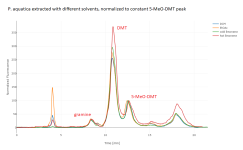
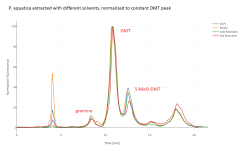
I'd mentioned previously that I'd tried extracting with different solvents to compare partition coefficients, but didn't trust my result. I've now repeated that experiment with the P. aquatica extract and I got basically the same result, so I'll report that now.

To each of four microcentrifuge tubes, I added 1 mL of the extract and 200 uL concentrated ammonia. I then added 500 uL of ethyl acetate, dichloromethane, or limonene. I did the limonene twice at two temperatures, 0 C and 50 C, the others once at room temperature. For the limonene samples, the aqueous extract and solvent were both pre-heated or pre-chilled, and I worked quickly whenever they weren't on their respective water baths.

I shook each tube, then left it for about ten minutes to separate. Only the cold limonene formed a clean interface; the others were strong emulsions. I centrifuged to separate, forming three layers, the two desired ones plus a thin waxy one, denser than water but lighter than DCM. This complicated my efforts to syringe off the solvent, but I did the best I could.

I added each solvent to 50 mL 0.25% citric acid in water. The ethyl acetate dissolved, which seemed fine. The DCM partially dissolved and the rest sank to the bottom, which also seemed fine. The limonene formed a cloudy emulsion, which did not seem fine (since I don't want to inject anything into my HPLC that won't dissolve in my eluent, and limonene doesn't much). I centrifuged and the extracts went clear again, and I carefully syringed off some water, avoiding the thin slick of limonene on the top. I injected these under the same chromatographic conditions as before.

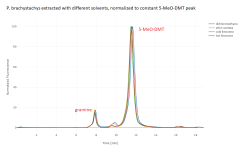
I've superimposed the four chromatograms for the four solvent options, normalized to the same 5-MeO-DMT peak height (for both species) and normalized to the same DMT peak height (for P. aquatica only, since that peak is tiny in the P. brachystachys). We see that for a given yield of 5-MeO-DMT, all the solvents pull almost exactly the same amount of gramine. For a given yield of DMT, the limonene pulls maybe 30% less gramine than the DCM or EtOAc. Temperature makes some difference, but not huge. P. aquatica has many unidentified peaks, and the limonene makes a much bigger difference on some of those, especially when cold. These chromatograms are fluorescence only; there are additional unidentified peaks in the absorption.

I don't think the gramine is particularly harmful under my conditions (yours may differ), but I don't think the limonene helps remove it much. @endlessness previously reported excellent rejection of gramine in an extraction using limonene followed by salting as the acetate. I think that must be correct (since there's no obvious experimental error that could result in that chromatogram, and I assume the peaks are correctly identified since it's GC-MS), but that the mechanism is something other than simple insolubility in limonene.

Alkaloid Content When Grown Indoors vs. Outdoors

I've also sampled the P. brachystachys that I germinated, grew, and sampled indoors under lights, then moved outdoors. Indoors, the plants consistently yielded about 950 ug 5-MeO-DMT per g fresh weight. Three samples outdoors yielded 447 ug/g, 428 ug/g, and 406 ug/g. I retook samples of plants from that same batch that I'd left indoors, yielding 562 ug/g, 908 ug/g, 850 ug/g, 1005 ug/g, 1221 ug/g, and 1150 ug/g. I'm not sure what happened with that first low sample indoors. That's the reason why I took so many additional samples, but those were all consistent.

So it seems like growing outdoors will probably yield about half the alkaloids of indoors for me. This may be caused by differences in:
  • daily light integral; I've seen claims that alkaloids are higher under shade cloth
  • dryback or nutrition; I irrigated daily outdoors with a hydroponic-type fertilizer solution, but I did get more dryback there than indoors; but drought stress is reported to increase alkaloid content, not decrease
  • photoperiod; though I'm at 16 hours on my lights and 13 hours sunrise to sunset now, not so different
  • temperature; the average outdoors is not that different from indoors now, but there's much more day-night swing.
My indoor space is currently overfull (mostly with cactuses and Sceletium), but I've cleared some room and will grow a square foot or so under lights. I've sown the rest outdoors in partial shade and will compare, and with luck those will yield enough to extract at larger scale.

 

Attachments

  • ph4-br-norm-5.png
    ph4-br-norm-5.png
    49.5 KB · Views: 8
  • ph4-aq-norm-5.png
    ph4-aq-norm-5.png
    62.7 KB · Views: 9
  • ph4-aq-norm-d.png
    ph4-aq-norm-d.png
    66.4 KB · Views: 8
Back
Top Bottom