• Members of the previous forum can retrieve their temporary password here, (login and check your PM).

~Phalaris = The Way Of The Future~

Migrated topic.
That "messiah" one from southern Lebanon too?
That's a selected clone from an Israeli wild accession not a cultivar (picked from border with Lebanon). Its like AQ1 it has to be cloned to maintain the same genetics but it's Super potent at least 2 to 3 times as yielding as CV. Tanit.

Unfortunately it hasn't flowered yet to include it's seed in our selective breeding programme but it should flower next spring.
 
I wouldn't worry much about pests.. one clipping should purge them..the regrowth is rarely eaten by insects in my experience if growing in soil. It's rich in Silica (mechanical defense) that erodes insects mandibles plus the chemical arsenal they have most potent of them against insects is gramine.

The only pest that's a real pain in the ass for phalaris aq is aphids because they poke the leaves to suck the sap instead of shewing so mechanical defense is useless against them and they can tolerate gramine and methylated tryptamines..it only slows them down but doesn't kill them or discourage them from feasting.

Yes seedlings does contain appreciable yield but the low biomass is very disadvantageous at that young age.. I suggest you let it grow larger at least 4 times as big. 40 to 50g fresh is enough for 3 to 4 average vaporized doses
 
Depending on climate conditions, P. aquatica can be highly susceptible to pest pressure. Thrips, in particular, can cause severe damage if left unchecked. Systemic treatment with acetamiprid is well tolerated by the plant and can be effective when used appropriately.
As with any such intervention, residue persistence in plant tissue and soil should be taken into account, and harvesting should not occur immediately after treatment.
 
A Comparative Bioassay: Synthetic 5-MeO-DMT vs. Full-Spectrum Phalaris aquatica CV. 'Tanit' Extracts (Seasonal Variations & Potency Notes)


Introduction

I recently had the opportunity to conduct a comparative bioassay between synthetic 5-MeO-DMT and full-spectrum extracts from our community's primary research cultivar, Phalaris aquatica CV. 'Tanit'. Given Tanit's previously identified 5-MeO-DMT dominant chemotype, this comparison aimed to explore similarities, differences, and the potential role of other compounds in shaping the overall experience.

Core Similarities & Key Differences

The initial onset and come-up phase of both the synthetic compound and the Tanit extract proved remarkably similar, reinforcing the cultivar's primary alkaloid profile. However, distinct differences emerged as the experience unfolded.

The most notable divergence was in duration and pattern. The full-spectrum Tanit extract consistently produced a longer overall effect, frequently characterized by a distinct second psychedelic peak. This secondary wave begins during the comedown from the initial 5-MeO-DMT-like peak, lasts longer, and is marked by a different qualitative character—often sharper more intense headspace.

The Impact of Seasonality on the 'Tanit' Profile

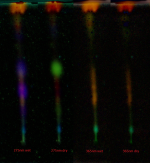
A critical finding from ongoing work is that the Tanit experience is not monolithic; it exhibits significant seasonal variation, which we have correlated with observable changes in TLC profiles.

-Late Spring (Flowering Period): Extracts from this period produce effects that are almost indistinguishable from high-dose synthetic 5-MeO-DMT in both character and duration. The profile is "clean" and singular.

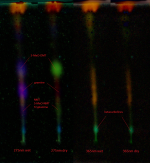
-Autumn to Early Spring: This period shows greater variability. Autumn harvests are notably potent, often exceeding the synthetic experience in intensity (particularly in that pronounced "second peak"). Winter harvests, in contrast, are milder than synthetic 5-meo-dmt. The experience aligns more with anecdotal reports of NMT—gentler, with barely noticeable visuals—and lacks secondary peaks. TLC analysis of these winter samples shows a spot with intrinsic fluorescence indicative of a 5 position methoxylated tryptamine but with an Rf value distinct from both DMT and 5-MeO-DMT (quiet lower RF), hinting at a compound like 5-MeO-NMT (since Tanit is a 5-meo-dmt chemotype its more plausible to have 5-meo-nmt instead of NMT as the secondary methylated tryptamine)

Potency Considerations & Speculation on Admixtures

Despite the longer duration and complex effects, the dosage potency of potent autumn Tanit extracts appears roughly equivalent to that of synthetic 5-MeO-DMT. This, combined with the enhanced subjective intensity, leads to a compelling hypothesis: the full-spectrum extract may contain potentiating agents, such as trace β-carbolines (MAOIs). This could explain both the extended duration (through inhibited metabolic breakdown) and the amplified perceptual intensity of the experience compared to the isolated compound and might also explain the second peak effect.

Conclusion & Future Work

This comparative bioassay reinforces that while 5-MeO-DMT is the primary driver of the 'Tanit' experience, the full-spectrum extract offers a more complex and seasonally modulated journey. The presence of other tryptamines (like the suspected 5-MeO-NMT in winter) and potential potentiators like betacarbolines (i think @Grasshoppers might have more to say on this) creates a rich pharmacological tapestry worthy of further study.

I will continue these comparative assays and keep the community updated. I hope this report contributes to a more nuanced understanding of this unique plant. discussion, questions and similar observations are Always welcomed

DISCLAIMER
This post details personal bioassay experiences with potent psychoactive substances for educational and harm reduction discussion. These are subjective observations, not definitive pharmacological data. The consumption of phalaris extract may carry significant health, and safety risks. Always prioritize safety and responsible research practices.
 
Thanks a lot for the TLC plate interpretation. That betacarboline fluorescence for this specific sample is greater than the average for Tanit profile that we're used to. I remember vividly that specific sample you're interpreting on that plate. That's what i had for my last Tanit bioassay and it had this accumulative second peak effect which is more significantly pronounced when redosing shortly after the come down from first dose.

Here's a bioassay report of a fellow redditor smoking a Tanit extract:

Notice his comments on redosing.
 
Follow-Up Update: Confirming Seasonal Chemotype Fluctuations & Documenting a Time-Dependent Entourage Effect in P. aquatica 'Tanit'


[DISCLAIMER]
This post details experimental bioassays with a psychoactive plant extract for research and harm reduction discussion. The cultivation, preparation, and bioassay of such materials carry significant health, and safety risks. This is not an encouragement for use but a report of phenomenological observations for scientific dialogue. Always prioritize safety, and responsible research practices.

---

1. Summary

This post consolidates observational data on our primary research cultivar, Phalaris aquatica 'Tanit', confirming a reproducible pattern of seasonal alkaloid profile fluctuations observed consistently since 2021. Furthermore, a controlled bioassay comparing a winter-harvest extract with synthetic 5-MeO-DMT has revealed a significant time-dependent entourage effect, where the full-spectrum extract potently modulates the effects of subsequent pure 5-MeO-DMT if administered within a specific window.

2. Consolidating Seasonal Chemotype Consistency

Long-term observation (2021-2025) now firmly establishes that the 'Tanit' chemotype is not static but varies predictably with seasons:

Autumn Harvests:
Exhibit the highest potency and most complex effects, characterized by intense, pronounced "second peaks."

Winter Harvests (e.g., Dec 28th Batch):
Produce a milder, smoother, and more lucid experience. The effects are longer-lasting and more somatic (e.g., a deeply relaxed, "warm blanket" sensation), with gentler visuals.

Late Spring Harvests:
Yield a "cleaner" profile most similar to isolated, synthetic 5-MeO-DMT, with a more singular, peak.

This consistent pattern strongly suggests environmental regulation of the biosynthetic pathways for tryptamines and β-carbolines in this cultivar.

3. Experimental Bioassay: December 28th Batch vs. Synthetic 5-MeO-DMT

Protocol: Vaporization of refined winter 'Tanit' extract and synthetic 5-MeO-DMT using a controlled RDA setup. Doses and intervals were tracked.

Key Observations:

1. Solo Extract Experience:
The winter extract exhibited its expected milder effect—an initial peak followed by a longer, smooth, and lucid plateau.

2. Critical Interval Discovery – 40-Minute Delay:
Upon vaping synthetic 5-MeO-DMT 40 minutes after the extract's effects had subsided, the experience was notably "cleaner," more euphoric, and upbeat—akin to a late-spring 'Tanit' profile.

3. Critical Interval Discovery – 5-Minute Delay:
In a separate session, vaping synthetic 5-MeO-DMT 5 minutes after the extract (during its extended plateau) resulted in dramatic potentiation: significantly longer duration, stronger body load, "flashy" harmala-like visuals, and a warmer, more "alive" quality.

4. Window of Modulation:
This potentiation effect vanished when re-dosing synthetic 5-MeO-DMT 20 minutes later, defining a clear ~20-30 minute window of active modulation by the extract's secondary compounds.

4. Pharmacological Interpretation

These results point decisively toward a synergistic entourage effect driven by secondary alkaloids in the full-spectrum extract (e.g., β-carbolines like 2-methyl-THβC, other tryptamines like suspected 5-MeO-NMT).

Time-Dependent "Priming":
The extract's secondary compounds appear to create a temporary, modified neurochemical state that alters the receptor response to subsequently administered 5-MeO-DMT. This effect is highly dependent on the concentration of these modulators in your system at the time of dosing.

Consistency with Redosing Observations: This mechanism explains why redosing the extract leads to stronger second peaks than redosing synthetic 5-MeO-DMT alone. With the extract, you are cumulatively increasing the concentration of both the primary tryptamine and the modulating compounds, leading to a self-potentiating system.

The Seasonal Link:
The fact that this modulation was clearly observed even in a "milder" winter chemotype underscores that the entourage effect is a robust, intrinsic property of the 'Tanit' alkaloid matrix, not an artifact of peak potency.

5. Conclusions and Future Directions

1. The seasonal chemotype of 'Tanit' is now a well-documented, reproducible variable for our research, allowing targeted harvesting for specific experimental profiles.

2. We have moved beyond observing "different effects" to identifying a measurable, time-dependent pharmacological interaction. The full-spectrum extract is not merely "5-MeO-DMT plus noise"; it is a coherent, modulating mixture.

3. The next major research frontier is the isolation and identification of the specific modulating alkaloid(s). Bioassay-guided fractionation of extracts to separate tryptamines from β-carbolines is the logical next step to test this hypothesis directly.

We welcome discussion on these findings, similar experiences with other cultivars, and ideas for designing the next phase of controlled experiments.
 

Attachments

  • IMG_20251231_205752_273.jpg
    IMG_20251231_205752_273.jpg
    1.3 MB · Views: 1
Last edited:
Hello Fellow Nexians & tryptamine enthusiasts:
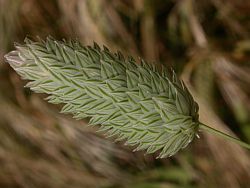
Phalaris is a genus of grasses. Various species of Phalaris grow on every continent except Antarctica. They can be found in a broad range of habitats from below sea level to thousands of feet above sea level and from wet marshy areas to dry places. P. arundinacea and P. aquatica are sometimes invasive species in wetlands, whereas the Portuguese, Phalaris brachystachys is an annual grass with growth habits and cultural requirements similar to Phalaris aquatica. It grows most actively during the spring and fall, while resting during the heat of midsummer and the short cool days of winter.

P.brachystachys (wildtype):
image001b.jpg

Reported DMT content: ~1-3%
This, to me looks like the most promising of all the DMT-containing Phalaris species. I have found that if you give it a decent amount of nutrients, without giving it root burn, it will grow much faster in full sun, as long as you keep the soil wet, I suggest auto-irrigation. A good method is to buy seeds online, then germinate them in a Styrofoam box with a little bit of potting soil. Once they germinate, you can carefully transfer the seedlings to your garden or hydroponic patch.
It took mine about half a year to reach reasonable harvest maturity, but when kept healthy you can virtually harvest a new batch every week.(Depending on climate and amount of sun, ofcourse)

aug003.jpg

So once the plants start to mature, their leaves grow incredibly quick, be careful when you put these in the ground, they can get out of control very quickly and invade into the local habitat. ;-D
From a weeks regrowth i was able to fill a pint-balljar with fresh leaf, and some vinegar+methylated spirits (ethyanol) and got this amount of DMT from the extaction. (Weights coming soon)
imag0140z.jpg

I figured out one day, that if you replaced a small urban backyard's grass with phalaris, you would technically have enough regrowth to extract 10g of dmt per week. O_o Why isn't anyone growing this??

Phalaris arundinacea 'Big Medicine' Plant:
From the Entheogen Review Vol. XI 2002:-
This is my newest release that I have been working on for the last few years. I call it "Big Medicine". This is a tall fast-growing Phalaris species which contains DMT. It has been selected to be spread by root cuttings, and thus bypasses the genetic rearrangement which would result from relaying seed dissemination.

Phalaris arundinacea 'Turkey Red' Plant:
From the Entheogen Review Vol. XI 2002:-
My old, "Turkey red," was selected to produce 5-MeO-DMT because this is the alkaloid that I personally prefer for my own work and the work I do with groups around the country. I feel 5-MeO-DMT most closely mimics the natural enlightenment state of a fully functioning pineal-gland. It does not distract one with visuals, but open one's energy field and dissolves the energetic barriers between people. By taking about 75mg of the "Turkey red" extract - equivalent to about 7.5mg of 5-MeO-DMT - potentiated with a RIMA such as Syrian Rue, one can experience much healing, and in the right group, a unification of consciousness within the group. I believe this medicine has a role to play in the next stage of evolution, which must involve some form of group consciousness.
There are about five other alkaloids in Turkey red aswell. I do not know what most of them are. I have tried to experiment of separating out just the 5-MeO-DMT and taking that orally with a MAOI, and I do get and effect, comparable to that of chemically produced pharmahuasca from synthesised 5-MeO-DMT. However, It does not have the magical shamanic effect I like to use for my group use. I have about a thousand TLC plates of my tests, each with its own unique and different alkaloid mixture. This could keep graduate students busy for years elucidating the unique healing properties of these mixtures


Some other notes on Phalaris:
Essentially one could plant a 1000 seedlings and germinate, Then do a thin layer chromatography (TLC) on them to determine their alkaloid profile. It has been found the most seed sources produce quite varied profiles within the seed source, suggesting that the genetic determination of alkaloid production was not uniform within the population.

Once a clean, relatively reliable source has been established and spread around, it is then possible to use a weatgrass juicer, to gain the dmt fluid from the grass. No need to have do an extraction. With a pre-dose of MAOI, and the right strain of P.brachy you could just take a teaspoon and stay in hyperspace for a few hours.

Phalaris alkaloids increase significantly when stressed with wind, cold, heat, sunlight, darkness, nutrients (nitrogen), etc, also the plant alkaloids tripple at sunset and sunrise, therefore it is essential to harvest at these times.

Also, if any of our lovely lab-friends had the means we could look into the biochemical pathways of how the DMT is produced in these plants, and see if it is possible to genetically manipulate those bottle necks which contol the production of DMT in Phalaris.


to be continued.

Hey there. My first time being on here. You obviously have better knowledge about this. I've tried to do research but it's hard to find good information. It was my understanding up until right now that Reed Canary Grass was the only dmt containing Phalaris. I did read a report that came out from Texas A&M on Reed Canary. They found believe 5 alkaloids. One being DMT. then something that surprised me and Texas A&M . They found methamphetamine.
I'll look for this research paper. I think I might have it saved on my phone. But I'll look for it.
 
Back
Top Bottom