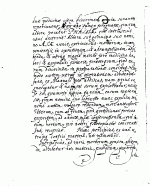
Here is a similar text to the one im working on its in english for those intersted.
Basilius Valentinus, Monk, of the Order of St. BENNET: His last WILL and TESTAMENT.

www.alchemy-texts.com
Here are the sections discussing PHALAIA , and ASA
“PHALAIA is the Universal Medicine to be used inwardly, and ASA is the Universal remedy for outward uses: it put fieth mans bloud, taketh away all impurity, strengthneth the brain, heart, stomack, and all other parts, causeth good bloud, strengthneth the memory, repaireth the d•fects, which are befall'n the three prin∣ciples, restore•h all lost things: it is the very Key, where∣by the body is opened: for it chaseth away Leprosie, Drop∣sie, Consumptions, Gout, and all other diseases general∣ly; for no sinfull Creature is fall'n so totally, but she may have a com•••t unto salvation in a spiritual way, and a Me∣dicine unto health, appointed thereunto by the Creator, which is had if nature be anatomized by an expert Artist, to be prepared for that use.”
“But of my PHALAIA I say thus much, according to my long experience, that nothing can conceal, or hide it self from her, being a penetrating searcher into all in∣firmities, she penetrateth the body spiritually like a fume, penetrateth the Arteries, Muscles, and all the parts of the body like a Balsam, restoreth strength which was lost by her Salt spirit. Further, I cannot speak in the praising of my PHALAIA, she being a praise to such that make use of her. He that getteth this PHALAIA tightly, to him is she sufficient for to cure all dis∣eases. No tongue is able to expresse, and set forth fully her vertues.”
“ASA is found in ye operation, for external Symptoms, as old Ulcers, Fistulaes, Cancers, which made many Chirur∣gians doubt whether ever they may be cured; but this ASA hath made the cure: it consumeth all bad bloud, which was fall'n into corruption, and may be inwardly used, because it will then exiccate, and dry up the foun∣tains, from whence spring all manner of Sores, Fistulaes, Cancers, Wolves, noli me tangere, running Legs, Worms, and the like, be it on what part of the body, where Plai∣sters, Pultesses, and the like cannot help, and are not strong enough, this alone will do it. For fresh wounds, be they made by stobbing, cutting, slashing, it needs not to be administred, being too strong for such wounds, gentler means are fitter for them; Balsams, Oyls, Plaisters, may heal•nes•, either outwardly, or inwardly; Powders and potions may be prepared. Symptomes in wounds, ha∣ving their causes from within, must be cured by searching into them, and the means for their cure must be prepared of that strength, that they may reach home”
“Be thankfull next God to me, that hath taught you in∣ward and outward Medicines, and are such, which others before me have concealed, they can cure fundamentally any Symptomes, be they within, or without on the body, such vertues are not found in Out-landish woods, drugs, or herbs: Forrainers have their proper climates, under which they have convenient Physical Vegetables: our climate af∣fords unto us proper Medicinal Vegetables, Animals, and Minerals for our constitution; onely Doctors are not ex∣pert to make their Medicinal preparations out of them. I hold with my Physick PHALAIA and ASA of one name in their descent, whereby nature hath made me to be a Physician; it keepeth good to the last, preserveth man in health and strength all the time the Creator hath appointed for him: vertue it hath shewed triumphantly in many parties, obtaining victory against all its enemies, and it was apparent to the world, that these two Medicines PHALAIA and ASA of one kinde, and of one mat∣ter made and prepared: and it is found dayly, that in the generality they can set all into a perfect degree, as being descended from the Center, can preserve the Center as the Root, and can bring things to right within and without, ten∣ding to that end, for which it is prepared.
Thus I wish the Reader, to whom I f•ithfully intimate the Manuals of it, prosperity and successe in the prepara∣tion of it, that it may be unto his health: the work will praise the Master, upon Oath I further inform you t us, that four things are required to make a perfect Philosopher and true Physician”