• Members of the previous forum can retrieve their temporary password here, (login and check your PM).

Pictorial Guide to Caapi Vine Alkaloid Extraction

Migrated topic.
It's mentioned elsewhere but I've found that you will have more impurities in your end product if you use sodium carbonate as a base rather than lye, for whatever reason. So if you are after a clean/pure product I suggest using lye.

cheers
 
Enoon, do you know why lye yeilds a cleaner product? This was done more to test the potency of the vine rather than to produce an ultra-pure product. It may be better with caapi to stick with sodium carbonate anyway, though, an yeild a more food-grade, but less pure product. With caapi, correct me if I'm wrong, but impurities in the product aren't as big of an issue as it is with toxin-rich syrian rue. Either way, I'm happy with the result. It went pretty much exactly like the tek.
 
Thanks gibran2 for your advice. I let it sit for a couple of hours but there was no precipation, so i threw it away. I blame a failed THP extraction for this. I don't support this method any longer. Enoons recent data seems to support that. It's at least a very bad idea to re-run the same water over and over through the percolator. I don't know why.

I also finished extracting from another batch. Final yield was 330mg from 50g source material.
It was a pain to to several washes and seperating the layers with a 10ml syringe. While washing the leftover stuff, i found out that you can just do one big wash with 1L to get the PH down just as efficiently. The Big wash extract also yielded a more white powder.
 
obliguhl said:
...It was a pain to to several washes and seperating the layers with a 10ml syringe. While washing the leftover stuff, i found out that you can just do one big wash with 1L to get the PH down just as efficiently. The Big wash extract also yielded a more white powder.
That’s a good point – the number of washes depends on the volume of your container. Bigger volume = fewer washes.
 
Tribal, I can't explain the mechanism, but I can tell you what I've observed. With sodium carbonate you get really big clumps of harmalas that almost look like a coaculation. They take a long time to settle and even when they do they take up a lot of space meaning there's still a lot of water and coloring trapped in these clumps. With lye the precipitates are very fine, like dust. They also take quite a while to fully settle out of the solution but when they do they are white rather than brownish. Being so fine they don't seem to trap any of the unwanted stuff.
If you get food-grade lye I don't see the problem with using it. The thing is with a pure product you really know how much you are taking. With an impure it's just guesswork and it can vary from extraction to extraction. That's why I'd always go for the purest feasible extract.
 
Enoon said:
If you get food-grade lye I don't see the problem with using it.

It's still a dangerous base. "Food grade" is actually one of the most deceiving labels since people think "since it's food grade, it's OK to eat/touch".

SODIUM HYDROXIDE
A.C.S. Reagent Special
Item No. S1300
Minimum purity: 98%
MAXIMUM LIMITS
Carbonate: 0.5%
Sodium Chloride:0.005%
Nitrogen Compounds: 0.001%
Phosphate: 0.001%
Sulfate: 0.003%
Ammonium Hydroxide: 0.02%
Heavy Metals: 0.002%
Iron: 0.001%
Mercury: 0.1 parts per million
Nickel: 0.001%
Potassium: 0.02%

SODIUM HYDROXIDE
F.C.C. (Food Chemical Codex)
Also known as "food grade lye"
Item No. S1303
ASSAY: 95.0 ~ 100.5%
MAXIMUM LIMITS
Carbonate: 3.0%
Arsenic: 3 mg per Kg
Heavy Metals (as Pb): 0.002%
Lead: 10 mg per Kg
Mercury: 0.1 parts per million

SODIUM HYDROXIDE
NF - Pharmaceutical Grade
NF = National Formulary
Item No. SO170
ASSAY: 95.0 ~ 100.5%
MAXIMUM LIMITS
Insoluble Matter: To pass
NF Organic Matter: To pass NF
Potassium: To pass NF
Heavy Metals 0.003%

Source:http://www.vgdusa.com/saleitems.htm
FCC entry: NaOH
 
What is the issue, Shaolin? Food grade wont make it less caustic but it will certainly mean that if small traces are present, they wont be toxic. I know NaOH is used in plenty of food products, but of course the pH of these products isnt high, its just traces that might remain.

Also, what about simply doing a first NaOH precipitation, then redissolving in acidified water and re-precipitating with food-safe sodium carb? this way you make sure there are no lye traces but you still get the advantage of having it clean because the first precipitation will already get rid of your clumping and colouring impurities
 
I don't see your point. of course you don't go drinking it. but if trace amounts stay in your product you won't be poisoning yourself with this, say due to heavy metal contams. 0.002% is good enough for me... I'm sure the foods we buy in the stores have about the same. This is all that food-grade implies. it doesn't mean you're supposed to throw it down the hatch and nom nom nom on it.
It means you can use it for food production, and if you do it right, your food won't be poisonous. that's what foodsafe is. otherwise it would say *edible*... or some other word with the same meaning.
 
endlessness: One reason why should one obtain food grade lye insted of "lab grade". Data wise. 0.003 vs 0.002 heavy metal content ? My point would be that I dislike using the label "food grade" since , to me, it implies "safe" which NaOH per se, isn't. Could be just my understanding though.

Enoon: Good point on the "edible".
 
great idea endlessness! Though personally I'm not worried about my product containing trace amounts of lye. I wash it well and so far my mouth has not been chemically burned... so I think I'm good
 
just want to say that this tek is great, and will produce quite clean alks--thanks gibran2

the first time i tried it, i wanted to use sodium carb. when i added it, i immediately got massive precipitation, but like stated above, the precips took up a lot of room in the jar, and were really clumpy. so i decided to stir, or shake, and ended up putting the alks into 'suspended animation'. that is to say they were still visible, but were evenly distributed, and would not re-settle. \
so i got out the trusty KOH, and spiked the ph to get them to fall back out.

so just a caution, if you use sodium carb, dont shake the jar!

btw, i use KOH instead of NaOH. i am actually quite puzzled why more folks dont use it.
it is available food/usp grade
it comes in flake form, and i find it "safer" to use, that is to say, i have no problem picking up flakes with bare hands.
i am very sensitive to things like that, and lye gives me the shivers. one speck of lye on the skin burns!

 
Shaolin said:
endlessness: One reason why should one obtain food grade lye insted of "lab grade". Data wise. 0.003 vs 0.002 heavy metal content ? My point would be that I dislike using the label "food grade" since , to me, it implies "safe" which NaOH per se, isn't. Could be just my understanding though.

Enoon: Good point on the "edible".

Shao, not everybody has choice acs grade vs food grade, some people might have the choice of industrial grade vs food grade (or no choice at all but rather just industrial/non-certified hardware store lye) and then the amount of heavy metals and other toxic impurities might be much larger.

Where I live lye is used a lot for food manufacture and things such as conserving olives, so they sell it cheap and food grade in the supermarkets.. I dont know how much I would be willing to consume a product precipitated out of lye water if I didnt have food grade lye. I guess I would at least do a redissolution and reprecipitation with food grade sodium carb.

and btw, if anybody thought 'food grade' sounds like one can just eat a spoonful without ill effects, well, they should research because that is definitely not what it means ;). Enoon already explained it pretty clearly what it is. I mean, we're not inventing a new misleading term here, this is a pretty established category in the food/pharmaceutical/chemical industry. Do you think we should add something to the FAQ or Health and Safety section related to this?
 
Let’s not let the heavy metal fears get out of hand.

Let’s say you have some lye with 0.003% heavy metal contamination. That’s 30ppm.
When you add the lye to water, you are diluting it. Let’s say we add 5g of lye to 500ml water – the lye is diluted by a factor of roughly 100, so now its concentration is 0.3ppm.

If the cleaning procedure is properly followed (four rinses, each of which removes 80% of the solution), then at most 0.16% of the original contaminants will remain, so now we are at about 4.8ppb contaminants.

Heavy metal limits in food additives are in the 1mg/kg range (1ppm, over 200 times as high as 4.8ppb), so you can be certain that you are consuming heavy metals every day (via food, water, and air) in excess of what is in your caapi alkaloids!
 
Hey gibran2, thanks for the very nice write up. If one were to use powdered caapi, instead of waiting for the liquid to settle, why not pour through a wet standard coffee filter then simply return the sediment caught in the filter to the pot for future boils?
 
lorentz5 said:
Hey gibran2, thanks for the very nice write up. If one were to use powdered caapi, instead of waiting for the liquid to settle, why not pour through a wet standard coffee filter then simply return the sediment caught in the filter to the pot for future boils?
I’ve never used powdered caapi, but I don’t see why your technique wouldn’t work. Let us know how it goes, yield, etc.
 
Thanks for the inspiring work, gibran2. I finally finished my lazy lazy extraction of some vine tea I've been sipping on and and got nice results:

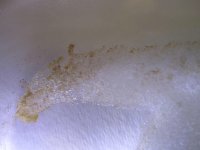
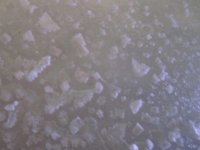
~50gms maya cielo vine tea, basified with soda carb, washed 4 times, then dissolved in hcl water, then the hcl water evapped. ~6 grams of salts, which is very heavy, but I didnt filter the redissolved acid water... I don't mind eating some extra salt. I will assay soon and see how the experience compares to an equivalent cup of the original tea.

pics!:
 

Attachments

  • harmal.jpg
    harmal.jpg
    90.1 KB · Views: 0
  • impure.jpg
    impure.jpg
    75.1 KB · Views: 0
  • pure.jpg
    pure.jpg
    66.2 KB · Views: 0
bnd said:
really does not matter to boil? In all ayahuasca recipe says it should not boil
Boiling a caapi brew does not seem to degrade harmalas or affect yield. Many ayahuasca recipes also say to boil for 9+ hours, which is completely unnecessary.
 
bnd said:
...can i use a filter to separate alkaloids from water? instead to wait the precipitate has settled.
Yes, you can filter liquids instead of decanting. I don’t have good equipment for filtering (glass funnel, good quality filter paper, etc.) so I always decant. Takes more time, but uses less equipment.
 
monty p said:
Great tek Gibran, I have 200g of caapi leaf, would this tek work just as well with leaf as bark?
I’ve never tried an extraction from caapi leaves. As long as there aren’t substances present in the leaves that would prevent alkaloids from settling, then I suppose it could work. Any idea how potent leaves are – what percent is alkaloids?
 
Back
Top Bottom