
-
Members of the previous forum can retrieve their temporary password here, (login and check your PM).
You are using an out of date browser. It may not display this or other websites correctly.
You should upgrade or use an alternative browser.
You should upgrade or use an alternative browser.
Psychoactive Lichen!!!...Novel Entheogen needs Research!
- Thread starter SKA
- Start date
Migrated topic.


Entropymancer said:According to Snu Voogelbreinder's Garden of Eden that species, Parmelia conspersa (possibly along with other unidentified lichens), was considered "potently magical and sacred by the Pima and Papago of southern Arizona and northwestern New Mexico." It "makes young men go crazy" when mixed with tobacco and smoked, and its effect has been compared to cannabis.
Time for a report on the bioassy of Parmelia Conspersa!
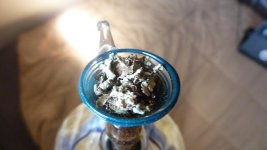
Today I finally loaded up a bong bowl of the pastel greenish/gray lichen and with an open mind, fired it up!
I like the way it tastes. It's a bit harsh, but I take big tokes and hold them in. It gets less harsh every hit that I take, not nearly as bad as tobacco or anything.
I am stoned right now! This stuff DEFINITELY contains some kind of terpenoid
Also, bloodshot eyes noted, with 0 pupil dilation.
If anyone else has access to Parmelia Conspersa, smoke it and report back! This is great!!! It can be found all along the California coast and mountains!
P.s. It seems to kick in harder the longer I wait. I'm slightly inebriated right now just like a good bowl of strong cananbis! I want to find a way to extract and make some kind of lichen hash! This is amazing!!!
P.P.S. My bong stem was clean, no resin on it or anything, only used it once before this! These effects are definitely from the P. Conspersa!
P.P.P.S. Reports on oral activity as well as ISO hash experiment coming soon!
Attachments


Xanthoparmelia in North America. I. The Parmelia conspersa-stenophylla Group on JSTOR
Mason E. Hale, Jr., Xanthoparmelia in North America. I. The Parmelia conspersa-stenophylla Group, Bulletin of the Torrey Botanical Club, Vol. 82, No. 1 (Jan. - Feb., 1955), pp. 9-21
 www.jstor.org
some interesting info on p. conspersa from 1955! if anyone has an account, to get the full paper...

So House, whats the word on the rest of the experience?
Any after effects?
How long did the stoned feeling last?
Make you sleepy?
This is good stuff, I may have a bunch growing around my area as well but I'll wait till I hear back on the full spectrum of the experience before I go smoking fat bowls of the stuff
Thanks for the bioassay!
Any after effects?
How long did the stoned feeling last?
Make you sleepy?
This is good stuff, I may have a bunch growing around my area as well but I'll wait till I hear back on the full spectrum of the experience before I go smoking fat bowls of the stuff
Thanks for the bioassay!


biopsylo said:Xanthoparmelia in North America. I. The Parmelia conspersa-stenophylla Group on JSTOR
Mason E. Hale, Jr., Xanthoparmelia in North America. I. The Parmelia conspersa-stenophylla Group, Bulletin of the Torrey Botanical Club, Vol. 82, No. 1 (Jan. - Feb., 1955), pp. 9-21
some interesting info on p. conspersa from 1955! if anyone has an account, to get the full paper...
Also if anyone has Schultes & Altshcul's Ethnobotany: Evolution of a Discipline, there's an article in there by Frank Lipp that discusses this lichen. I put in a request for the book at my local library a while ago, but the request seems to have been lost.
According to an old book, Lichens by A.L. Smith (1921), salazinic acid has been obtained from the lichen. And more recently Lichens of North America by Brodo et al. (2001) reports that it contains usnic acid, stictic acid, and norstictic acid.
Very interesting report, ۩. You've given this thread some real subtance!

does anyone know the growth range of this lichen?..is it found in the PNW?
archaic_architect said:So House, whats the word on the rest of the experience?
Any after effects?
How long did the stoned feeling last?
Make you sleepy?
This is good stuff, I may have a bunch growing around my area as well but I'll wait till I hear back on the full spectrum of the experience before I go smoking fat bowls of the stuff
Thanks for the bioassay!
Well, keep in mind that I am an individual with unique neurochemistry. Cannabis never makes me sleepy unless I use a lot of it at night time.
I still feel the effects now but they are wearing off. I feel great, very relaxed. Try it yourself.
Link provided below by fractal enchantment said:Xanthoparmelia conspersa [“Peppered rock shield”; syn. Parmelia conspersa]
USES: Medicine (Africa), Dye (Europe)
Xanthoparmelia conspersa has been used in southeastern and eastern Africa to treat snake bite and venereal disease (Brodo et al. 2001). And Xanthoparmelia conspersa was used in England to dye woolens red-brown (Uphof 1959).
Xanthoparmelia conspersa contains usnic, norstictic, and stictic acid (Brodo et al. 2001). This lichen was also found to have some antibiotic properties (Burkholder et al. 1944). A crude extract of Xanthoparmelia conspersa inhibits Bacillus subtilis.
Bet it would be good orally/medicinally with Turkey Tail mushrooms when one is sick...
Fractal's second link said:The chemistry of Xanthoparmelia conspersa is not especially unique. In fact, given the state of Xanthoparmelia taxonomy when these ethobotanical reports were made, the actual species could be any of several: I think all isidiate broad-lobed species were lumped back then. So it could well be X. mexicana, X. amableana, X. plittii, etc. (I see 20 species matching this basic description in the Sonoran Flora.)
All contain usnic acid (a common “sunblock” used by a very broad selection of lichen genera and species) in the cortex. Most contain some stictic acid and related substances and/or salazinic acid – also very common substances in a wide range of lichens – in the medulla. But for the most part, lichenologists only know about substances that show up in TLC, so there could well be additional things.
The report that it grows on both rock and (more rarely) dead wood is very typical of Xanthoparmelia, but I’ve observed that most saxicolous lichens will grow on very weathered old dead wood if given a chance.
I’ve never noticed a strong odor with any desert saxicolous crusts, but then again, I don’t make a habit of grinding up lichens and smoking them! (The only lichens whose odor I’ve noticed are a group of cyanolichens, particularly some Sticta, which smell like fish in excessively damp locations — when decomposing?)
I’m not sure what the description “reddish and white and different colors” might mean. Many lichens will discolor when they die, particularly Parmelia s. str., for example, which will often turn reddish and whitish. I personally suspect the reddish color comes from salazinic acid, which turns very dark red in KOH, so I figure as it breaks down and the salazinic acid is exposed to the environment it might change color if bird droppings or other products of decomposition induce the same color change. Unfortunately, in Arizona (i.e., the desert), Xanthoparmelia just sort of desiccates and turns brown or bleaches out in my experience.
fractal enchantment said:does anyone know the growth range of this lichen?..is it found in the PNW?
Garden of Eden said:"On the sunny side of rocks and rarely on wood, sometimes on tiles; throughout northern US, southward in the mountains (Fink 1935)."
The source he's citing is out of copyright and available for download, but it doesn't provide any more detail:
The Lichen Flora said:"On rocks and rarely on wood, throughout northern United States, and southward in the mountains."
Sounds like it has a pretty broad range and probably occurs throughout the PNW.
found this as well..

Mushroom Observer
Mushroom Observer is a forum where amateur and professional mycologists can come together and celebrate their common passion for mushrooms by discussing and sharing photos of mushroom sightings from around the world.
mushroomobserver.org

Mitakuye Oyasin
Titanium Teammate
That is outstanding House. I'm in Cali a few times a year, perhaps I will have to take a Lichen hike. Very interested in the possibility of making a tea or ethanol extract from this. Keep up the good work and looking forward to further reports and observations.

Thank you House! I found some of what I believe to be Parmelia conspersa or a closely related species, dried it and smoked it, and I agree - this stuff is absolutely active! Relaxed good feeling similar to cannabis, but not quite. Not too potent, and only lasts a few hours top. I've smoked a lot of cannabis the last few days, so I will have to test this lichen again when I don't have cannabis tolerance. Maybe it plays a role. Lichen hash is an excellent idea, looking forward to hear how that works out!
Fractal: The article linked to at Drugs-Forum, for the Collema family, shows that they have extremely low amounts of bufotenine, the highest concentration found was 14.2 μg per 100 g.
Just a heads up everyone, usnic acid is known to be toxic to animals, and liver toxicity has been reported in humans following oral use over long time. Usnic acid has been used as a weight-control-medication.
Fractal: The article linked to at Drugs-Forum, for the Collema family, shows that they have extremely low amounts of bufotenine, the highest concentration found was 14.2 μg per 100 g.
Just a heads up everyone, usnic acid is known to be toxic to animals, and liver toxicity has been reported in humans following oral use over long time. Usnic acid has been used as a weight-control-medication.
Ginkgo said:Just a heads up everyone, usnic acid is known to be toxic to animals, and liver toxicity has been reported in humans following oral use over long time. Usnic acid has been used as a weight-control-medication.
Very good information Ginko, Thank you!
Do we know if Usnic acid is psychoactive or just a toxin?
If it's just in there causing a ruckus maybe it could be removed during the hash making process?
I will only imbibe the lichen on special occasions...like when I make my way to the mountains where it grows. Don't forget your Milk Thistle!
Or maybe we should just mark it as psychoactive and move on :twisted:

Here is some serious lichen pRon:
http://fiveprime.org/hivemind/Tags/lichen,tasmania
This place in Tasmania is called the 'Bay of Fires' thanks to the bright colored lichen. Tasmania would have to be a lichen lovers paradise.
http://fiveprime.org/hivemind/Tags/lichen,tasmania
This place in Tasmania is called the 'Bay of Fires' thanks to the bright colored lichen. Tasmania would have to be a lichen lovers paradise.

..great work House! thanks..
speaking of 'Novel' ideas and psychedelic Lichens, if anyone hasn't read "The Three Stigmata Of Palmer Eldritch" by P. K. Dick, i highly recommend it..the legendary Palmer Eldritch, first human to live with the indigenous Proxis, from the Proxima Centauri system, returns with a lichen..to the proxis it is like a form of tobacco, but when ingested by humans..well! (bit like high dose salvinorin) ..it threatens to take over from the dominant popular psychedelic called "CanD"..it is marketed as "ChewZ" by a consortium with the slogan "God promises you everlasting life, we deliver!"..one of the most 'entheogenic' novels ever written..
..some further info on psychoactive lichens from Snu Voogenbreinder's Garden Of Eden, some of interest to Canadians..
- a yellow dead-tree lichen in Peru is said by the Lamista to be "associated with a snake, and singing it's icaro is said to act against witchcraft"
- Parmelia conspersa (sacred to the Pima and Papago of s. Arizona and n.w. Mexico), effects described as similar to cannabis;
- Parmelia molliuscula (Canadian Rocky Mountains) local native-americans used as narcotic;
- Parmelia cirrhata & spp. (India) used to prepare drug 'chharila', an Ayurvedic aphrodisiac, analgesic & calmative
- Nephroma articum ('Kidney Lichen', Alaska & w. Canada).."taken as an infusion to give strength to someone in a weakend state.." -
- there are also some reports of a "highly intoxicating lichen-fortefied beer from Siberia and Russia" using Lobaria (or Sticta) pulmonaria, some similar lichens (Sticta, Lobaria) from North America Great Lakes region (growing on maple or hemlock trees) edible, used as a soup or tonic..
- a Dictyonema sp. (related to the lichenised tree fungus used by the Waorani of eastern Equador) contained 3-galactosyldiacylglycerides (glycolipids) [S. Voogenbreinder citing Sassaki et al 1999];
..i can add that similar tree fungi are occasionally inhaled as an 'incense' by indigenous australians for medicinal/inebriating effects [personal comm., + P. Latz Bushfires and Bushtucker]
.
speaking of 'Novel' ideas and psychedelic Lichens, if anyone hasn't read "The Three Stigmata Of Palmer Eldritch" by P. K. Dick, i highly recommend it..the legendary Palmer Eldritch, first human to live with the indigenous Proxis, from the Proxima Centauri system, returns with a lichen..to the proxis it is like a form of tobacco, but when ingested by humans..well! (bit like high dose salvinorin) ..it threatens to take over from the dominant popular psychedelic called "CanD"..it is marketed as "ChewZ" by a consortium with the slogan "God promises you everlasting life, we deliver!"..one of the most 'entheogenic' novels ever written..
..some further info on psychoactive lichens from Snu Voogenbreinder's Garden Of Eden, some of interest to Canadians..
- a yellow dead-tree lichen in Peru is said by the Lamista to be "associated with a snake, and singing it's icaro is said to act against witchcraft"
- Parmelia conspersa (sacred to the Pima and Papago of s. Arizona and n.w. Mexico), effects described as similar to cannabis;
- Parmelia molliuscula (Canadian Rocky Mountains) local native-americans used as narcotic;
- Parmelia cirrhata & spp. (India) used to prepare drug 'chharila', an Ayurvedic aphrodisiac, analgesic & calmative
- Nephroma articum ('Kidney Lichen', Alaska & w. Canada).."taken as an infusion to give strength to someone in a weakend state.." -
- there are also some reports of a "highly intoxicating lichen-fortefied beer from Siberia and Russia" using Lobaria (or Sticta) pulmonaria, some similar lichens (Sticta, Lobaria) from North America Great Lakes region (growing on maple or hemlock trees) edible, used as a soup or tonic..
- a Dictyonema sp. (related to the lichenised tree fungus used by the Waorani of eastern Equador) contained 3-galactosyldiacylglycerides (glycolipids) [S. Voogenbreinder citing Sassaki et al 1999];
..i can add that similar tree fungi are occasionally inhaled as an 'incense' by indigenous australians for medicinal/inebriating effects [personal comm., + P. Latz Bushfires and Bushtucker]
.

SHroomtroll
Rising Star
Lol Parmelia Conspersa is very common in my country i have a hard time accepting this could get me stoned lol.
I will def go out tonight and scrape some of this stuff up and try.
Sounds to good to be true.
I will def go out tonight and scrape some of this stuff up and try.
Sounds to good to be true.
۩ said:Do we know if Usnic acid is psychoactive or just a toxin?
If it's just in there causing a ruckus maybe it could be removed during the hash making process?
In Humboldt county there is a sickness everyone calls the "Humboldt Crud" its some sort of nasty respiratory cold but its very common during the winter.
Usnea a type of lichen that contains mostly usnic acid grows all over there and it is used by some locals to treat the "crud".
So I don't think it is psychoactive, just an antimicrobial.
And toxin in large amounts.
I'd recommend leaving it out of the hash.
Similar threads

- Replies
- 32
- Views
- 1K
- Replies
- 3
- Views
- 385
- Replies
- 5
- Views
- 695


- Replies
- 6
- Views
- 1K
