




It's been a decently long process, this one, and a fairly labor-intensive one too. In this thread I want to share with you how I went about preparing my own blend of rapeh and what my conclusions and main takeaways are, as well as provide some historical context from the perspective of Gesileu Phaspy Ninawa, one of the most legendary rapeh makers in the world, whose blend is my personal favorite.
Ingredients:
Equipment:
Several words of advice:
The mapacho roll came packaged in vacuum and upon taking it out, I realized it wasn't dry at all. In fact, it was very sticky. So I unrolled it and then shredded it into small pieces with my hands:
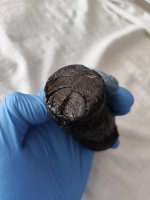
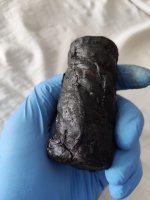
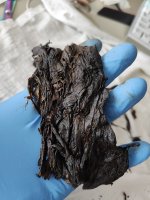
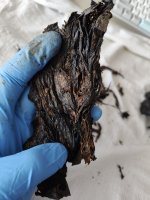
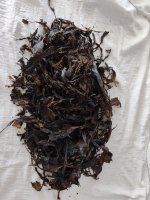
The aroma coming out of it at this point was incredibly intense and potent. To dry it, I put the pieces in a piece of cloth, then loosely tied the top of that cloth and hanged it in front of a table fan and ran it at low speed for approximately 3 days, at which point the pieces were almost bone-dry.
The next step was to turn them into powder. To do this, I bought a mid-range coffee grinder and started blending the tobacco in small batches. 5 blitzes for about 5-10 seconds each, with about 10 second pauses in between so the grinder doesn't overheat, seemed to do a decent enough job. There were some fibers left but I was planning on sifting the ground tobacco through a fine mesh anyway, so I wasn't stressing out about it.
Static charge mitigation: After pulsing, let the grinder rest untouched for 3 minutes so the static charge dissipates and the dust settles. You could also wipe the outside of the grinder with a barely damp microfiber cloth just before opening it to bleed off residual static.
The best particle size for rapeh seems to be about 100 microns, and my thought process led me to buy a roll of 100-micron metal mesh which I turned into a small sieve by taking a plastic supplement container, cutting a hole in the bottom, as well as cutting a hole in the lid itself (but leaving the lid ring intact). Then I placed the mesh on the top and screwed the lid ring on it to clamp it down tight.
The first round of sieving went great and I got extremely fine tobacco dust. But the second round it got clogged badly and no matter what I tried, it wasn't sifting with a rate that I found acceptable. I tried scraping it, I tried putting a metal coin in the sieve so that it would do the scraping for me as I shook it, but nothing worked:
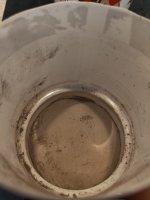
Because of this, I decided I won't be sieving it at all and will instead do as much as I could with the grinder before moving to manual grinding.
At this point I also considered adding some other plants in the mix to experiment. In my case that was Tonka bean as an aromatic additive, as well as dried passionflower for a calming effect. However, Tonka bean is a bit challenging. For one, it contains coumarin, which can cause nausea when insufflated in larger amounts, and because it's so strongly aromatic it can easily overpower your blend, so you have to be really careful with the amount you add.
On top of this, it's very oily, so integrating it properly in the ash takes a specific approach called geometric dilution of lipids. The theory is as follows:
In a glass or ceramic mortar, place your tonka powder and an equal weight of your chosen ash. Grind them aggressively with a pestle until the ash absorbs the oil. Add an amount of ash equal to the mixture in the bowl (doubling the volume) and grind again. Repeat this geometric dilution until the powder is completely dry and light. Record your final Tonka-to-Ash ratio so you can account for this extra ash in your final calculations.
Ultimately, I decided to not add anything to my blend and keep it simple and as close to the indigenous (known) recipes as I can, but you can experiment and see if you can find a combo that works really well.
Once your mapacho is as finely ground as you can make it, the time to create your test batches has come. The first thing you need to decide is the tobacco-ash ratio. I initially tried a 50:50 blend with Tsunu, but it felt a bit too weak, so I bumped it up to 60:40 and proceeded to make 8 separate blends with various ratios between the three ash types:
CST stands for Cumaru-Samauma-Tsunu
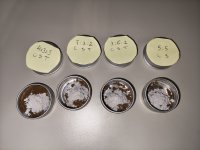
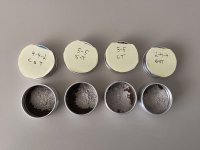
To simplify measurements, I was doing 2 gram batches, so every blend had 1.2g of tobacco and 0.8g of ash. The calculations are not complex, just multiplying 800 * 0.4 which gives you 320mg, or the 4 parts of your 4-4-2 blend. Rinse and repeat until you got all the ash added to each batch, and then you have to incorporate it.
To do this, you add the entire blend to your granite pestle & mortar and you start carefully grinding it. The abrasiveness of the ash will help break down the tobacco further, and if you started off with a 250-micron particle size, it'll most likely drop to about 150 or even less with ~10 minutes of grinding or thereabouts.
Once you're done, seal your test blends, clearly labeling their ratios, and let them cure. It's optimal to leave them for at least one week so that the ashes can alkalize the tobacco and let it be absorbed more easily by your nasal lining, but you can test them as early as the 4th day. Two weeks is basically a full curing cycle and you get the most potent and finished blend.
Once you've tried them all you will find out which one you like the most and that'll be your winner blend. Weigh your remaining tobacco, run the final calculations and repeat the last steps for that blend - mixing, grinding, sealing, curing.
That's it, you're done. Congrats. My tobacco conveniently came out at roughly 60 grams, so I just had to add 40 grams of ash. The blend I chose was the 4-3-3 CST. The resulting roughly 100g of finished rapeh, after curing for 3 full days:
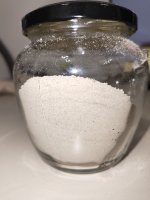
It's definitely not 100-micron fine, but it's fine enough to present absolutely no issues with application and absorption (the dark flecks in the photo are shadows from imperfections in the glass jar).
And now, for my personal takeaways... I read a lot about how the indigenous people make rapeh. All of them put much more emphasis on the spiritual work that goes into preparing this medicine rather than the ingredients themselves. Sure, you need mapacho to make it happen, but it's the prayer that makes the magic happen.
I'll be 100% honest with you all, I found basically no difference between any of the 8 blends I made. The biggest difference was not in them, but in me and my application method. The kuripe I use is a double-barrel (with a really cool Ayahuasca vine insert):
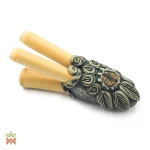
When it works, it works really well - double the hit in half the work. But when it doesn't work, you sometimes get 80% of the rapeh in one sinus and only 20 in the other. Sometimes, because of the more complex inner geometry of this design compared to a single-barrel kuripe, a lot of the rapeh gets stuck at the bottom between the barrels, and you get less than you put in.
Because of this inconsistency, as well as personal differences like being more tired on one day compared to another, or being in a worse mood, or being slightly dehydrated, etc, all of these differences made the blends feel different. But on days where I feel the same, different blends felt the same as well.
I tried praying on the second batch of blends, putting in a lot of love and care and gratitude and all of these ingredients that the indigenous people say are invaluable to making a good rapeh, and I can't say I noticed any difference.
This is 100% on me. These people have had centuries of living in full symbiosis with the rainforest, developing these techniques and strengthening their sacred connection with this medicine. I'm just a city dweller that wanted to imitate but couldn't because I lack this connection. And I'm not saying this in a self-deprecating way, I'm just stating a fact - I would never compare my connection to Nature to an indigenous person that has lived their entire life in the jungle - there is no grounds for comparison.
I still like the blend and appreciate the immense power and wisdom of tobacco, of course. But it's not like Gesileu's blend. Not even close. This has instilled in me a profound, newfound respect for this man and all other indigenous people that make this medicine and give it to the rest of the world.

Upon being asked how someone working with this medicine can earn the respect of others, Gesileu says this:
Furthermore emphasizing on the relationship between the healer and the medicine:
Upon being asked about the spiritual aspect of preparing rapeh, his wise words are as follows:
You can read the full interview between him and Amanda Viana here. I strongly recommend it if you're interested in a deep dive into the historical context of this medicine from his perspective, having a Huni Kuin and Yawanawa background and initiation. Some really wise and fascinating perspectives in there.
In any case, it has become clear to me that what I'm trying to do, while it can be a fun experiment, does not even come close to being the real thing. What I've done is a tobacco snuff. Rapeh is a much more powerful thing, the preparation of which involves a vast amount of spiritual wisdom and a very strong connection to Nature - things I currently don't possess to a degree I would call sufficient. And I can see this translate into the blend I've made.
Once I'm through this blend, I will probably not pursue making my own blends anymore, at least not until I move somewhere much closer to nature, if I ever have the opportunity to do so. And I will continue buying Gesileu's blend because not only does that financially support him and allow him to continue sharing his wonderful medicine with the world, but it also allows me to partake in that medicine, and that's a win-win if I've ever seen one.
This should not discourage you from trying it yourself, of course. Perhaps the tobacco spirits will call upon you much more strongly. Perhaps even you will find your path coincides with theirs, and the light that shines brightest upon you is theirs. Commit to it. Listen to your heart and follow the teachings of the plant spirits. It's a wonderful thing and I deeply admire and respect everyone that has chosen this path, or has been chosen by this path.
And just in case you're wondering about the health risks of ingesting rapeh, you can refer to another thread I made on this topic - A Systematic Review of Cancer Risk From Rapé/Rapeh and Related Nasal Tobacco Blends
Thank you for reading.
May light be upon your path
Ingredients:
- 100g of cured Sabia Mapacho (Nicotiana rustica) from Brazil
- Cumaru (Dipteryx odorata) ashes
- Tsunu (Platycyamus regnellii) ashes
- Samauma (Ceiba pentandra) ashes
- Any other plant additives you want to experiment with, such as Tonka bean or passionflower
Equipment:
- Centigram-level scale (no need for milligram-level really, unless you want to be extremely precise with your measurements for some reason)
- Pestle & mortar
- Coffee grinder
Several words of advice:
- Work in an environment with as low an ambient humidity as possible (mine was 35% average), keeping all bulk materials sealed in glass jars until the moment you need them.
- Eliminate all plastic tools; use only stainless steel spoons and scrapers.
- Ground yourself by touching a metal pipe or radiator before handling the powders, and discharge your tools by tapping them against a grounded metal object before inserting them into the powders.
- Always wear gloves when working with powdered tobacco - it can and will seep through your skin and get absorbed, because that's how nicotine patches work.
- Always wear a tightly fitting face mask when working with finely-powdered tobacco - it flies everywhere and inhaling it is very unpleasant on your respiratory system.
The mapacho roll came packaged in vacuum and upon taking it out, I realized it wasn't dry at all. In fact, it was very sticky. So I unrolled it and then shredded it into small pieces with my hands:
The aroma coming out of it at this point was incredibly intense and potent. To dry it, I put the pieces in a piece of cloth, then loosely tied the top of that cloth and hanged it in front of a table fan and ran it at low speed for approximately 3 days, at which point the pieces were almost bone-dry.
The next step was to turn them into powder. To do this, I bought a mid-range coffee grinder and started blending the tobacco in small batches. 5 blitzes for about 5-10 seconds each, with about 10 second pauses in between so the grinder doesn't overheat, seemed to do a decent enough job. There were some fibers left but I was planning on sifting the ground tobacco through a fine mesh anyway, so I wasn't stressing out about it.
Static charge mitigation: After pulsing, let the grinder rest untouched for 3 minutes so the static charge dissipates and the dust settles. You could also wipe the outside of the grinder with a barely damp microfiber cloth just before opening it to bleed off residual static.
The best particle size for rapeh seems to be about 100 microns, and my thought process led me to buy a roll of 100-micron metal mesh which I turned into a small sieve by taking a plastic supplement container, cutting a hole in the bottom, as well as cutting a hole in the lid itself (but leaving the lid ring intact). Then I placed the mesh on the top and screwed the lid ring on it to clamp it down tight.
The first round of sieving went great and I got extremely fine tobacco dust. But the second round it got clogged badly and no matter what I tried, it wasn't sifting with a rate that I found acceptable. I tried scraping it, I tried putting a metal coin in the sieve so that it would do the scraping for me as I shook it, but nothing worked:
Because of this, I decided I won't be sieving it at all and will instead do as much as I could with the grinder before moving to manual grinding.
At this point I also considered adding some other plants in the mix to experiment. In my case that was Tonka bean as an aromatic additive, as well as dried passionflower for a calming effect. However, Tonka bean is a bit challenging. For one, it contains coumarin, which can cause nausea when insufflated in larger amounts, and because it's so strongly aromatic it can easily overpower your blend, so you have to be really careful with the amount you add.
On top of this, it's very oily, so integrating it properly in the ash takes a specific approach called geometric dilution of lipids. The theory is as follows:
In a glass or ceramic mortar, place your tonka powder and an equal weight of your chosen ash. Grind them aggressively with a pestle until the ash absorbs the oil. Add an amount of ash equal to the mixture in the bowl (doubling the volume) and grind again. Repeat this geometric dilution until the powder is completely dry and light. Record your final Tonka-to-Ash ratio so you can account for this extra ash in your final calculations.
Ultimately, I decided to not add anything to my blend and keep it simple and as close to the indigenous (known) recipes as I can, but you can experiment and see if you can find a combo that works really well.
Once your mapacho is as finely ground as you can make it, the time to create your test batches has come. The first thing you need to decide is the tobacco-ash ratio. I initially tried a 50:50 blend with Tsunu, but it felt a bit too weak, so I bumped it up to 60:40 and proceeded to make 8 separate blends with various ratios between the three ash types:
CST stands for Cumaru-Samauma-Tsunu
- 4-3-3 CST
- 5-3-2 CST
- 3-5-2 CST
- 2-4-4 CST
- 4-4-2 CST
- 5-5 CS
- 5-5 CT
- 5-5 ST
To simplify measurements, I was doing 2 gram batches, so every blend had 1.2g of tobacco and 0.8g of ash. The calculations are not complex, just multiplying 800 * 0.4 which gives you 320mg, or the 4 parts of your 4-4-2 blend. Rinse and repeat until you got all the ash added to each batch, and then you have to incorporate it.
To do this, you add the entire blend to your granite pestle & mortar and you start carefully grinding it. The abrasiveness of the ash will help break down the tobacco further, and if you started off with a 250-micron particle size, it'll most likely drop to about 150 or even less with ~10 minutes of grinding or thereabouts.
Once you're done, seal your test blends, clearly labeling their ratios, and let them cure. It's optimal to leave them for at least one week so that the ashes can alkalize the tobacco and let it be absorbed more easily by your nasal lining, but you can test them as early as the 4th day. Two weeks is basically a full curing cycle and you get the most potent and finished blend.
Once you've tried them all you will find out which one you like the most and that'll be your winner blend. Weigh your remaining tobacco, run the final calculations and repeat the last steps for that blend - mixing, grinding, sealing, curing.
That's it, you're done. Congrats. My tobacco conveniently came out at roughly 60 grams, so I just had to add 40 grams of ash. The blend I chose was the 4-3-3 CST. The resulting roughly 100g of finished rapeh, after curing for 3 full days:
It's definitely not 100-micron fine, but it's fine enough to present absolutely no issues with application and absorption (the dark flecks in the photo are shadows from imperfections in the glass jar).
And now, for my personal takeaways... I read a lot about how the indigenous people make rapeh. All of them put much more emphasis on the spiritual work that goes into preparing this medicine rather than the ingredients themselves. Sure, you need mapacho to make it happen, but it's the prayer that makes the magic happen.
I'll be 100% honest with you all, I found basically no difference between any of the 8 blends I made. The biggest difference was not in them, but in me and my application method. The kuripe I use is a double-barrel (with a really cool Ayahuasca vine insert):
When it works, it works really well - double the hit in half the work. But when it doesn't work, you sometimes get 80% of the rapeh in one sinus and only 20 in the other. Sometimes, because of the more complex inner geometry of this design compared to a single-barrel kuripe, a lot of the rapeh gets stuck at the bottom between the barrels, and you get less than you put in.
Because of this inconsistency, as well as personal differences like being more tired on one day compared to another, or being in a worse mood, or being slightly dehydrated, etc, all of these differences made the blends feel different. But on days where I feel the same, different blends felt the same as well.
I tried praying on the second batch of blends, putting in a lot of love and care and gratitude and all of these ingredients that the indigenous people say are invaluable to making a good rapeh, and I can't say I noticed any difference.
This is 100% on me. These people have had centuries of living in full symbiosis with the rainforest, developing these techniques and strengthening their sacred connection with this medicine. I'm just a city dweller that wanted to imitate but couldn't because I lack this connection. And I'm not saying this in a self-deprecating way, I'm just stating a fact - I would never compare my connection to Nature to an indigenous person that has lived their entire life in the jungle - there is no grounds for comparison.
I still like the blend and appreciate the immense power and wisdom of tobacco, of course. But it's not like Gesileu's blend. Not even close. This has instilled in me a profound, newfound respect for this man and all other indigenous people that make this medicine and give it to the rest of the world.
Upon being asked how someone working with this medicine can earn the respect of others, Gesileu says this:
The main thing is, you have to be fair. To be fair not only with yourself but also with the people around you, with the medicine you are working with, with Mother Nature, with the animals, plants, and every being surrounding you. The moment you are fair with these forces, you have great chances of achieving a higher degree in your interaction with the force of this medicine. It’s no use showing that you are fair merely as a pretense, because some people will perhaps believe you, but the medicine knows that deep inside you are not, and it begins to look at you differently. It will tell you, “You are a liar, so we won’t help you anymore”.
Furthermore emphasizing on the relationship between the healer and the medicine:
...there is no point in saying to the person you have treated: “I have cured you”. This is not fair, since it is the medicines that heal, whereas the human being is only a channel of their power. The expression “I have cured you” comes from the ego of the person: it is an expression of vanity. We must be very careful with such medicines not to be arrogant, not to be seduced by the vanities of the ego. We should rather listen to what the medicines say and how they guide us.
Upon being asked about the spiritual aspect of preparing rapeh, his wise words are as follows:
First you need to ask permission from these beings to do whatever you want or have to do. An opening prayer is uttered, and in that prayer you have to declare your intention of using a certain plant. For example, you can say to the plant you need, “I need you and I want you to help me. I will remove your bark and parts of your branches to crush them into ashes, which I will use to make my rapé, and this rapé will help people who need to be healed”. You can’t just place your hand on the tobacco leaves and rip them out.
When you are producing the medicine, you must pray to it throughout the preparation. It is necessary to invoke the beings of the forest and the energy of healing with the different qualities required for the case: love, peace, happiness, health, abundance, etc. So, you summon these energies and put them inside the rapé. Apart from this, it is essential that you feel well at this moment. If you are sick or if you are angry with someone, it means that you are not fit to prepare rapé. If your soul is full of anguish or your heart is full of sorrow, you are not fit to produce rapé. If you are a person who gets easily irritated, who carries a lot of anger inside and may have a fit of rage for no reason, you are not fit to prepare rapé. Just as when you are on a diet with a plant, you must work on special introspection before embarking on the preparation of rapé. You must forgive those you are angry with and you must ask forgiveness from those you have offended. You must pray and cast all negative feelings out of you. Only when you feel that your heart has been cleansed of these negative energies can you start preparing rapé. If you prepare rapé with negative feelings, you will pass those feelings on to the medicine and, consequently, on to the people you treat. They will be contaminated with these feelings; they will receive your negative feelings and experience them in the same way as you have experienced them. Instead of helping these people, you will harm them.
You can read the full interview between him and Amanda Viana here. I strongly recommend it if you're interested in a deep dive into the historical context of this medicine from his perspective, having a Huni Kuin and Yawanawa background and initiation. Some really wise and fascinating perspectives in there.
In any case, it has become clear to me that what I'm trying to do, while it can be a fun experiment, does not even come close to being the real thing. What I've done is a tobacco snuff. Rapeh is a much more powerful thing, the preparation of which involves a vast amount of spiritual wisdom and a very strong connection to Nature - things I currently don't possess to a degree I would call sufficient. And I can see this translate into the blend I've made.
Once I'm through this blend, I will probably not pursue making my own blends anymore, at least not until I move somewhere much closer to nature, if I ever have the opportunity to do so. And I will continue buying Gesileu's blend because not only does that financially support him and allow him to continue sharing his wonderful medicine with the world, but it also allows me to partake in that medicine, and that's a win-win if I've ever seen one.
This should not discourage you from trying it yourself, of course. Perhaps the tobacco spirits will call upon you much more strongly. Perhaps even you will find your path coincides with theirs, and the light that shines brightest upon you is theirs. Commit to it. Listen to your heart and follow the teachings of the plant spirits. It's a wonderful thing and I deeply admire and respect everyone that has chosen this path, or has been chosen by this path.
And just in case you're wondering about the health risks of ingesting rapeh, you can refer to another thread I made on this topic - A Systematic Review of Cancer Risk From Rapé/Rapeh and Related Nasal Tobacco Blends
Thank you for reading.
May light be upon your path
Last edited:


