• Members of the previous forum can retrieve their temporary password here, (login and check your PM).

Regarding 'oiling out'

Joined
May 21, 2008
Messages
7,238
Merits
676
We've all seen it, a clear (sometimes yellowish/orange) residue that doesn't resolve. It's frustrating. Sometimes it is due to impurities, but often it's simply a supersaturated solution of unresolved polymorphs. I've recently applied a couple effective strategies to resolve it. One involves adding ethyl acetate, with a glass dropper. I add just a few drops, swirl it around, and pour into another clean flask. As it evaporates, it usually leaves behind clear crystals, which are suitable for seeding.
Another effective strategy is adding a small amount of boiling methanol. Since methanol has a lower boiling point and is more polar, it will spontaneously cause dmt freebase to crystallize.

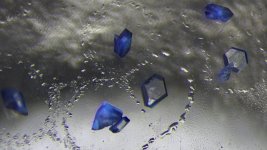
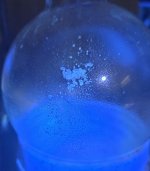
To determine whether or not you may have dimers/polymers in your extract, isolate a small sample and illuminate it with a 365nm blacklight. DMT should glow light blue, dimers will glow orange. This is due to a larger Stokes shift, there are more pi-bonds (double-bonds), so the emission wavelength is longer.
 
Last edited:
Nice so you use ethyl acetate to rinse the crystals and dissolve the oil off them / the dish?

Another effective strategy is adding a small amount of boiling methanol. Since methanol has a lower boiling point and is more polar, it will spontaneously cause dmt freebase to crystallize.
That is really cool. So that doesn't dissolve the oil but forces the oil droplets to solidify? Could be great for people that have a more sticky, waxy product. One boiling methanol wash = dry free-flowing freebase powder?

To determine whether or not you may have dimers/polymers in your extract, isolate a small sample and illuminate it with a 365nm blacklight. DMT should glow light blue, dimers will glow orange.
Is this to be done to the wet oil, crystallized oil, or are people getting dimer crystals?
 
There is no oil. what happens is hot methanol dissolves the supersaturated solution of polymorphs, and the solubility drops sharply as it cools/evaporates. It also dissolves in ethyl acetate, but EtOAc has a higher b.p.
Dimers don't tend to crystalize well, if at all. Too much rotatabilty about the alpha and beta carbons on each molecule. The reason I knew I had dimers in the past was because I screened with LCMS. They tend to form when dmt is allowed to sit in high basic solution for too long, and using DCM. I have since switched to EtOAc for pulls.
 
Last edited:
DMT's polymorphic properties are due to its partiallly-rotatable alpha and beta carbons, a feature in common with tryptophan (which allows tryptophan to participate in protein-folding).
So when I say residue, I'm referring to the yellow or amber viscous solution leftover once all the solvent evaporates. It's a mixture of various polymorphs, and the art of crystallization becomes a matter of solvent selection, temperature, and patience.
 
Last edited:
Would Acetone or IPA also work? or does one need EtOAc or MeOH?
they would. Ethanol (absolute) works too.
Even (boiling) deionized water should work, although it should be a really small amount, because it doesn't evap as easily.
These solvents are considerably more polar than dmt, so we're exploiting the property of marginal solubility when hot, to no solubility when cooled/evaporated. Once you've established some crystals, you may proceed with the nonpolar solvent of your choice, to resolve the rest. Those seed crystals provide a stable foundation for more crystal formation around them.
 
Last edited:
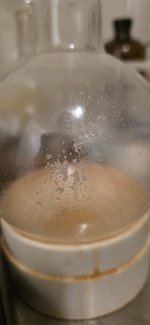
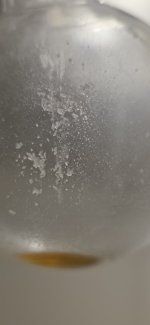
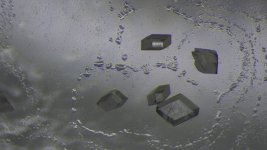
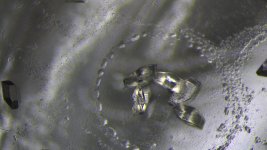
Well this is interesting. I just snapped these. The crystals had been sitting out at room temp, with air in the flask. No discoloration. Boiling methanol seems like a good strategy to get clear crystals. I need to do m.p. tests next.
(That amber liquid is residual methanol. It will leave more crystals as it evaporates).
 

Attachments

  • 1000008241.jpg
    1000008241.jpg
    808.2 KB · Views: 2
  • 1000008245.jpg
    1000008245.jpg
    529.7 KB · Views: 2
  • 1000008242.jpg
    1000008242.jpg
    404.4 KB · Views: 2
Oiling out is very interesting to me. Seems to be a common problem in the pharmaceutical industry, as there's a lot of documented research.


IMG_0288.jpg
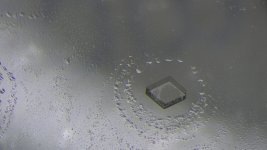
My last recrystallization from heptane featured these rings of oil around the crystals. Pretty fun to imagine how this is happening. Normally I just see an even film of oil. But here there's less near the crystals, then the ring of oil, then a dispersed film beyond the oil ring. Like there's a magnetic field around the crystal. Crystals close enough to have overlapping fields appear to share a distorted ring.

IMG_0287.jpg
Look how the crystal in the center of the other four is smaller. Perhaps its magnetic collection of molecules was shaded by it's neighbor.

IMG_0314.jpg
This bunch seems different too. I think it might be a quintuplet twin rather than five individuals that grew into each other.

Anyway this all happened at room temperature. I did a mini-a/b, while stirring in heptane. Filtered the heptane and sealed it in a jar. Without dropping the temp, a fraction of the solute crystallized out on its own, and the oil oiled out on its own. Idk how I could lower the solubility slower than 0 degrees per hour. Safe to say oiling out is a universal issue. Maybe growing as prisms makes it worse? By having a strong point source attracting molecules vs a dispersed dendrite of crystals?

IMG_0305.jpg
The oil itself didn't really fluoresce.
It reminds me of an asteroid belt in a solar system, or the event horizon of a black hole.

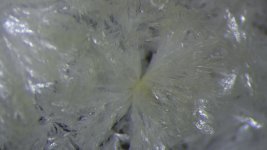
One more thing I've heard about oiling out is that it can cause secondary nucleation, aggregation, and dendritic growth. Think 95% of DMT crystals photographed. All those balls of spikes likely nucleated off of a central oil droplet.
IMG_0299.jpg
 
Last edited:
I gotta admit this was kind of unexpected. The only thing I can think of is the initial evaporation was so rapid, the lattice was instantly locked into a tight formation, analogous to flash/drop forged metal vs cast. I'm guessing these would melt in the high 60s/low 70s. I'm going to try this on some of the orange crystals.

My last batch was done at room temp, with pet ether. The crystals were initially prism-like. But after a few days, they turned yellowish, and were waxy (amorphous solid), the 40s m.p. range. The experience was very smooth and visual at just 11mg. I was in the cartoonish nursery/waiting room. The carpet morphed into a river of alphabet snakes, and my arms looked scaley, reptilian. Pulsar APX Volt is my vessel of choice.
 
Last edited:
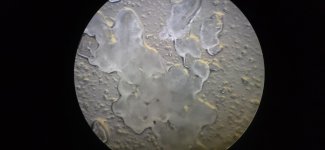
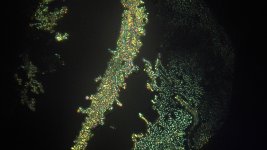
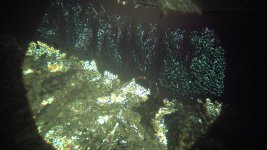
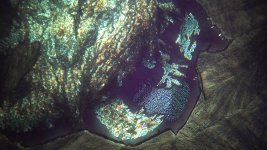
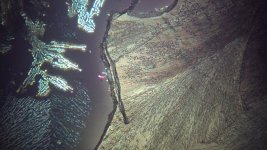
Have you ever melted DMT on a slide and watched it grow? This is a peek through cross polarized light. This was a crazy example but there were oils all over that shrank into smaller units. Notice how the units in this formation are all different colors though. The oil separated and dried into units that had aligned molecules, and those alignments varied from unit to unit. I'm sure polymorphism plays a role in this.
IMG_0026.jpg
And equally cool is when the alignments among units follows a pattern that is larger than the units.
IMG_0025.jpgIMG_0001.jpgIMG_0002.jpg
 
Back
Top Bottom