• Members of the previous forum can retrieve their temporary password here, (login and check your PM).

Research Sceletium alkaloid extraction

Research done by (or for) the DMT-Nexus community

Woolmer

Established member
Joined
Jul 21, 2019
Messages
274
Merits
179
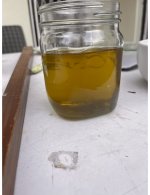
I performed a CIELO-type extraction on 43 g of Sceletium tortuousm with 80 ml water and 13 g CaOH. It was a bit too much water as a tiny amount of water came out in the first pull when I squeezed it with the coffee plunger. The water did not seem to pass through the coffee filter though.

I dumped the citric acid without any stirring and it resulted in a very thick goo. Unfortunately, there was plastic that came loose from the lid of my jar and some probably dissolved into the ethyl acetate. I had to redissolve the product back in water and try to filter the plastic out.

Yield 1.37% mesembrine (and related alkaloids) citrate

I tried to make the benzoate salt by doing a mini A/B with NaOH but struggled to redissolve the freebase back into ethyl acetate or acetone. The bit that did dissolve I salted with by dropping the benzoic acid directly and it made a less waxy but still not crystalline product.

I might try to dissolve some in pg/vg to vape it, though I am a bit wary of the plastic from the lid.

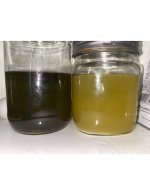
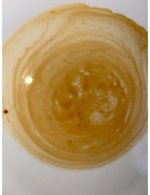
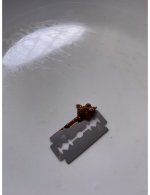
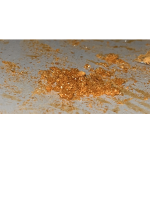
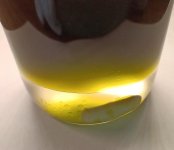
The second picture below is next to a mescaline extraction that I was doing at the same time, right after having added the citric acid. The last picture is the citrate salt.
 

Attachments

  • IMG_40.jpg
    IMG_40.jpg
    297.3 KB · Views: 18
  • IMG_41.jpg
    IMG_41.jpg
    235.1 KB · Views: 13
  • IMG_42.jpg
    IMG_42.jpg
    299.6 KB · Views: 20
  • IMG_43.jpg
    IMG_43.jpg
    232.4 KB · Views: 18
Last edited:
I repeated a second extraction using 50 g S. tortuosum.

75 g water, 13 g CaOH, 5 x EA pulls totaling about 420 g. The amount of water was perfect and none came out when squeezing hard with the French press.

This time I did a fridge rest before salting. Something started precipitating in the fridge so I placed the EA in the freezer. About 30 mg worth of some white precipitate formed. I vaporized a small amount (1~3 mg?) but could not feel effects past placebo. It seems to have a very low boiling point as it vaporizes very quickly on my convection e-mesh setup. It is likely not mesembrine as the literature states mesembrine freebase being a brown oil.

The EA was then salted with citric acid, yielding 550 mg (1.1%) of the alkaloid salt. This time I redissolved the citrate alkaloids into water and then evaporated the water on a plate in the oven at around 60 °C. Interestingly, the resulting extract is very hard to scrape and when scraped small shiny crystals can be seen. Shortly after scraping the extract seems to have picked up water and gone back to a thick syrup texture.

Since the yield came out lower than the first extraction I decided to combine it with the leftover sceletium from the first extraction and do more pulls. I was able to (so far) recover 170 mg more.


I tried playing around with other salts (benzoate and fumarate) but struggled to redissolve the freebase (which I converted using NaOH) into either ethyl acetate or limonene. **I found out recently that NaOH and ethyl acetate should not be combined due to hydrolysis. I have only been able to recover 100 mg of freebase by evaporating the lye solutions and pulling with acetone so I am not sure what has happened to the rest.
 

Attachments

  • IMG_4238.png
    IMG_4238.png
    6.5 MB · Views: 11
Last edited:
I have not gotten around to trying it properly yet. Only vaporized a tiny bit of the crystalline material on e-mesh during the comedown of a bufotenine experience so I could not quite tell the effects :giggle:.

I will try run some TLC plates.
 
I have vaporized a bit more and put small amounts under my tongue. The effect so far has just been a subtle mood boost, but perhaps I just need to up the dose. It's hard to weigh given the stickiness.

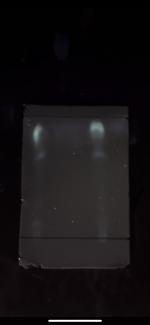
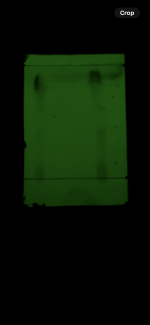
Attached is a TLC plate I ran with DCM:MeOH 3:1. The sample was dissolved in MeOH. The two columns are just two replicates.
 

Attachments

  • IMG_4860.PNG
    IMG_4860.PNG
    2.5 MB · Views: 6
  • IMG_4858.PNG
    IMG_4858.PNG
    1.3 MB · Views: 6
I'm not sure what to make of that TLC. Can you get a commercial standardized extract to compare? If you haven't found Srinivas Patnala's thesis already, then it also has a chapter on TLC (and it's generally excellent).

And I assume that's purchased milled powder? I tried two commercial sources myself, and both yielded around 0.2% mesembrine, by HPLC with commercial extract as my standard. I think that's potentially a significant underestimate, since my standard is ">3%" and public analyses for it show up to double, and I'm giving freebase and you're giving citrate, and mesembrine isn't the only alkaloid. Your yield still seems suspiciously high to me (though such yields are certainly possible; the powders I've bought are weak, but my best plants are well above that.)

I've been extracting twice into acidified water, centrifuging or settling for a few days, filtering, making basic with ammonia, then extracting twice with EtOAc (again with centrifuging or long waiting). I then evaporate off the solvent at 50 C, yielding a yellow oil or wax. I redissolve that in 0.5 M citrate buffer at pH 5.0, around 10 mg/mL mesembrine. I dose 100-200 uL under my tongue, and the euphoria is unmistakable. I'm not particularly happy with this method, since the emulsions are unmanageable without either a centrifuge or extreme patience. Patnala extracted initially with alcohol then evaporated that and redissolved in acidified water, and others also report that solves the problem. I guess the CIELO approach solves that too, but that also pulls the chlorophyll (but if you redissolve in water after evaporating off the solvent then maybe that's fine?).
 
Attached is a TLC plate I ran with DCM:MeOH 3:1. The sample was dissolved in MeOH. The two columns are just two replicates.
It's a good idea to include a standard spot, using something like caffeine, alongside your unknowns. This helps with cross-referencing between different runs, where variations in performance can occur because of variations in real-life conditions [temperature, humidity, ventilation, solvent composition etc.]
 
Woolmer, have you tried to salt the EA directly with fumaric acid?
I've not tried to salt with fumaric acid. Will try if I get a chance.

I'm not sure what to make of that TLC. Can you get a commercial standardized extract to compare? If you haven't found Srinivas Patnala's thesis already, then it also has a chapter on TLC (and it's generally excellent).

And I assume that's purchased milled powder? Your yield still seems suspiciously high to me (though such yields are certainly possible; the powders I've bought are weak, but my best plants are well above that.)
I've now gotten a commercial extract with known quantities of mesembrine, mesembrenone, and delta-7-mesembrenone that I'll use as a reference. I've seen Patnala's thesis but haven't looked into it enough. Yes, it is commercial milled powder.

I am also skeptical of my yield as I've yet to feel anything that's definitely past placebo even when dosing in the low milligrams.

I guess the CIELO approach solves that too, but that also pulls the chlorophyll (but if you redissolve in water after evaporating off the solvent then maybe that's fine?).
The chlorophyll does not crash out when salting the EtOAc anyway though, right?
 
The chlorophyll does not crash out when salting the EtOAc anyway though, right?
I mean if you evaporate the solvent off to recover the alkaloids as freebase, instead of trying to precipitate them as salts. All the methods I've seen in the literature evaporate off, since that pretty much always just works. Precipitation is better when possible since it's selective, faster, etc., but some effort is often required to find a method that yields a cleanly-separable precipitate.

Evaporation is otherwise strictly worse, since it's not selective. But I was thinking that you could extract alkaloids into EtOAc with a CIELO-style method, evaporate off the solvent, then redissolve into acidified water (or buffer) and filter, settle, centrifuge, extract with naphtha, etc. to remove the fats. That said:
  • The solution wouldn't be directly suitable for vaporizing. I believe sublingual or intransal is much more common, though.
  • You might need to dry the EtOAc (like with anhydrous magnesium sulfate) before evaporating to avoid carrying over lime dissolved in the water dissolved in the solvent. I don't usually dry, but I'm using ammonia so excess evaporates. I guess I do carry over some ionic stuff from the plant, but not visibly much.
  • There'd be no opportunity to weigh the product, so you'd be depending entirely on your TLC to judge the dose.
It might be worth the experiment, though. Sceletium is very rewarding to extract, since a small amount of material yields many active doses. The chemotaxonomy is also complex (per my thread), and I believe could be usefully studied by TLC; so I'd highly recommend it to anyone with an interest in plant drugs.
 
I tried this myself, starting with 10 g purchased milled powder in a 50 mL beaker. I added 2 g Ca(OH)2 and sufficient DI water to make a thick paste, stirring with a thin metal spatula. I then added 20 mL ethyl acetate and stirred for about a minute. The powder formed a less cohesive mass than cactus does, but it still separated easily from the solvent. I used a plastic disk cut from a milk bottle to press down (since I don't have a microscale French press) and that worked fine, even with gaps and holes around 4 mm. I repeated this for a total of four pulls. The solvent turned light green, with surprisingly little difference in color between pulls, leaving me concerned that I wasn't mixing enough.

But by HPLC-UV, the four pulls yielded 13.5 mg, 6.7 mg, 1.9 mg, and 0.9 mg mesembrine. Those form something close to an exponential, and the total agrees closely with analytical-scale extractions by sonication of the powder with large volumes of acidifed water or methanol; so I'm pretty sure I've extracted all the mesembrine.

I combined the pulls, dried with sodium sulfate, and filtered easily to remove the sodium sulfate plus a little stray lime and powder. I then extracted the ethyl acetate with 0.15% hydrochloric acid in water three times, about 15 mL per pull. The first two pulls turned quite yellow, and pH rose to 5-6. The third was clear, with pH 1-2. By HPLC, the first two pulls yielded 16.4 mg mesembrine. The third yielded almost nothing, and there was almost nothing remaining in the ethyl acetate.

I evaporated the water to dryness under an air stream on a 55 C water bath, yielding a sticky brown wax. I don't usually weigh the extract (since the beaker is too heavy for my milligram scale), but the amount seemed surprisingly large compared to my previous runs. I redissolved it and transferred to a smaller beaker, yielding 252 mg after re-evaporating. I redissolved that in 1.5 mL of 0.5 M pH 5.0 sodium citrate buffer, yielding a cloudy dark brown liquid. (I typically use that buffer to dissolve freebase alkaloids; for salts a little higher pH would probably be good.) I filtered through a 13 mm 0.45 um syringe filter, which slowed but didn't fully clog, yielding a clear dark brown liquid. By HPLC, this contains 18.2 mg mesembrine. That's not the full expected mass, since mesembrine is only ~half the UV area of the chromatogram, and my mesembrine standard is as freebase and may be an underestimate. It seems like at least half the mass is unaccounted for though, and probably rather more.

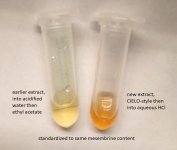
This extract is also a darker brown than my prior extract of the same powder, standardized to the same concentration of mesembrine. So standardized, my new extract has ~1.5x as much suspected epimesembranol (the 13.3 min peak in my current HPLC system; see earlier posts). I hadn't noticed before, but my earlier extraction yielded less suspected epimesembranol than my analytical samples, implying that it wasn't fully extracting that. This may partially account for the color difference, since Patnala reports epimesembranol to be darker in color, though I can't believe that small ratio would make such a difference. When I separated an earlier extract on an SPE cartridge I found at least three yellow components, so it's hard to say much from color. This new extract has a different odor, sweeter and spicier, without the earthy notes (strongly reminiscent of the raw powder) of my previous extract. I dosed 100 uL of the new extract under my tongue, and felt the expected euphoria.

As compared to my previous method starting with extraction into acidified water, there's zero trouble with clogged filters or emulsions, and yield is higher. It's more work, though. The end product also seems less pure, and I have no idea why. I guess fats could have carried over in the ethyl acetate dissolved in the water? But almost everything must have redissolved in the citrate buffer, or else my syringe filter would have clogged. Is the hydrochloric acid pulling something that was insoluble as the citrate before? Some kind of reaction?

Max step-to-step yield is 111%, so my accuracy still isn't great. The major inaccuracy is probably from the liquid volumes (taken from markings on beakers and centrifuge tubes), and the dilution (of 10 uL samples into 1 mL, with a cheap adjustable pipette, drippy with volatile ethyl acetate). That issue aside, the yield seems excellent.

It's possible that the drying was unnecessary. I had trouble before when I used potassium carbonate and didn't dry, with significant carryover into the ethyl acetate. But maybe calcium hydroxide's low solubility in water means that's negligible here? But I'm not sure how that interacts with ionic stuff from the plants. If the drying is necessary, then it would be better to remove some water from the ethyl acetate (brine wash, chill) before using the sodium sulfate, to minimize yield loss in that. I think sodium sulfate is probably the best drying agent; magnesium sulfate is slightly acidic and has slightly lower capacity, potassium hydroxide is dangerous and might hydrolyze the ethyl acetate, and potassium carbonate has lower capacity.

The purity seems like the major problem. I guess precipitation as the citrate didn't work per above. Crystallization seems optimistic given the complex mixture here, so active goo would seem like a success to me; but I think @Woolmer would have perceived if theirs was. Maybe a different acid (acetic?) would work, directly into the ethyl acetate or with water like I did. Or maybe someone with better analytical skills or equipment could figure out what the rest of that mass is, but I'm afraid that's probably GC-MS territory.
 

Attachments

  • mes3-extracts.jpg
    mes3-extracts.jpg
    36.1 KB · Views: 8
I repeated this extraction using higher-quality material that I grew myself. I normally water the plant weekly, and the medium is normally completely dry by the end of that week. To further stress the plant, I stopped watering entirely, harvesting three weeks after my last watering. I believe this drought stress is very important, and primarily explains the ~10:1 variation in alkaloid content that I've observed within the same clone.

I harvested 55 g fresh weight, froze it for storage, and dried it in a glass dish in a toaster oven around 65 C. I powered only the lower element, since I think I've seen scorching from the radiant heat if the plant can see the element. This drying took overnight. The odor was surprisingly intense, not unpleasant but characteristic and medicinal; I should probably have done it outside. I reduced the dried material to a flour-like powder in a coffee mill (the kind with a rotating blade), yielding 7.4 g.

I added 2.5 g Ca(OH)2 and sufficient water to make a stiff paste, about 12 mL. I pulled four times with 20 mL ethyl acetate each, stirring for two minutes each time. Unlike before, the pulls were progressively lighter, the first almost opaque and the last almost colorless. The remaining plant material was also noticeably decolorized. This may be due to the freezing (which lyses the cells), or because I milled my powder finer, or a difference in the plants. The plant material was even less cohesive than my previous Sceletium run, but still cohesive enough to separate easily. I filtered under gravity to remove any stray particles, or careful re-decanting might have worked. I made no attempt to remove water dissolved in the ethyl acetate. For a rough estimate, my 80 mL ethyl acetate dissolve perhaps 2.4 mL water, and 2.4 mL water would dissolve perhaps 1.6 mg calcium hydroxide, which seemed negligible.

I combined the ethyl acetate pulls and extracted twice, each time with 20 mL water plus 4 mL household vinegar. That should be sufficient for (2 pulls)*(4 mL vinegar/pull)*(0.05 g acetic acid / mL vinegar)*(289 g mesembrine / 60 g acetic acid) = 1.9 g mesembrine, a big excess. I chose the vinegar since acetic acid is volatile, same as the hydrochloric acid was, so that excess should evaporate; but since acetates tend to be less water-soluble than chlorides, I hoped less unwanted stuff would get pulled. The milder acid should also decrease the chance of an unwanted reaction. I stirred each pull for at least five minutes, vigorously enough to make a constant swirl of small droplets of mixed solvents. After I stopped, the interface was perfect, with no trace of any emulsion. The boundary between the dark green solvent and lighter water was particularly easily perceived. The first pull was strongly yellow but still transparent, the second pale yellow.

I combined the water pulls and evaporated to dryness under an air stream on an 80 C water bath, yielding 760 mg of yellow resin, lighter in color than my previous attempt. By HPLC, that contained about 205 mg mesembrine. That's relatively less mass unaccounted for than in my previous attempt at this method, though still more than when I extract first into water. The odor was different from before, weaker and vaguely eggy.

I attempted to redissolve this resin in 14 mL water. This failed, yielding a cloudy dispersion with pH around 7 or 8. That seems way too high for mesembrine acetate as a salt, so I'm not sure what happened. Does mesembrine acetate not actually form upon drying? Is there something else basic that requires excess acid to bring pH low enough to keep mesembrine in solution? I adjusted pH to 5 or 6 with 80 mg citric acid, and the solution went clear. I filtered through syringe filters (two 13 mm filters, since the first began to clog; if they're allowed to clog fully then product will be lost). This slightly improved the clarity and removed a few stray particles. I dosed 100 uL sublingually, and felt the expected effects.

From my previous run, I'd expected those two pulls to extract all the mesembrine from my ethyl acetate; but when I tested, I found ~30 mg remaining. I pulled a third time as before, and was surprised to find yellow globs that dissolved in neither the water nor the ethyl acetate, stuck to the stir bar and the sides of the beaker.
mes5-beaker.jpg

I warmed the beaker in a 50 C water bath and scraped with a spatula, and the globs eventually dissolved, leaving the water a transparent pale yellow. I wondered if the problem was temperature, since night had fallen and the room was colder; but the solution remained clear upon chilling in an ice bath. So I can't explain that, but HPLC confirms the mesembrine did go in to the water.

I conclude that:
  • Drying of the ethyl acetate (like I did with sodium sulfate before) is probably unnecessary.
    • I saw no crystalline impurities in the resin or other evidence that ionic stuff had carried over.
    • It's possible that the milligram or so that I syringed-filtered off was calcium salts from the lime, but that was easily removed.
  • Acetic acid seems preferable to hydrochloric. I found nothing on mesembrine acetate in the literature, so I was worried it wouldn't get pulled; but it seems to quite well.
    • Less unwanted stuff seems to get pulled, and excess acid is easily evaporated.
    • I don't understand how the pH ends up so high when I redissolve, but the citric acid solves that.
    • I don't understand what happened in the third pull, but gentle heating put the resin back into solution.
  • The powder that I grew myself is much stronger than the powder that I purchased, >10x. I don't know why. It doesn't seem much harder to grow strong kanna than weak, just good genetics and controlled irrigation.
    • Are some growers just not that sophisticated?
    • Are the weak plants grown outdoors and harvested in rainy weather?
    • Do sophisticated extract makers buy all the good harvests, leaving the dregs to be sold as raw powder?
  • Any extraction involves hazards, but this one seems pretty safe.
    • The only chemicals used are lime, ethyl acetate, vinegar, citric acid, and water.
    • Ethyl acetate is highly flammable, but we evaporate the water and not the solvent. Ventilation is still important, since the water does contain dissolved ethyl acetate, but the fire risk is lower.
    • Overdose may be quite unpleasant and should be avoided, but shouldn't usually result in long-term harm. I've never heard of a fatality, and rat studies showed no adverse effects at 20 mg alkaloids per kg, maybe 500x a normal human dose. Without analytical facilities, I would dose sublingually under the assumption that the weighed product was 100% mesembrine, then double the dose every half hour until I felt the effects.
I again used a plastic disk to separate the solids from the ethyl acetate instead of a French press, and that again worked well. I used a magnetic stirrer when extracting from ethyl acetate into water, and an ultrasonic cleaner to redissolve by sonication. I believe hand-stirring could replace both, though. To evaporate, I used an aquarium air pump and my ultrasonic cleaner's heated water bath. Simpler equipment would be slower but probably just as good, like a fan or a space heater, or just an open dish and patience. I separated liquids using a 10 mL glass syringe with a long blunt needle, tilting the beaker for the last few drops. I weighed my dried product by evaporating it in a weighed beaker and subtracting, since it's too sticky to handle.

I'm happy with this extract. The chromatogram shows quite pure mesembrine (~96% by UV area), since that's what the plant happened to be producing when I harvested. I've seen big variation in the ratio of mesembrine to mesembrenones within the same clone, which I can't yet explain. Commercial products claim different benefits for different ratios, but that's all from anecdote and not always consistent. I'm not sure what I perceive myself.

I believe my previous CIELO-style extract was clearly worse than this one, with weaker mood elevation and sometimes a slight headache the following day. I don't know whether that was the 13.3 min peak (suspected epimesembranol), or the unknown additional substances extracted by the hydrochloric acid, or something else. I'll continue to experiment, though I unfortunately have no plants of my own with the 13.3 min peak. Sceletium tortuosum's gene pool remains diverse and mostly unexplored.
 
Nice work!

To further stress the plant, I stopped watering entirely, harvesting three weeks after my last watering. I believe this drought stress is very important, and primarily explains the ~10:1 variation in alkaloid content that I've observed within the same clone.

Have you seen this paper by Glynwoods (2021)? They propose that mesembrine alkaloids might have a photoprotective effect due to the following reasons: An increase in alkaloid content in summer, accumulation of alkaloids in mature outer leaves, UV quenching abilities in mesembrine, and a speculative relationship to the biosynthetic pathway of betalain pigments that are also important to quench UV.

I've also heard from another researcher that they found alkaloid content tends to increase with altitude (where UV would also be more intense). And I believe there is a paper that found higher alkaloid contents in the Northern Cape where it is hotter, drier, and the UV is more intense.

I could see how drought stress might also be linked to UV stress. If there is no water available to split in the electron transport chain then the energy from photons cannot be consumed in photosynthesis and must be dissipated some other way. Just musings though
 
Have you seen this paper by Glynwoods (2021)? They propose that mesembrine alkaloids might have a photoprotective effect due to the following reasons: [...]
I'd been looking at the tissue culture results in that thesis. I hadn't read Chapter 2 until now. The proposed mechanism is interesting, but seems very speculative to me. Most drugs absorb at UV (thus the popularity of UV detection in analytical chemistry), so that alone doesn't mean much. UV should increase at higher elevations, but water stress will also change and that's known to have a huge effect; so I don't see how that alone could be excluded as the cause.

I grow under LED lights with negligible UV, and my extraction above yielded 32,000 mg mesembrine per kg dry weight. That's ~8000x her average from Chapter 2 (!), so her genotype there looks pretty different. (Maybe that's the predominant wild type; and since hers also contained epimesembranol, maybe that's also similar to my purchased powder? I hate to think I purchased wild-collected material, and I'm glad I have no need to purchase again.)

The kanna that she grew in later chapters (from a commercial nursery, probably selected for alkaloids) was much stronger, though my harvest was still >4x her strongest. I believe my best clone is very close to what Gericke et al. use to produce Zembrin and other commercial extracts, so I feel lucky to have it.

I'd certainly recommend that thesis to anyone with an interest in these drugs. It's got less chemical detail than Patnala's, more botanical. Her practically relevant discoveries include that immediate freezing yields more mesembrine and much more d4-mesembrenone than drying at 50 C, and that the stems contain the highest concentrations.

Returning to the UV question, that could be answered pretty easily by experiment, growing indoors with and without UV lights. Most South African growers (including Glyn-Woods in Chapter 3) seem to use a greenhouse or poly tunnel, which would exclude almost all UV absorbed by mesembrine. That seems like a hint that the benefit of UV is small, or at least much smaller than controlled irrigation.

nice crystals!
I should clarify that nothing crystallized here. When I evaporated the water from the first two pulls, I got an amorphous yellow resin. The third pull resulted in the unexpected precipitate shown above, but that was also amorphous. That's the reason why I extracted the ethyl acetate into water and evaporated, since the resin is difficult to separate from the solvent by filtration (unlike crystals).

Crystallization of mesembrine as the hydrochloride is reported in the literature, but with an unfriendly method, by precipitation from IPA with acidified ether. I may experiment to see if I can find less hazardous conditions, though I think the practical value is limited. Mesembrine is active around 1 mg, which is too little to weigh with typical equipment. So for dosing it's most easily handled as a solution in water, so the solid form doesn't matter much.

This particular extract contains almost no mesembrine alkaloids other than mesembrine itself, so purification by crystallization wouldn't change that profile much (though might separate the additional mystery mass). In general the extracts tend to contain smaller amounts of alkaloids including mesembrenones, which are generally considered beneficial. Those would be depleted by a typical crystallization (assuming all the alkaloid salts have similar solubility), so that may be undesirable. It's possible that mesembrine alkaloids are just best handled as the amorphous resin, similarly to cannabis resin and for similar reasons.

Anyways, I appreciate the nudge from @Woolmer to try this, since it seems to have worked great. I think this method with the acetate is currently the easiest known extraction of alkaloids from Sceletium, and I'd be interested to see results from anyone else who tries it.
 
Just reviewing things here - since this would be a good point to add a link, do you mean your kanna thread, and not some other chemotaxonomy one that I've overlooked?
That's the one. The best references in the literature are doctoral theses by Srinivas Patnala and Christina Glyn-Woods.

The chemotaxonomy of cultivated mature plants might be simpler than I was thinking, since the late-eluting peaks observed at a seedling stage disappeared, and the suspected epimesembranol is (a) perhaps present only in wild types with much less mesembrine than cultivated varieties and (b) probably not a desirable constituent. It still seems greatly underexplored to me, and to be an unusually safe amateur project in both medical and legal terms.
 
Summary: I've extracted more Sceletium using this method, with good yield salting to both the succinate and oxalate but no crystals. I developed a new TLC method eluting with ethyl acetate and heptane, with potentially better separation than the DCM-based systems typically reported. I used that system on a flash column to purify and separate mesembrine from mesembrenone. The two drugs have very similar effect, though either mesembrenone is less nauseating than mesembrine or the chromatography separated an additional unknown nauseating constituent.

Extraction of Crude Alkaloids

I extracted more of my self-grown powder using this CIELO-like technique. I harvested from two clones with different alkaloid profiles, one close to pure mesembrine, one with roughly equal mesembrine and mesembrenone. I mixed 17 g finely powdered plant material with 6 g Ca(OH)2, made a stiff paste (with about 30 g water), and pulled with 4x 45 mL ethyl acetate.

I calculated the theoretical pH of mesembrine oxalate or succinate in 1:1 molar ratio, with a small excess of acid. This is 2.2 for oxalic acid, 4.7 for succinic acid. I then salted by adding 5% acid in water, in increments of 3-4 mL, stirring for at least five minute after each increment, until the water reached the target pH. Some solids precipitated when I added the aqueous acid, especially with the oxalate. I filtered those off, and analysis of the solids showed negligible mesembrine alkaloids.

The volume of acid required was almost 10x as much as expected for the alkaloid content by HPLC. I can't currently explain this. I don't think it's lime carried over in dissolved water due to that low solubility. Perhaps it's another basic ionic compound, but I've never seen crystalline impurities. This is consistent with the larger mass, darker color, and stronger odor and flavor of this STB extract vs. prior A/B extracts starting with acidified water.

Failed Crystallization of Crude Alkaloids

I evaporated the water at 90 C under an air stream. Both formed resins, the oxalate more viscous. I attempted to crystallize by various means with no luck. Whatever the impurities are, they seem to be a great cosolvent for the mesembrine salt. Both crude amorphous salts appeared to be highly soluble in methanol, ethanol, isopropanol, and even acetone. Slow evaporation of the oxalate did result in some crystals, but the crystals weren't mesembrine alkaloids.

Maybe drying at higher temperature or under vacuum would help, but I didn't want to risk the former and I don't have the equipment for the latter. For now I'll probably give up on direct formation of the desired salt, and just use an excess of vinegar since that's quick and the acetic acid is easy to evaporate. The acetate also seems fine to directly consume, just with an unpleasant taste.

TLC Method Development

To inform my eluent choice for flash chromatography, I first did some TLC work. These TLC systems are also useful for analysis, both of the column fractions and more generally (e.g. for plant selection).

Most reported TLC systems for mesembrine use dichloromethane in the eluent. This may be undesirable due to its toxicity and consequent legal restrictions on its sale in some regions. Separation between mesembrine and mesembrenone is also reported to be marginal. Patnala was able to isolate those alkaloids by preparative TLC by scraping the top and bottom of a single unresolved band, but with poor yield since most of the band contained both substances.

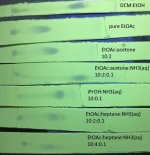
I spotted an extract containing both mesembrine and mesembrenone. I eluted in various solvent systems. I visualized by quenching of the plate fluorescence at 254 nm.
mes8-tlc-systems.jpg

The top plate is Patnala's system for reference, 95:5 DCM:ethanol. Pure ethyl acetate gives a reasonable Rf, but with some tailing. 10:2 EtOAc:acetone is about the same. An additional 0.1 parts concentrated aqueous ammonia maybe improved the tailing. Isopropanol:ammonia 10:0.1 was close to ethyl acetate. EtOAc:n-heptane:ammonia 8:2:0.1 decreased Rf and may begin to show separation of the main spot, while 8:4:0.1 maybe separated a little better. Hexanes or any other similar fraction of alkanes would probably work about the same, but n-heptane is less toxic.

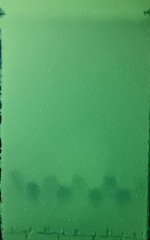
These are low-quality plates and I spotted without much care. Separation is still obvious when alternating fractions (from the flash column below) are spotted:
mes8-tlc-fractions.jpg

It may otherwise be hard to judge though. Improved technique would probably give better separation, like better plates, spotting with a microliter syringe while blowing with a hair dryer, more effort to saturate the air in the developing chamber with eluent, etc. Rf was also unexpectedly low in the plate above, probably because I'd been using the eluent for a couple days and the ethyl acetate evaporates faster.

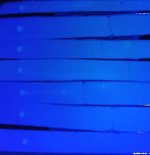
In all of these systems, the mesembrine alkaloids eluted while an additional spot stuck to baseline. That baseline spot was yellow under normal lighting, also visible by natural fluorescence at 395 nm and by quenching at 254 nm.
mes8-tlc-longwave.jpg

The baseline spot eluted near the solvent front in 99:1 methanol:ammonia (not pictured), as did the mesembrine alkaloids with no separation. I don't know what that is, but it probably explains the darker color of the STB vs. A/B extract. Perhaps it's polar enough that it partitions into the larger amount of water in the A/B and gets discarded after the liquid-liquid extraction. (Would an aqueous wash of the ethyl acetate in the STB help? Or filtration through a plug of silica would probably work, though preferably with a weaker eluent than pure ethyl acetate per results below.)

Flash Chromatography

I started with 280 mg of crude alkaloid base found by HPLC to contain about 45 mg each of mesembrine and mesembrenone. From the previous section, I selected 7:3:0.1 EtOAc:heptane:ammonia as my eluent. The water from the ammonia dissolved in the EtOAc:heptane mix, but only with heavy stirring. Triethylamine or ammonia in an organic solvent may be preferable.

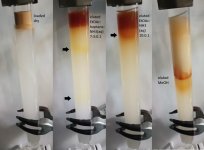
I wet-packed 15 g silica in a 22 x 300 mm glass column. I loaded my alkaloids dry in 2 g additional silica. (I meant to use about half that, but my scale was inaccurate.) I used an aquarium pump to apply 2 psi, and collected 10 mL fractions.
mes8-flash.jpg

Two pale yellow bands moved as I eluted, the first in fraction 4. Its composition is unknown. The second came off near the beginning of the mesembrine alkaloids, around fraction 16, but I think that's an impurity since it seems too yellow. I pooled fractions 17-21 for mesembrine. Fractions 22-24 were hard to interpret by TLC, so I pooled them with the expectation of a mixed extract. I pooled fractions 25-37 for mesembrenone.

Starting with fraction 31, I switched to 10:0.1 EtOAc:ammonia, because it was late and the column was eluting a lot slower than I'd expected. The pure ethyl acetate separated a new yellow band from the baseline, though most of the color still didn't move. I stopped collecting fractions before the new yellow band reached the bottom. I finally switched to methanol, eluting all the color in a single sharp band.

I evaporated each set of pooled fractions, yielding a mass of 67 mg from the mesembrine fraction, 34 mg mixed, 80 mg mesembrenone. The mesembrine was 92% pure by HPLC UV area at 280 nm, the mesembrenone 85%. That means I probably should have put more fractions in the mixed pool, but my TLC wasn't good enough to see that. The mixed pool was 67% mesembrenone, the rest mesembrine. All extracts were faint yellow in color, much lighter than any prior extract at the same alkaloid concentration. The mixed extract was the faintest, suggesting that the color was at least two different impurities, one faster-eluting and one slower.

All purities compared to my standard were less than half that, and I'm not sure why. I used MT55 extract as my standard, and I see from published lab results they're potentially ~double their nominal 3% mesembrine. I should try to crystallize some mesembrine for a better standard. There may also be residual solvent since I'm not drying under vacuum.

Bioassay

I redissolved the extract in water and citric acid for ~10 mg/mL alkaloids and pH around 5. I filtered through a syringe filter to remove slight cloudiness. A single dose is thus around 100 uL, easily measured with a needle-less 1 cc syringe and placed sublingually.

I'd previously consumed very pure mesembrine extracts, from plants with that natural alkaloid profile. I hadn't previously consumed pure mesembrenone, since I have no such plants (and haven't yet seen evidence they exist, thus my interest in chromatographic separation). I therefore tried the mesembrenone fraction first.

The two drugs have extremely similar effects. I'm not confident I could distinguish them blind. The primary benefit of these drugs is the mood elevation over subsequent days, but that's hard to judge without a statistical study. I think the short-term euphoria from the mesembrenone is a possibly stronger, though it still reaches a plateau with increasing dose. That's perhaps a more frivolous benefit, and also what puts these drugs at risk of a ban; but I don't think it's entirely frivolous, for the same reasons MDMA-assisted psychotherapy is studied. In any case, I had a nice evening with my partner.

I've also found this extract less nauseating than the pure mesembrine extracts I've previously consumed. I don't know whether that effect is actually mesembrine vs. mesembrenone, or whether it's the improved purification. I guess I'll find out when I try the mesembrine fraction.

I'll continue to consume these extracts, and see what I can judge. I'll probably run a few more columns, to see if I can improve separation and/or decrease solvent use. I'll also re-attempt crystallization on a larger quantity of the purified drug.

 
Last edited:
Awesome that you are still working with this method. I will give your TLC method a go.

Bit of a side question, do you notice a stronger / more bitter taste in your higher alkaloid clones? Some phenotypes have a very diluted or watery taste, and in my stronger plants, it seems that you can actually taste the alkaloids. I'm wondering whether this is some other bitter compound present by coincidence or whether I am actually tasting the alkaloids. Even if I crush the leaves, it smells quite a bit like the extracts that I made using the CIELO-type extraction.
 
Bit of a side question, do you notice a stronger / more bitter taste in your higher alkaloid clones?
The initial flavor of the extract is reminiscent of the live plant, but the flash column separated most of that for me. What remains is sort of waxy and fruity. After some investigation, I believe that comes not from the plant but from my ethyl acetate, which seems to leave a near-invisible but strongly odorous residue upon evaporation. In future I'll purify the ethyl acetate or change suppliers (or maybe high vacuum would get that off?).

I just tasted fresh leaves from six plants, including both my strongest and a completely inactive clone. They mostly just taste sour to me, I assume from the oxalate, like an insipid, watery rhubarb. So if taste does predict mesembrine alkaloid content for you, then I'd guess it does so indirectly through a different secondary metabolite whose abundance correlates.

I've also tried the purified mesembrine fraction now. I'm pretty confident it's more nauseating than the mesembrenone fraction at a similar dose by mass or HPLC-UV area, most noticeably the following morning, though maybe also with greater long-term mood elevation. It might be less nauseating than the crude alkaloids.
 
Back
Top Bottom