Summary: I've extracted more
Sceletium using this method, with good yield salting to both the succinate and oxalate but no crystals. I developed a new TLC method eluting with ethyl acetate and heptane, with potentially better separation than the DCM-based systems typically reported. I used that system on a flash column to purify and separate mesembrine from mesembrenone. The two drugs have very similar effect, though either mesembrenone is less nauseating than mesembrine or the chromatography separated an additional unknown nauseating constituent.
Extraction of Crude Alkaloids
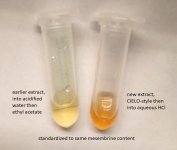
I extracted more of my self-grown powder using this CIELO-like technique. I harvested from two clones with different alkaloid profiles, one close to pure mesembrine, one with roughly equal mesembrine and mesembrenone. I mixed 17 g finely powdered plant material with 6 g Ca(OH)2, made a stiff paste (with about 30 g water), and pulled with 4x 45 mL ethyl acetate.
I calculated the theoretical pH of mesembrine oxalate or succinate in 1:1 molar ratio, with a small excess of acid. This is 2.2 for oxalic acid, 4.7 for succinic acid. I then salted by adding 5% acid in water, in increments of 3-4 mL, stirring for at least five minute after each increment, until the water reached the target pH. Some solids precipitated when I added the aqueous acid, especially with the oxalate. I filtered those off, and analysis of the solids showed negligible mesembrine alkaloids.
The volume of acid required was almost 10x as much as expected for the alkaloid content by HPLC. I can't currently explain this. I don't think it's lime carried over in dissolved water due to that low solubility. Perhaps it's another basic ionic compound, but I've never seen crystalline impurities. This is consistent with the larger mass, darker color, and stronger odor and flavor of this STB extract vs. prior A/B extracts starting with acidified water.
Failed Crystallization of Crude Alkaloids
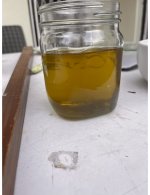
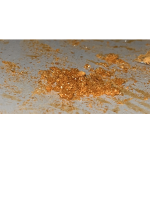
I evaporated the water at 90 C under an air stream. Both formed resins, the oxalate more viscous. I attempted to crystallize by various means with no luck. Whatever the impurities are, they seem to be a great cosolvent for the mesembrine salt. Both crude amorphous salts appeared to be highly soluble in methanol, ethanol, isopropanol, and even acetone. Slow evaporation of the oxalate did result in some crystals, but the crystals weren't mesembrine alkaloids.
Maybe drying at higher temperature or under vacuum would help, but I didn't want to risk the former and I don't have the equipment for the latter. For now I'll probably give up on direct formation of the desired salt, and just use an excess of vinegar since that's quick and the acetic acid is easy to evaporate. The acetate also seems fine to directly consume, just with an unpleasant taste.
TLC Method Development
To inform my eluent choice for flash chromatography, I first did some TLC work. These TLC systems are also useful for analysis, both of the column fractions and more generally (e.g. for plant selection).
Most reported TLC systems for mesembrine use dichloromethane in the eluent. This may be undesirable due to its toxicity and consequent legal restrictions on its sale in some regions. Separation between mesembrine and mesembrenone is also reported to be marginal. Patnala was able to isolate those alkaloids by preparative TLC by scraping the top and bottom of a single unresolved band, but with poor yield since most of the band contained both substances.
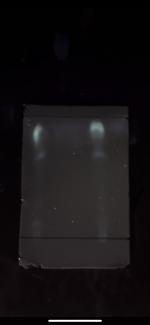
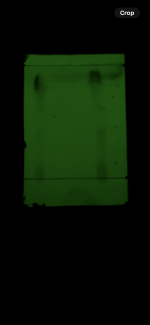
I spotted an extract containing both mesembrine and mesembrenone. I eluted in various solvent systems. I visualized by quenching of the plate fluorescence at 254 nm.
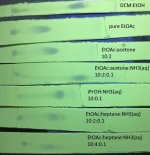
The top plate is Patnala's system for reference, 95:5 DCM:ethanol. Pure ethyl acetate gives a reasonable Rf, but with some tailing. 10:2 EtOAc:acetone is about the same. An additional 0.1 parts concentrated aqueous ammonia maybe improved the tailing. Isopropanol:ammonia 10:0.1 was close to ethyl acetate. EtOAc:n-heptane:ammonia 8:2:0.1 decreased Rf and may begin to show separation of the main spot, while 8:4:0.1 maybe separated a little better. Hexanes or any other similar fraction of alkanes would probably work about the same, but n-heptane is less toxic.
These are low-quality plates and I spotted without much care. Separation is still obvious when alternating fractions (from the flash column below) are spotted:
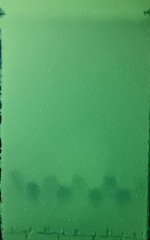
It may otherwise be hard to judge though. Improved technique would probably give better separation, like better plates, spotting with a microliter syringe while blowing with a hair dryer, more effort to saturate the air in the developing chamber with eluent, etc. Rf was also unexpectedly low in the plate above, probably because I'd been using the eluent for a couple days and the ethyl acetate evaporates faster.
In all of these systems, the mesembrine alkaloids eluted while an additional spot stuck to baseline. That baseline spot was yellow under normal lighting, also visible by natural fluorescence at 395 nm and by quenching at 254 nm.
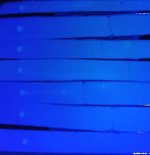
The baseline spot eluted near the solvent front in 99:1 methanol:ammonia (not pictured), as did the mesembrine alkaloids with no separation. I don't know what that is, but it probably explains the darker color of the STB vs. A/B extract. Perhaps it's polar enough that it partitions into the larger amount of water in the A/B and gets discarded after the liquid-liquid extraction. (Would an aqueous wash of the ethyl acetate in the STB help? Or filtration through a plug of silica would probably work, though preferably with a weaker eluent than pure ethyl acetate per results below.)
Flash Chromatography
I started with 280 mg of crude alkaloid base found by HPLC to contain about 45 mg each of mesembrine and mesembrenone. From the previous section, I selected 7:3:0.1 EtOAc:heptane:ammonia as my eluent. The water from the ammonia dissolved in the EtOAc:heptane mix, but only with heavy stirring. Triethylamine or ammonia in an organic solvent may be preferable.
I wet-packed 15 g silica in a 22 x 300 mm glass column. I loaded my alkaloids dry in 2 g additional silica. (I meant to use about half that, but my scale was inaccurate.) I used an aquarium pump to apply 2 psi, and collected 10 mL fractions.
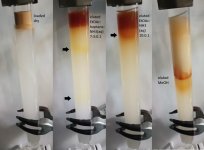
Two pale yellow bands moved as I eluted, the first in fraction 4. Its composition is unknown. The second came off near the beginning of the mesembrine alkaloids, around fraction 16, but I think that's an impurity since it seems too yellow. I pooled fractions 17-21 for mesembrine. Fractions 22-24 were hard to interpret by TLC, so I pooled them with the expectation of a mixed extract. I pooled fractions 25-37 for mesembrenone.
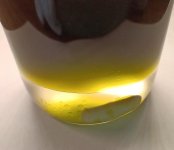
Starting with fraction 31, I switched to 10:0.1 EtOAc:ammonia, because it was late and the column was eluting a lot slower than I'd expected. The pure ethyl acetate separated a new yellow band from the baseline, though most of the color still didn't move. I stopped collecting fractions before the new yellow band reached the bottom. I finally switched to methanol, eluting all the color in a single sharp band.
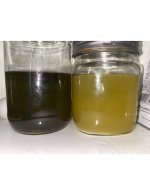
I evaporated each set of pooled fractions, yielding a mass of 67 mg from the mesembrine fraction, 34 mg mixed, 80 mg mesembrenone. The mesembrine was 92% pure by HPLC UV area at 280 nm, the mesembrenone 85%. That means I probably should have put more fractions in the mixed pool, but my TLC wasn't good enough to see that. The mixed pool was 67% mesembrenone, the rest mesembrine. All extracts were faint yellow in color, much lighter than any prior extract at the same alkaloid concentration. The mixed extract was the faintest, suggesting that the color was at least two different impurities, one faster-eluting and one slower.
All purities compared to my standard were less than half that, and I'm not sure why. I used MT55 extract as my standard, and I see from published lab results they're potentially ~double their nominal 3% mesembrine. I should try to crystallize some mesembrine for a better standard. There may also be residual solvent since I'm not drying under vacuum.
Bioassay
I redissolved the extract in water and citric acid for ~10 mg/mL alkaloids and pH around 5. I filtered through a syringe filter to remove slight cloudiness. A single dose is thus around 100 uL, easily measured with a needle-less 1 cc syringe and placed sublingually.
I'd previously consumed very pure mesembrine extracts, from plants with that natural alkaloid profile. I hadn't previously consumed pure mesembrenone, since I have no such plants (and haven't yet seen evidence they exist, thus my interest in chromatographic separation). I therefore tried the mesembrenone fraction first.
The two drugs have extremely similar effects. I'm not confident I could distinguish them blind. The primary benefit of these drugs is the mood elevation over subsequent days, but that's hard to judge without a statistical study. I think the short-term euphoria from the mesembrenone is a possibly stronger, though it still reaches a plateau with increasing dose. That's perhaps a more frivolous benefit, and also what puts these drugs at risk of a ban; but I don't think it's entirely frivolous, for the same reasons MDMA-assisted psychotherapy is studied. In any case, I had a nice evening with my partner.
I've also found this extract less nauseating than the pure mesembrine extracts I've previously consumed. I don't know whether that effect is actually mesembrine vs. mesembrenone, or whether it's the improved purification. I guess I'll find out when I try the mesembrine fraction.
I'll continue to consume these extracts, and see what I can judge. I'll probably run a few more columns, to see if I can improve separation and/or decrease solvent use. I'll also re-attempt crystallization on a larger quantity of the purified drug.







 .
.