
-
Members of the previous forum can retrieve their temporary password here, (login and check your PM).
You are using an out of date browser. It may not display this or other websites correctly.
You should upgrade or use an alternative browser.
You should upgrade or use an alternative browser.
Swims Peganum Harmala Extraction
- Thread starter Phlux-
- Start date
Migrated topic.

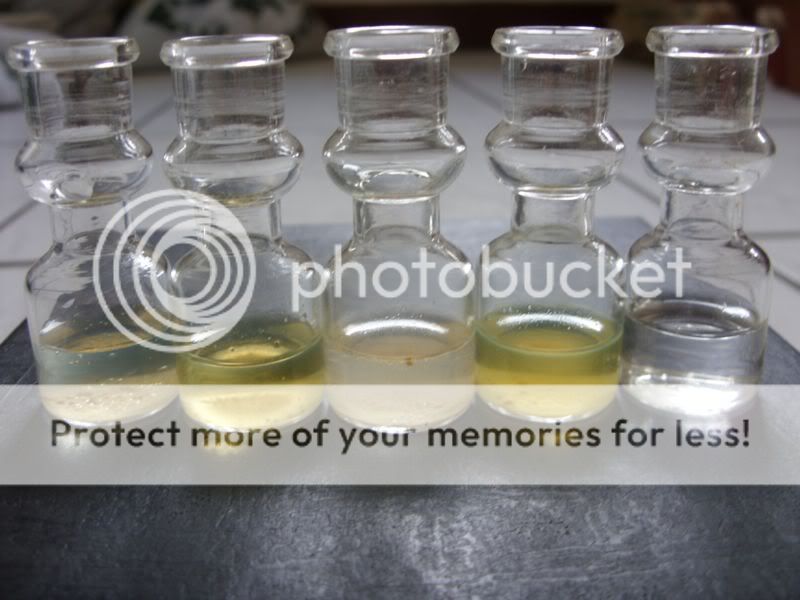
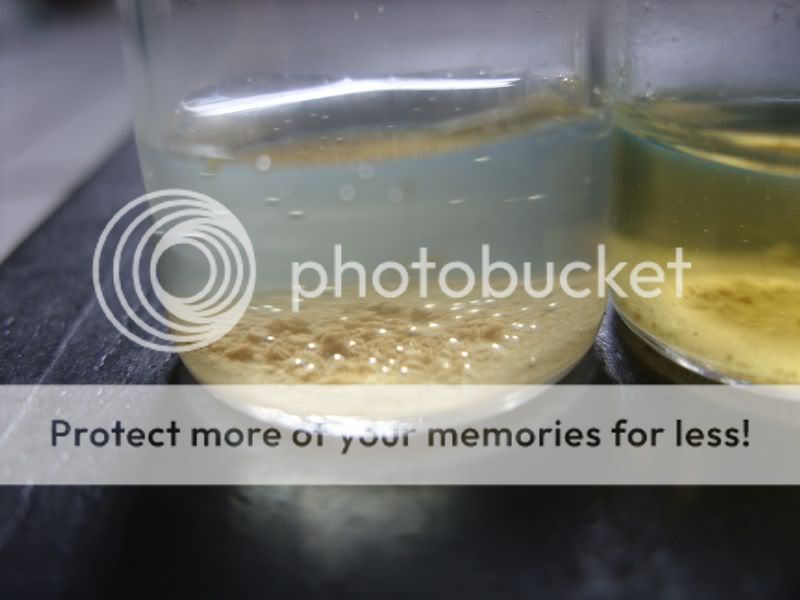
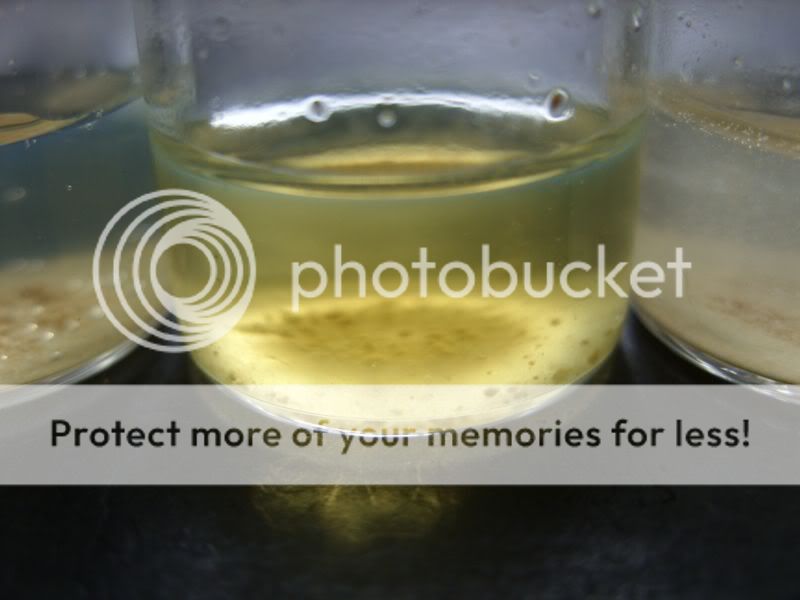
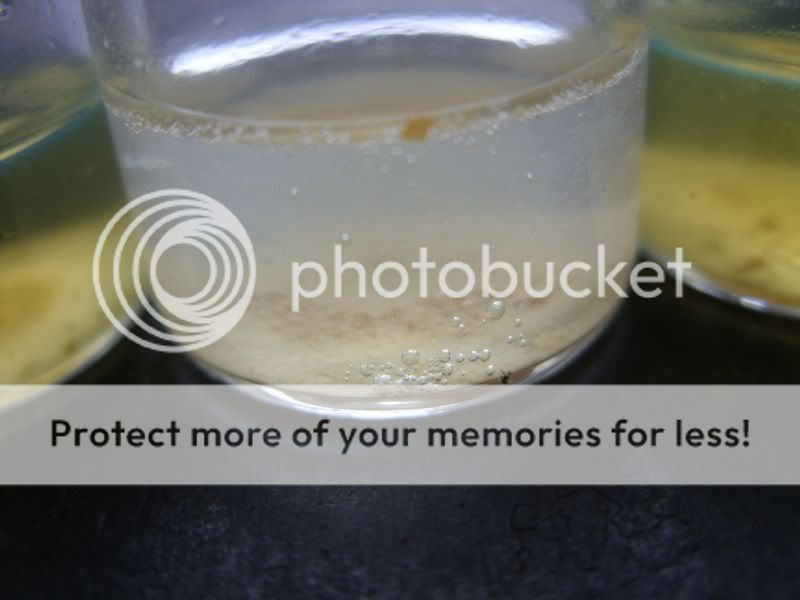
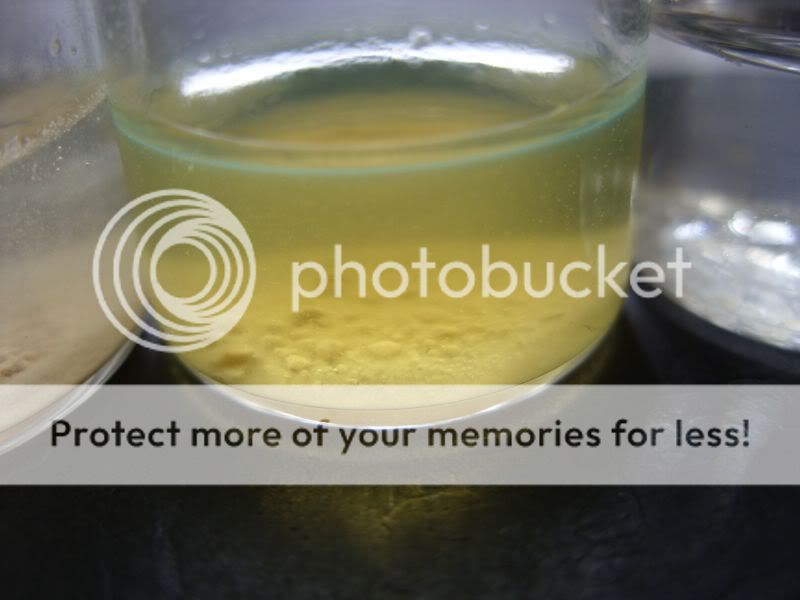
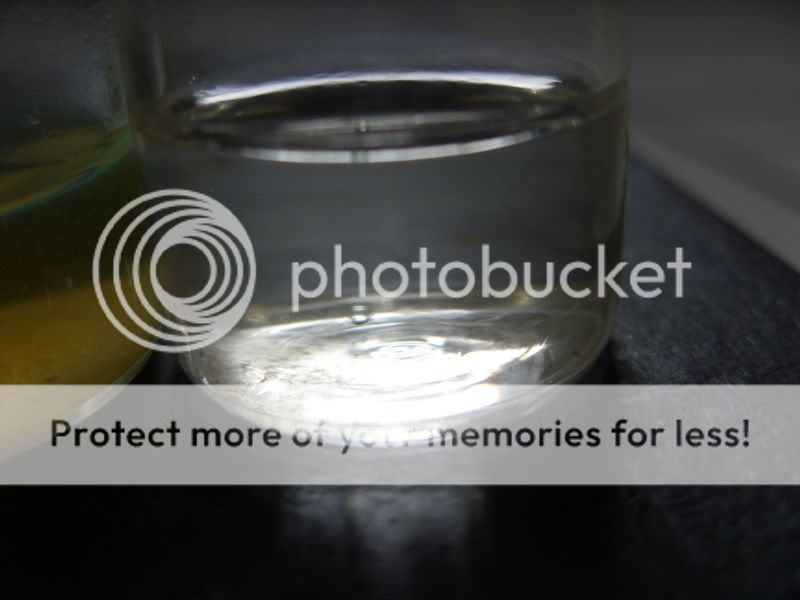

Very nice, so far the IPA ones show the reaction.Its also quite interesting that if you look closely to the photos of the yellowing samples you can notice some fluorescence at the top.
Hmmmm... two options : shake each bottle in a vortex like manner to dissolve it ,or cap the bottles and apply brief heat to all of them (prefferably at the same time) via a waterbath shaking them in the above fashion if needed.
The second method introduces another parametre but usually this just speeds the reaction up (closed bottles so as not to have any evaporation and loss).
Hmmmm... two options : shake each bottle in a vortex like manner to dissolve it ,or cap the bottles and apply brief heat to all of them (prefferably at the same time) via a waterbath shaking them in the above fashion if needed.
The second method introduces another parametre but usually this just speeds the reaction up (closed bottles so as not to have any evaporation and loss).
tried shaking it - il try the hot water bath.
and yeah - there is flourescens in the iso - as usual - that shows a disolved salt i think - perhaps if all else fails il add a drop or 2 of vinegar - should have perhaps used that in the beginning instead of hcl.
and yeah - there is flourescens in the iso - as usual - that shows a disolved salt i think - perhaps if all else fails il add a drop or 2 of vinegar - should have perhaps used that in the beginning instead of hcl.
Any news on outcomes/colors/pictures?
Shameless Bump of a way interesting thread!
Shameless Bump of a way interesting thread!
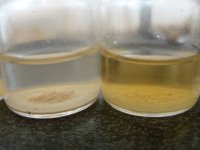

Having read something the other day (will try and locate it) about Harmala Red, it was supposed to be Harmalol that causes the red colour and is easily removed with activated charcoal and heat. There was a method for separating harmine and harmaline from a manske using pyridine as well.
Will post the links when I find them
Will post the links when I find them

It’s my understanding that harmalol being harmala red is just a theory and that the source of harmala red is currently unknown. I’ve seen a couple of different theories about the source of harmala red. None of them have been proven as far as I know.
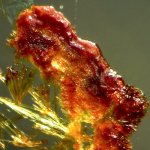
A while ago I posted a picture of pure harmaline turning red. The picture was taken under a microscope. The red was sort of gel-like, and matched many descriptions of harmala red.
It formed after being evaporated in alcohol with the aid of heat.
The test was done ages ago by SWIM, and confirmed, at least for SWIM, that harmala red is oxidized harmaline that forms after evaporation in alcohol with the aid of heat.
Here's that old picture of harmala red forming from harmaline HCl.
A while ago I posted a picture of pure harmaline turning red. The picture was taken under a microscope. The red was sort of gel-like, and matched many descriptions of harmala red.
It formed after being evaporated in alcohol with the aid of heat.
The test was done ages ago by SWIM, and confirmed, at least for SWIM, that harmala red is oxidized harmaline that forms after evaporation in alcohol with the aid of heat.
Here's that old picture of harmala red forming from harmaline HCl.
Attachments
Here is a link to an extraction that uses Ethanol to extract and uses activated charcoal to remove the red. It also mentions the pyridine method for separating the harmala's.
Here is the link to Harmalol being the red dye (near the middle page 136), granted this was being discussed in the 1840's - but its an interesting read all the same.
Also I have never read anywhere that alcohol is an oxidising agent, maybe it acts as a catalyst in some way?
Here is the link to Harmalol being the red dye (near the middle page 136), granted this was being discussed in the 1840's - but its an interesting read all the same.
Also I have never read anywhere that alcohol is an oxidising agent, maybe it acts as a catalyst in some way?
Alcohol is not oxidizing it, but instead forms anhydrous harmaline HCl which is available to attack by oxygen.
Harmaline HCl formed in water is not anhydrous and so the water protects it from being oxidized.
Don't know if that's a fact, but that's how it was explained in the book I read.
Harmaline HCl formed in water is not anhydrous and so the water protects it from being oxidized.
Don't know if that's a fact, but that's how it was explained in the book I read.
Hmmmm well then, the addition of H2O2 will make short work of it either in solution -if the dehydration can happen while in solution- or when it starts drying. Eitherway, we will see how it behaves when dried, so far the alkaloids arent exactly protected against oxidation :d . Ah, how nice it would be if we could have some spectral analysis on Harmala red or at the products of this experiment. From what i see though ,that can prove from difficult to impossible.
I wanted also to comment on the first link geeg30, gives us and please be free to comment on my commentary:
First of all i think i have spotted a mistake :
Second page,near the end and continuing over the the third
This was done in an acetic 5% solution but...exposing it to 650 degrees celcius (1202 F)?!?! There could be a typo there, the solution would evaporate or worse! I think they made a typo there and meant 65 C (149 F). Whats your opinion on that?
Another comment is on text on third page:
Wouldnt dissolving in ethanol (freebase here) turn it to anhydride as 69ron mentioned and make it lent itself to oxidation ? Hmmm I would expect them to see more "harmala red" forming and propably detect "something else" in their apparatus although they didnt seem to do so. I wonder if harmala red indeed forms from peganum harmala but it forms from something else than harmine or harmaline.
Also note that their yield were quite low!
Hmmm, maybe their purity accounts for it given that after a point there are diminishing gains.All in all they found the seeds to contain 1.7% alkaloids? Propably people at forums find they contain more due to less meticulous methods? For example noone would sweat if their alkaloids are 89% clean .Another thought is, if indeed harmala red is formed by harmine and harmaline ,did they loose yield from there? And could carbon selectively pick what is harmala red but not other beta-carbolines?
Hmmm, all in all very interesting!
I wanted also to comment on the first link geeg30, gives us and please be free to comment on my commentary:
First of all i think i have spotted a mistake :
Second page,near the end and continuing over the the third
Then 40g of NaCI was added to this decolorized solution and was kept at 650Co for
30minutes to change the acetates of Harmine and harmaline into their hydrochloride
This was done in an acetic 5% solution but...exposing it to 650 degrees celcius (1202 F)?!?! There could be a typo there, the solution would evaporate or worse! I think they made a typo there and meant 65 C (149 F). Whats your opinion on that?
Another comment is on text on third page:
Pyridine insoluble Harmaline was collected and dissolved in EtOH and recrystallized. Both bases were further purified by recrystallization of their hydrochlorides. Their Rf values, melting points, UV and IR values were determined.
Wouldnt dissolving in ethanol (freebase here) turn it to anhydride as 69ron mentioned and make it lent itself to oxidation ? Hmmm I would expect them to see more "harmala red" forming and propably detect "something else" in their apparatus although they didnt seem to do so. I wonder if harmala red indeed forms from peganum harmala but it forms from something else than harmine or harmaline.
Also note that their yield were quite low!
Harman alkaloids (Harmine and Harmaline) were isolated by complexation with
mercuric ions (Hg++) with high selectivity and fairly good yields, 0.2 % Harmine
and 1.5 % Harmaline per total weight of Peganum harmala seeds (reported
values 0.8 % and 1.7 %), respectively. Purity of the complexes was checked by
TLC, both gave a single spot.
Hmmm, maybe their purity accounts for it given that after a point there are diminishing gains.All in all they found the seeds to contain 1.7% alkaloids? Propably people at forums find they contain more due to less meticulous methods? For example noone would sweat if their alkaloids are 89% clean .Another thought is, if indeed harmala red is formed by harmine and harmaline ,did they loose yield from there? And could carbon selectively pick what is harmala red but not other beta-carbolines?
Hmmm, all in all very interesting!
Crystalito said:Hmmmm well then, the addition of H2O2 will make short work of it either in solution -if the dehydration can happen while in solution- or when it starts drying. Eitherway, we will see how it behaves when dried, so far the alkaloids arent exactly protected against oxidation :d . Ah, how nice it would be if we could have some spectral analysis on Harmala red or at the products of this experiment. From what i see though ,that can prove from difficult to impossible.
I wanted also to comment on the first link geeg30, gives us and please be free to comment on my commentary:
First of all i think i have spotted a mistake :
Second page,near the end and continuing over the the third
Then 40g of NaCI was added to this decolorized solution and was kept at 650Co for
30minutes to change the acetates of Harmine and harmaline into their hydrochloride
This was done in an acetic 5% solution but...exposing it to 650 degrees celcius (1202 F)?!?! There could be a typo there, the solution would evaporate or worse! I think they made a typo there and meant 65 C (149 F). Whats your opinion on that?
You've got to remember that these are scanned and converted - there are a lot of errors
Another comment is on text on third page:
Pyridine insoluble Harmaline was collected and dissolved in EtOH and recrystallized. Both bases were further purified by recrystallization of their hydrochlorides. Their Rf values, melting points, UV and IR values were determined.
Wouldnt dissolving in ethanol (freebase here) turn it to anhydride as 69ron mentioned and make it lent itself to oxidation ? Hmmm I would expect them to see more "harmala red" forming and propably detect "something else" in their apparatus although they didnt seem to do so. I wonder if harmala red indeed forms from peganum harmala but it forms from something else than harmine or harmaline.
Also note that their yield were quite low!
They use 75% ethanol and water - the water would have given more protection from H Red. The link was only meant to show that the red colouration could be removed by activated charcoal and that pyridine could be used to separate the harmalas.
Also got to remember that there are over twenty different alkaloids in P Harmala seeds - maybe the less meticulous methods are extracting some of the other alkaloids. But I also thought the yield was low.Harman alkaloids (Harmine and Harmaline) were isolated by complexation with
mercuric ions (Hg++) with high selectivity and fairly good yields, 0.2 % Harmine
and 1.5 % Harmaline per total weight of Peganum harmala seeds (reported
values 0.8 % and 1.7 %), respectively. Purity of the complexes was checked by
TLC, both gave a single spot.
Hmmm, maybe their purity accounts for it given that after a point there are diminishing gains.All in all they found the seeds to contain 1.7% alkaloids? Propably people at forums find they contain more due to less meticulous methods? For example noone would sweat if their alkaloids are 89% clean .Another thought is, if indeed harmala red is formed by harmine and harmaline ,did they loose yield from there? And could carbon selectively pick what is harmala red but not other beta-carbolines?
Hmmm, all in all very interesting!
However from what Ron is saying about using higher proof ethanol will result in more H Red seems to be confirmed with this extraction and would account for the lower yields if some of the harmalas were being converted to H Red.
ok well - so far the harmaline in alcahol is showing a different product - a red gum, as 69Ron said - il take more pix then evap it with the aid of heat.
nothing else is showing anything else like this.
nothing else is showing anything else like this.
On the link I posted Goebel states that he converts Harmaline to H Red with no mention of converting Harmine - might it be that only Harmaline 'oxidises' to H Red ( as per Phlux's experiment).
This might also explain why some have had activity when bioassaying H Red from a mix of Harmala's, anyone any info that states otherwise?
If it is oxidised Harmaline then should there not be a way to remove the oxygen?? A Zn/HCl combination perhaps
This might also explain why some have had activity when bioassaying H Red from a mix of Harmala's, anyone any info that states otherwise?
If it is oxidised Harmaline then should there not be a way to remove the oxygen?? A Zn/HCl combination perhaps
I've never heard of harmine being converted to harmala red. From what I understand, this is only possible with harmaline.
Vitamin C should prevent this from occurring though.
You might want to try the same test with vitamin C present. I bet it will prevent harmala red from forming in alcohol.
Vitamin C should prevent this from occurring though.
You might want to try the same test with vitamin C present. I bet it will prevent harmala red from forming in alcohol.
Anyone tested harmala red? Would be interesting to know what effects it has.


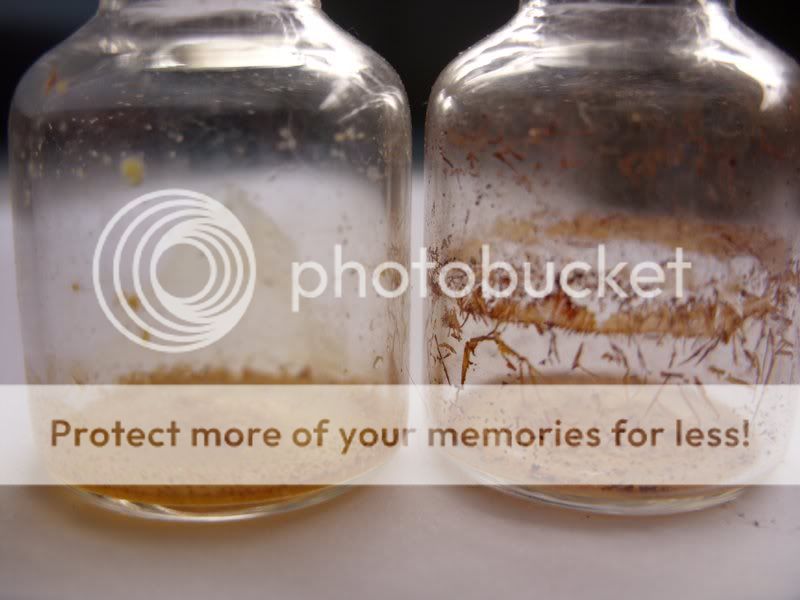
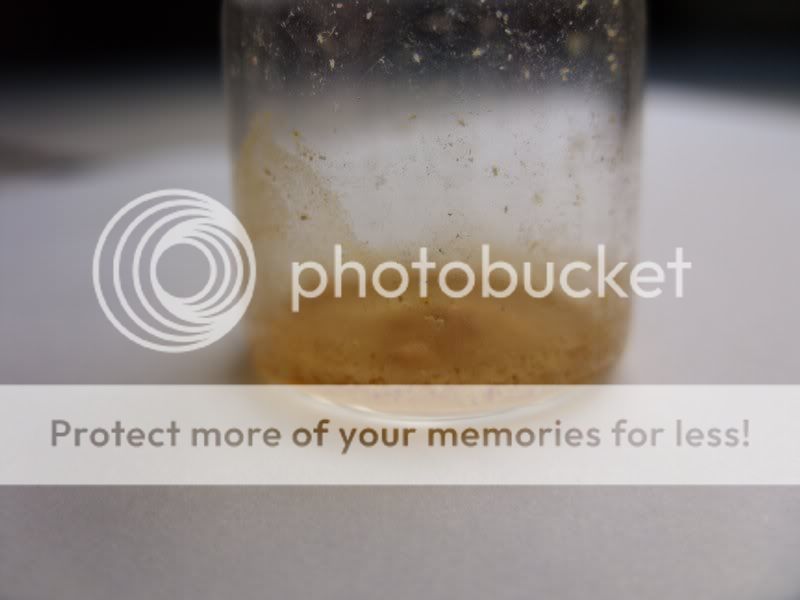
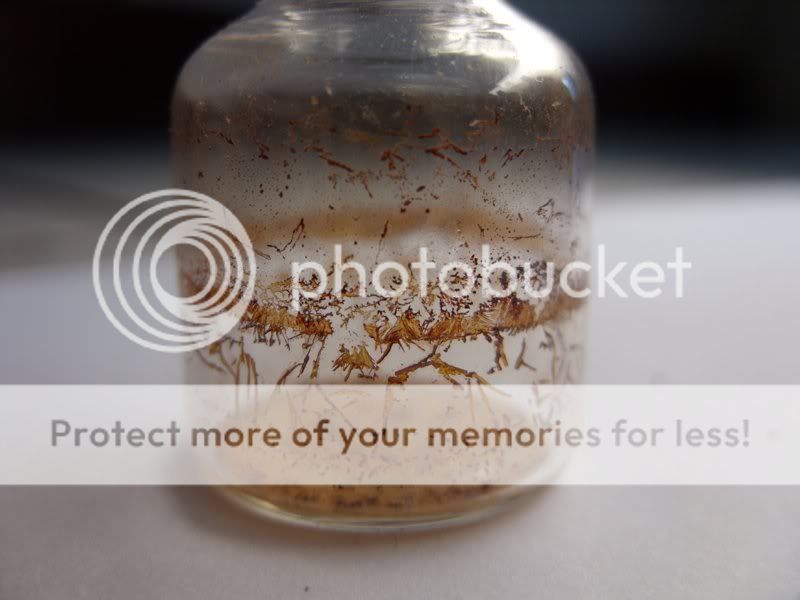
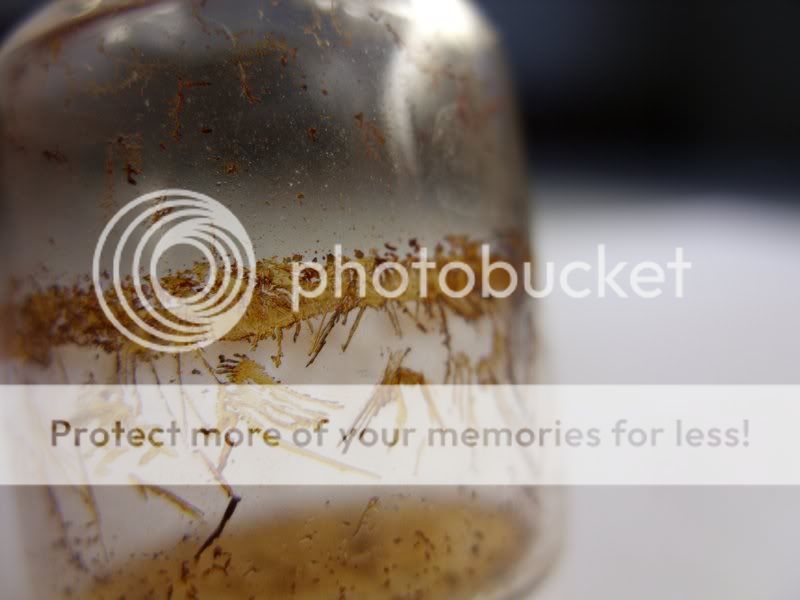
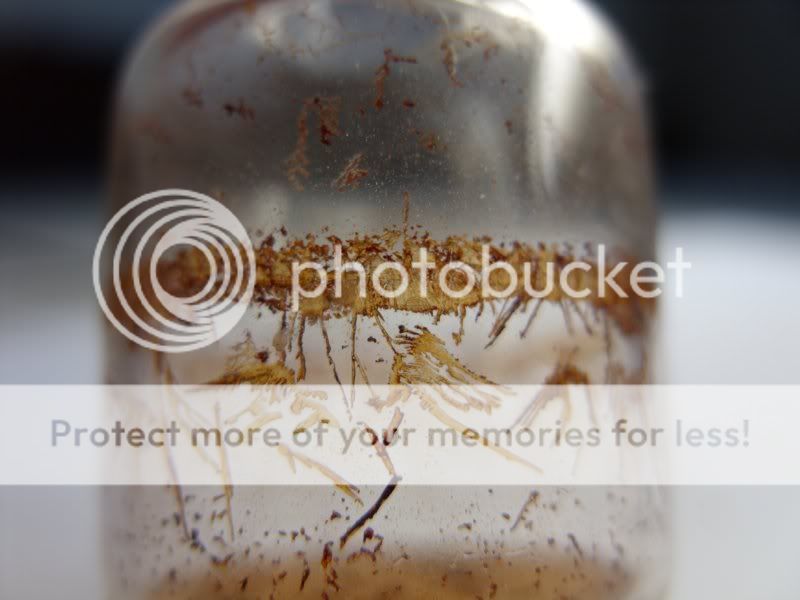

Whiterasta mentions a red film/oil on the filter, so the reaction forming the red did indeed take place.Crystalito said:Well ,the whole harmala red issue seems -it might not be, but it seems- easy to crack:
If one wants to see if its an oxidation product ,harmine/harmaline mixture or even better seperately can be added to hydrogen peroxide, let the reaction take place and see if it becomes red.
Same with addition of alcohol:If there is red to be seen it will be seen.I think i spoke with a member that did the alcohol experiment and found it became red.On the other hand,was it whiterasta that extracted with alcohol and had no such problems? Look here,seems it worked like a charm!

Big Inhale
The Enlightend One
I did this extraction on 50 grams rue seed an got three grams of harmalas back after two salts and two basifications. I was wondering if that was about right because it looks right just seems like a lot.


