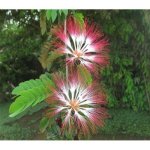
CALLIANDRA CHEMISTRY?
[Q: Has anyone come up with analysis for any Calliandra species to see if they are in fact DMT-containing? In Ott’s Shamanic Snuffs or Entheogenic Errhines, he mentions that this is used as a direct replacement for Diplopterys carbrerana in ayahuasca preparation. Ott strongly suggests that this genus may have some DMT containing species. — J.S., OR]
E.R. : The one analysis that we have seen mentioned comes from the Shulgins’ book TIHKAL in listing #54 on tetrahydroharmine (THH), wherein Sasha states:
"There are a number of other plants that are known to contain tetrahydroharmine and to have been used in various native preparations. I have recently learned of analysis of an Ayahuasca brew that had used the plant Calliandra pentandra as a component, instead of the usual Psychotria viridis. Ott’s magnificent compendium Pharmacotheon makes mention of a Calliandra augustifolia as a component of ayahuasca, but there is no mention of this pentandra species. The preliminary analysis that I have been given of this decoction is that a component that had initially appeared to be DMT by HPLC analysis had proven to be tetrahydroharmine when assayed by GCMS. There was no detectable DMT present. And yet the material appears to have psychopharmacological activity.
"More studies on tetrahydroharmine are absolutely imperative."
We had previously noticed some remarks regarding the activity of THH made by chemist Jace Callaway (Callaway 1995), so we asked him for his thoughts:
J.Callaway: "The picture is not at all clear on this one. THH is a weak SRI (serotonin reuptake inhibitor), like the other 1-methyl-THBCs, so one can expect it to have about as much psychoactivity as a SSRI (i.e., little to none). In combination with MAOI, it acts to promote serotonergic activity
by blocking 5-HT reuptake. Clearly, it is not a potentially lethal combination, as with harmine and Prozac for example, and I suppose that serotonin will compete with THH for the uptake site once serotonin concentrations have reached sufficient levels (pure speculation; those experiments have not been done, to my knowledge).
"However, in a broad (as yet unpublished) survey of Banisteriopsis caapi, Psychotria viridis and subsequent teas, which included phytochemical analyses of all, plus subjective ratings of the teas, a strong correlation was found with teas that contained high amounts of THH and not DMT! This rating was from a large body of experienced users (regular União do Vegetal members who had consumed ayahuasca for 10+ years). In short, yes, there seems to be important activity from THH, but likely not the sort of activity that currently seems valuable to the
lay user in the U.S. or E.U.; e.g., more temporal, than whirly/swirly, if you know what I mean.
"I have tried THH, alone and in combination with MAOI, and there is a twinkling of sorts, but one might get a substantially similar reaction from Prozac. Also, there are two isomers possible from THH (+ and -, or d and l). I would suppose that one is more active than the other. Simply heating in boiling water will convert one to the other, so most teas will have both. the “d” form is the one reported to be found in the plant (d-leptaflorine), and I have often wondered about tales from the rainforests, where the tea is sometimes prepared just from soaking the macerated vine overnight (no heating, no admixtures), with visions resulting. Note: I suppose the desired vine should be a chemovare having high levels of THH.
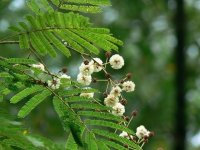
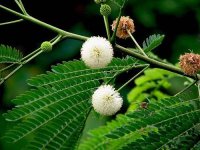
"Calliandra pentandra has good amounts of THH in the leaves, and it is used as an add mixture by some groups like the Shuar in Equador, and visions have been reported by reliable western folk from this and Banisteriopsis caapi. So, there still may be something there to look at more closely.
"I am not aware of any other analyses on this plant species, aside from my own investigations (which are what Sasha refers to in TIHKAL). From my limited perspective, C. pentandra does not contain any DMT, and THH was the major component that showed up in my analysis. These two compounds have quite similar chromatographic characteristics; without mass spectral detection, I would have to doubt any claims that lack such
specificity."
— Jace Callaway, Ph.D.



 ..i wish i'd videoed the audience at the talk so i could take in who was there..it was all very freeform..loved that conference!