
-
Members of the previous forum can retrieve their temporary password here, (login and check your PM).
You are using an out of date browser. It may not display this or other websites correctly.
You should upgrade or use an alternative browser.
You should upgrade or use an alternative browser.
Trying to improve Acacia information
- Thread starter nen888
- Start date
Migrated topic.


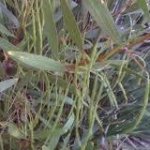

Regarding the plant im my previous post.
Just for the sake of science ...
A small sample of the bark (about 150g) was taken and shredded. Q21Q21's vinegar/lime extraction tek was applied on the resulting dust and fibers. After evaporating one naphta pull, only small traces stayed on the bottom of the tray.
By thoroughly scraping it, it was possible to make a tiny (1mg or less) blob of something. This extraction was then heated on a tip of a knife with a lighter. Although it wasn't solid, it didnt melted or evaporated.instead it turned into singed lump.
The smell of it burning was somewhat familiar...
My guess is that it was only plant fats, some dust that fell during nap evaporation and unmeasurable traces of possible active substances...
Just for the sake of science ...
A small sample of the bark (about 150g) was taken and shredded. Q21Q21's vinegar/lime extraction tek was applied on the resulting dust and fibers. After evaporating one naphta pull, only small traces stayed on the bottom of the tray.
By thoroughly scraping it, it was possible to make a tiny (1mg or less) blob of something. This extraction was then heated on a tip of a knife with a lighter. Although it wasn't solid, it didnt melted or evaporated.instead it turned into singed lump.
The smell of it burning was somewhat familiar...
My guess is that it was only plant fats, some dust that fell during nap evaporation and unmeasurable traces of possible active substances...
..thanks for that report Muttley, i probably should mention that it was particularly Acacias longifolia, maidenii and obtusifolia in which alkaloids were found to be greatly reduced during flowering..there was a bit on longifolia's chemical races on p.10 of this thread #193..in the case of A. longifolia var. sophorae alkaloids were completely absent during flowering and seeding, but present in twigs 3-4 months later..
..while it sounds like there wasn't much in there, for quick ideas of how much is in something a bit of heat can help nudge things out..also, the two A. confusa extraction reports linked earlier in the thread are both good teks..
..while it sounds like there wasn't much in there, for quick ideas of how much is in something a bit of heat can help nudge things out..also, the two A. confusa extraction reports linked earlier in the thread are both good teks..

Is acacia confusa, and Formosa koa the samething? or how about acacia koa?
....Just found out that a. confusa grows wild all around where i live from big tall old trees to new sprouts and can not wait to experiment. How does one obtain root bark with out to much damage to the tree/s? or should i just stick to twigs and leaves?
....Just found out that a. confusa grows wild all around where i live from big tall old trees to new sprouts and can not wait to experiment. How does one obtain root bark with out to much damage to the tree/s? or should i just stick to twigs and leaves?
..hi stoneyone, yes 'formosa koa' is an hawaiian common name for A. confusa, and it does grow in Maui..based on most known acacias, the trunk bark should be similar content to the root bark (up to 2.85% DMT/NMT for confusa), and the stem bark similar content but lower percentage (0.6-0.9% based on current knowledge) ..damage to more than perhaps 15-20% of the root system will usually lead to tree death..
..for more on Acacia confusa and other asian, and pacific island acacias incl. koa see p. 5 of this thread #83 and #93, acacias in hawaii p.14..
..stem bark/branch bark is the most eco-friendly..
..for more on Acacia confusa and other asian, and pacific island acacias incl. koa see p. 5 of this thread #83 and #93, acacias in hawaii p.14..
..stem bark/branch bark is the most eco-friendly..
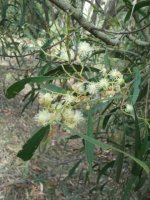
nen888 said:... i probably should mention that it was particularly Acacias longifolia, maidenii and obtusifolia in which alkaloids were found to be greatly reduced during flowering
mmm... good to know. Maybe this happens with other acacias as well? Is there any post or wiki page talking about this subject?
Muttley wrote:
.
NB. the Australian Species List on p.5 - here.. #82 is updated at intervals to keep the info as up-to-date and referenced as possible..other region lists (see Index of Thread p.1) are similarly kept updated..
..as far as i know, and i'd love any other reserachers to step forawrd, the most detailed research on acacia alkaloids and variation is being done by the contributors to this thread, and also the australian reseracher J.J. mentioned earlier in the thread..there was some good preliminary work done by Trout and Mulga in the late '90s, but it didn't continue for long and was not backed up with bioassays..prior to this thread the most comprehensive acacia alkaloid list was Acacia which hasn't been updated in a long time, had no bioassay info., and some uncertain references..cool effort though! it was after seeing this blog, and noticing some discussion here on the nexus, that i decided things could go further..and prior to that information was sacttered in Entheogen Review, but only little bits and pieces..Is there any post or wiki page talking about this subject?
.
NB. the Australian Species List on p.5 - here.. #82 is updated at intervals to keep the info as up-to-date and referenced as possible..other region lists (see Index of Thread p.1) are similarly kept updated..
Regarding podalyriaefolia and White, all of White's Acacia analyses were done on plants growing in New Zealand.
Regarding alkaloids during flowering, White often found reasonably high levels of alkaloids in the flowers, and while perhaps reduced, content in stems was sometimes still reasonable (less so in phyllodes). This was observed with longifolia and numerous others (most of this should be summed up on the wikipedia page for Acacias known to contain psychoactive alkaloids, unless someone's changed it since I last edited it).
Calliandra - I don't know where the species name 'pentandra' came from. It doesn't seem to exist in botanical literature and I can't find an author for the name. As far as I can tell, statements about the plant containing THH or possibly DMT are actually in reference to the analysis of an ayahuasca brew which contained a Calliandra species known as 'samik', which was thought by the researchers to be C. pentandra (again, where they pulled this name from is a mystery, and the real identity of the plant - perhaps the same as C. angustifolia? - remains unclear). So, this is not an analysis of the actual plant at all, and who knows if there were other additives to the brew that the researchers didn't notice going in? We have a lot to learn about the Calliandras...
Regarding alkaloids during flowering, White often found reasonably high levels of alkaloids in the flowers, and while perhaps reduced, content in stems was sometimes still reasonable (less so in phyllodes). This was observed with longifolia and numerous others (most of this should be summed up on the wikipedia page for Acacias known to contain psychoactive alkaloids, unless someone's changed it since I last edited it).
Calliandra - I don't know where the species name 'pentandra' came from. It doesn't seem to exist in botanical literature and I can't find an author for the name. As far as I can tell, statements about the plant containing THH or possibly DMT are actually in reference to the analysis of an ayahuasca brew which contained a Calliandra species known as 'samik', which was thought by the researchers to be C. pentandra (again, where they pulled this name from is a mystery, and the real identity of the plant - perhaps the same as C. angustifolia? - remains unclear). So, this is not an analysis of the actual plant at all, and who knows if there were other additives to the brew that the researchers didn't notice going in? We have a lot to learn about the Calliandras...
..thanks for that wira, i was pondering writing a post on seasonal variation, but there isn't a lot of systematic study..in my own research alkaloids have been reduced (not absent) and changed (e.g. more of other alkaloids) during flowering of a few species..also, floral oils can be present in stem bark which transfer to NP extractions..and as i've mentioned, heavy rain seems to affect things..others have noted this..
..but there is also so much regional and chemo-type variation, that i think the best thing is for researchers to get to know the patterns of what plants are around them or accessible..within perhaps five years there should be more seed about of selected and stable strains..
..i should have also mentioned the oft mentioned Garden Of Eden by Voogelbreinder [2009] as being the most up-to-date book dealing with acacia alkaloids (and just about any other kind of psychoactive plant or animal you can think of)
..a number of species have turned up since it's publication..
..as for Calliandra pentandra, as far as i can tell it probably is C. angustifolia (Bobinzana) as it is described in a few sources as 'closely related', and angustifolia is quite a distinct calliandra..it does seem from statements in both texts, however, that both Ralph Metzner and Jace Callaway analysied the actual plant, whatever species..Callaway also published on the THH containing ayahuasca brews..i believe the 'pentandra' name is from an anthropological work i am currently searching for..
.
..but there is also so much regional and chemo-type variation, that i think the best thing is for researchers to get to know the patterns of what plants are around them or accessible..within perhaps five years there should be more seed about of selected and stable strains..
..i should have also mentioned the oft mentioned Garden Of Eden by Voogelbreinder [2009] as being the most up-to-date book dealing with acacia alkaloids (and just about any other kind of psychoactive plant or animal you can think of)
..a number of species have turned up since it's publication..
..as for Calliandra pentandra, as far as i can tell it probably is C. angustifolia (Bobinzana) as it is described in a few sources as 'closely related', and angustifolia is quite a distinct calliandra..it does seem from statements in both texts, however, that both Ralph Metzner and Jace Callaway analysied the actual plant, whatever species..Callaway also published on the THH containing ayahuasca brews..i believe the 'pentandra' name is from an anthropological work i am currently searching for..
.

noticed the top few photos look very little like floribunda?
nen888 said:..Acacia heterophylla is endemic to Réunion island in the Indian Ocean, and introduced to Madagasgar..it is very evolutionarily and genetically closely related to Acacia confusa, and believed to have a high probability of containing dmt or other tryptamines..
and i gotta say, both these photos are beautiful.. capture the living spirit in the acacia

nen888 said:..for those in n.e. nsw, aus., here's Acacia difformis from the region posted recently on another site..Trout found tentative 5meoDMT and DMT in the phyllodes..
i have seen a number of these in my hometown back up in the new england, nsw ... any info on the alkaloid profile of the bark for this species?
..thanks for the floribunda link bricklaya..acacia ID can be confusing due to the constant morphing of features like phyllode shape..in fact the whole taxonomy of Acacia has been recently under review by australian and international botanists..
the key feature of floribunda (to differentiate from close relatives like longifolia and maidenii) is the absense of a basal gland on the phyllodes..
..re: A. difformis, Trout only breifly tested the phyllodes (from, i believe, near Tenterfield NSW) so it is unknown what may be in the bark..in most cases bark alkloids are similar and in greater quantity than phyllodes, exceptions being A. longissima which has 0.2-0.3% in phyllodes, and almost none in bark, and some examples of obtusifolia with more NMT in the leaves, and acuminata (broad leaf) which an example was recently found by endlessness to have more betacarbolines than tryptamines in the phyllodes (not neccessarily a bad thing)
..i am planning some tests on A. difformis ASAP, and am very interested in others' findings..
lastly, A. heterophylla..yeah, beautiful looking tree..well worth a holdiay to Reunion if i could only afford one right now..
the key feature of floribunda (to differentiate from close relatives like longifolia and maidenii) is the absense of a basal gland on the phyllodes..
..re: A. difformis, Trout only breifly tested the phyllodes (from, i believe, near Tenterfield NSW) so it is unknown what may be in the bark..in most cases bark alkloids are similar and in greater quantity than phyllodes, exceptions being A. longissima which has 0.2-0.3% in phyllodes, and almost none in bark, and some examples of obtusifolia with more NMT in the leaves, and acuminata (broad leaf) which an example was recently found by endlessness to have more betacarbolines than tryptamines in the phyllodes (not neccessarily a bad thing)
..i am planning some tests on A. difformis ASAP, and am very interested in others' findings..
lastly, A. heterophylla..yeah, beautiful looking tree..well worth a holdiay to Reunion if i could only afford one right now..
..i thought it worth mentioning (as it's in the detail of the NMT research presented elsewhere) that, by comparison of various reactions to reagents, it appears that Acacia fimbriata (a sweet perfumed eastern australian native) phyllode and twig contain mainly or exclusively phenethylamines..it is sometimes asked about in plant forums..
similar color change reactions were observed for it, and A. harpophylla (found to contain mainly phenethylamines)
..no one in my team has bioassyed exclusively PEA acacias..i have heard one report of A. harpophylla as 'psychoactive, maybe stimulant', but without much detail..the toxicology of these simple phenethylamines is not well documented..
thanks to 'M' for the original help with re-agents..
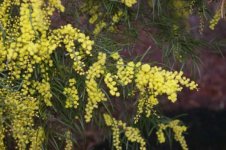
below, Acacia fimbriata, a nice ornamental...
similar color change reactions were observed for it, and A. harpophylla (found to contain mainly phenethylamines)
..no one in my team has bioassyed exclusively PEA acacias..i have heard one report of A. harpophylla as 'psychoactive, maybe stimulant', but without much detail..the toxicology of these simple phenethylamines is not well documented..
thanks to 'M' for the original help with re-agents..
below, Acacia fimbriata, a nice ornamental...
Attachments
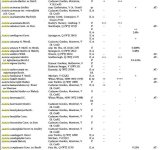
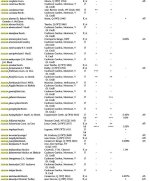
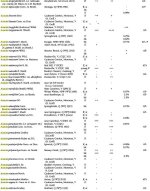
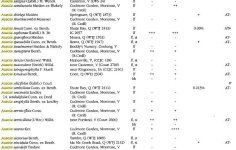
..for intrepid researchers, here are CSIRO australian acacia alkaloid screening results up to 1990..they did further work, which i'll try to source if possible, in the 90s..
..after the species name the Locality/voucher # is given..next column is Plant part..then there are three alkaloid columns showing results for Mayers reagent - Silicotungustic reagent - & Other..a rough indicator of amount of alkaloids is based on a score of + to ++++..
+++, for instance, is a high amount..the final column on the right is Anti-tumor activity screening (AT)
..the alkaloids are not identified in this kind of screening, but these give good indicators for future research..will look for a list of african acacia screenings, which have been done..as you can see, many more species are known to contain alkaloids than the one's whose alkaloid type are known...
..after the species name the Locality/voucher # is given..next column is Plant part..then there are three alkaloid columns showing results for Mayers reagent - Silicotungustic reagent - & Other..a rough indicator of amount of alkaloids is based on a score of + to ++++..
+++, for instance, is a high amount..the final column on the right is Anti-tumor activity screening (AT)
..the alkaloids are not identified in this kind of screening, but these give good indicators for future research..will look for a list of african acacia screenings, which have been done..as you can see, many more species are known to contain alkaloids than the one's whose alkaloid type are known...
Attachments
..i'm still trying to compile a list of Acacias naturalized in Europe, to give people an idea of growing parameters..one website says of the acacia: "..even in the neighborhood of London it has been known to reach forty feet within ten years..." [LoveToKnow - Live a Life You Love]
..australian species known to be in the region include A. adunca, A. baileyana, A. dealbata, A. floribunda, A. hanburyana (an European hybrid between A. dealbata and A. podalyriifolia, that has phyllodes with a varying number of pinnately arranged pairs attached ), A. longifolia, A. retinodes & A. saligna..also A. cyclops is naturalized in the Canary Islands..
A. farnensiana (world-wide distribution, now Vachellia farnensiana) is widely grown..most of these species have had tryptamines or alkaloids detected at some time or location..
here is a lecture i found:
Acacia 2006: Knowing and Growing Australian wattles; Melbourne 26.-28.8.06 - Australian Acacias in Europe by Wolf-Achim Roland
Solingen, Germany..it puts minus 12 degrees C as the lower climate limit for most aussie species..
from the lecture:
..australian species known to be in the region include A. adunca, A. baileyana, A. dealbata, A. floribunda, A. hanburyana (an European hybrid between A. dealbata and A. podalyriifolia, that has phyllodes with a varying number of pinnately arranged pairs attached ), A. longifolia, A. retinodes & A. saligna..also A. cyclops is naturalized in the Canary Islands..
A. farnensiana (world-wide distribution, now Vachellia farnensiana) is widely grown..most of these species have had tryptamines or alkaloids detected at some time or location..
here is a lecture i found:
Acacia 2006: Knowing and Growing Australian wattles; Melbourne 26.-28.8.06 - Australian Acacias in Europe by Wolf-Achim Roland
Solingen, Germany..it puts minus 12 degrees C as the lower climate limit for most aussie species..
from the lecture:
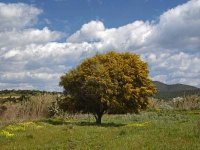
..below are aussie acacias in Sardinia, Italy, and in France..the first looks like A. dealbata, the second (near water) A. hanburyana ..for more on Euro-Acacias see post after next...The cut flower trade started to take off after 1871. Farmers re-planted land with acacia trees, because of the high profit margins. New hybrids were cultivated, and trees were grafted onto stems of A. retinoides to better cope with the alkaline soil of the Cannes area. Different grafting methods are used: At first grafting by approachment, then chip bud grafting. There is also some success with cuttings.
Today the cultivated trees are nearly all hybrids between Acacia dealbata and Acacia baileyana. They are called Mirandole, Rustica, Gaulois etc.. There remain some plantations of A. retinoides var. Imperialis, the Mimosa of 4 Seasons.
Attachments
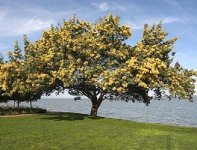
..this post is BOTANICAL TERMS RELATING TO ACACIAS..still compiling it..
- acuminate - coming to or having a fine/sharp point, refers to phyllodes; similar meaning as acute, but refers to extended or long sharp point as opposed to - mucronate, meaning an abrupt short fine point.
- anastomoses - on phyllodes, small veins which diverge at angles (like streams or arteries) from the parallel main veins or nerves.
- aril - a kind of sheath or hood covering the top of the seed, usually joined by the funicle.
- basal-gland - a small dot or round swelling on the leaf edge, either at the base of the phyllode where it joins the petiole, or a few millimeters above the base.; not present in all species.
- bi-pinnate - [see 'pinnate'] - leaflets arrising off the 'secondary petioles', in a feather-like or fern-like pattern; pinnately compound leaves in which the leaflets are themselves pinnately compound; mimosa-like.
- falcate - tending to 'sickle-shaped', refers to phyllodes.
- funicle - a thin stalk connecting the aril to the seed pod.
- glabrous - smooth, glossy with no fine hairs, refers to leaves.
- glaucous - pale grey or bluish-green appearance, usually refers to phyllodes.
- globose - having spherical or globe-like appearance, refers to flowers or seeds.
- inflorescence - a cluster or group of flowers attached to a main stem (penduncle), sometimes single flowers attached to penduncle by 'pedicels'.
- pinnae - small leaves in groups attached to the stems (usually 'bi-pinnate' in acacias), are true compound leaves, unlike phyllodes; all 'juvenile' leaves of acacias are pinnate or bi-pinnate.
- pinnate - leaves arranged in feather-like or fern-like formations arising from both sides of a common axis in a stem.
- pedicel - a stem that attaches single flowers to the main stem (peduncle) of the 'inflorescence'.
- peduncle - the main stem of an inflorescense.
- petiole - the stalk or stem that connects the leaf to the plant.
- phyllode - look like leaves on most acacias, are actually a photosynthetic extension of the petiole (which is bark); usually have a few prominent longitudinal nerves, and often many fine longitudinal veins in between these.
- pruinose - resembles covered in white dust/flour.
- pulvinus - the swelling at the base of the petiole, often capable of changing form to bring about movement of leaf, sometimes glandular or responsive to touch.
- raceme - a type of inflorescence that is unbranched and indeterminate and bears pedicellate flowers — flowers having short floral stalks called pedicels — along the axis (stalk) ..e.g. usage: "in racemose inflorescences.."..in acacias the raceme (clusters of tiny flowers) are ball-shaped (globose), or 'spikes'.
- rachis - the midrib of a leaf (pinnae), it is usually continuous with the petiole and is often raised above the lamina (the leaf blade); there can be glands present on the rachis.
- reticulate - having a network of veins.
- spikes - 'rod' like clusters (raceme) of flowers 1.5-10cm (e.g. A. longifolia and many species) as opposed to the other kind of acacia flower shape - 'balls';
a Spike is a type of 'raceme' in which individual flowers are 'sessile' (that is, lack pedicels)..in some cases the stalk supporting the cluster becomes the pedicel.
- terete - cylindrical, circular in middle but slightly tapering at both ends, refers usually to phyllodes.
- turgid - swollen or distended, refers to seeds.
..
- acuminate - coming to or having a fine/sharp point, refers to phyllodes; similar meaning as acute, but refers to extended or long sharp point as opposed to - mucronate, meaning an abrupt short fine point.
- anastomoses - on phyllodes, small veins which diverge at angles (like streams or arteries) from the parallel main veins or nerves.
- aril - a kind of sheath or hood covering the top of the seed, usually joined by the funicle.
- basal-gland - a small dot or round swelling on the leaf edge, either at the base of the phyllode where it joins the petiole, or a few millimeters above the base.; not present in all species.
- bi-pinnate - [see 'pinnate'] - leaflets arrising off the 'secondary petioles', in a feather-like or fern-like pattern; pinnately compound leaves in which the leaflets are themselves pinnately compound; mimosa-like.
- falcate - tending to 'sickle-shaped', refers to phyllodes.
- funicle - a thin stalk connecting the aril to the seed pod.
- glabrous - smooth, glossy with no fine hairs, refers to leaves.
- glaucous - pale grey or bluish-green appearance, usually refers to phyllodes.
- globose - having spherical or globe-like appearance, refers to flowers or seeds.
- inflorescence - a cluster or group of flowers attached to a main stem (penduncle), sometimes single flowers attached to penduncle by 'pedicels'.
- pinnae - small leaves in groups attached to the stems (usually 'bi-pinnate' in acacias), are true compound leaves, unlike phyllodes; all 'juvenile' leaves of acacias are pinnate or bi-pinnate.
- pinnate - leaves arranged in feather-like or fern-like formations arising from both sides of a common axis in a stem.
- pedicel - a stem that attaches single flowers to the main stem (peduncle) of the 'inflorescence'.
- peduncle - the main stem of an inflorescense.
- petiole - the stalk or stem that connects the leaf to the plant.
- phyllode - look like leaves on most acacias, are actually a photosynthetic extension of the petiole (which is bark); usually have a few prominent longitudinal nerves, and often many fine longitudinal veins in between these.
- pruinose - resembles covered in white dust/flour.
- pulvinus - the swelling at the base of the petiole, often capable of changing form to bring about movement of leaf, sometimes glandular or responsive to touch.
- raceme - a type of inflorescence that is unbranched and indeterminate and bears pedicellate flowers — flowers having short floral stalks called pedicels — along the axis (stalk) ..e.g. usage: "in racemose inflorescences.."..in acacias the raceme (clusters of tiny flowers) are ball-shaped (globose), or 'spikes'.
- rachis - the midrib of a leaf (pinnae), it is usually continuous with the petiole and is often raised above the lamina (the leaf blade); there can be glands present on the rachis.
- reticulate - having a network of veins.
- spikes - 'rod' like clusters (raceme) of flowers 1.5-10cm (e.g. A. longifolia and many species) as opposed to the other kind of acacia flower shape - 'balls';
a Spike is a type of 'raceme' in which individual flowers are 'sessile' (that is, lack pedicels)..in some cases the stalk supporting the cluster becomes the pedicel.
- terete - cylindrical, circular in middle but slightly tapering at both ends, refers usually to phyllodes.
- turgid - swollen or distended, refers to seeds.
..
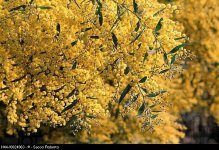
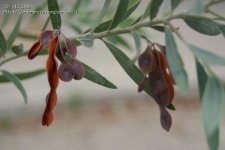
..a very interesting wattle in terms of distribution and content is Acacia retinodes (Swamp Wattle, or Wirilda) being native to southern Australia, and naturalized in such diverse places as Hawaii, Bolivia, France and Spain..
it has several sub-varieties..
..one German reported test found 0.5% alkaloids (DMT, NMT, nicotine); Roveli in Australia [1967] found 0.2% of a completely unknown alkaloid, and no nicotine..
the closely related Acacia provincialis was once classified as A. retinodes X saligna..nexian yatiqiri found 0.2-0.5% of an unknown mix of alkaloids which had tryptamine-like and also some possibly unique effects [see question about my acacia spice thread]
..certainly a tree for further, cautious chemical investigation..
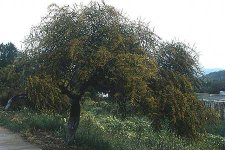
below are A. retinodes growing in Germany, Hawaii, and Australia, and below them is
A. adunca, aussie native found in Europe, and found alkaloid positive by CSIRO..phenethylamines 1 report..
it has several sub-varieties..
..one German reported test found 0.5% alkaloids (DMT, NMT, nicotine); Roveli in Australia [1967] found 0.2% of a completely unknown alkaloid, and no nicotine..
the closely related Acacia provincialis was once classified as A. retinodes X saligna..nexian yatiqiri found 0.2-0.5% of an unknown mix of alkaloids which had tryptamine-like and also some possibly unique effects [see question about my acacia spice thread]
..certainly a tree for further, cautious chemical investigation..
below are A. retinodes growing in Germany, Hawaii, and Australia, and below them is
A. adunca, aussie native found in Europe, and found alkaloid positive by CSIRO..phenethylamines 1 report..
Attachments
Similar threads

- Replies
- 0
- Views
- 525
- Replies
- 6
- Views
- 2K

- Replies
- 4
- Views
- 473

- Replies
- 2
- Views
- 380

- Replies
- 149
- Views
- 16K
