westernspice
Rising Star
Sorry one for question, if you were to cultivate one species in the southern states which would it be? From reading the entire thread, acuminata seems the flavor of the month.

..if i had to pick just one, then yes, probably acuminata for outright percentage..though floribunda also totally rocks and grows a bit faster, and mucronata is a lesser known (& more variable) southern favorite of mine..if you were to cultivate one species in the southern states which would it be?


 wrote:
..thank you heaps seldom!!, i was thinking of such a 'page-hopper'..that's great!:d
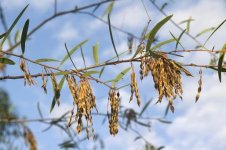
..could be a Jacksonia, they are very interesting australian shrubs in Fabaceae, which like acacias have phyllodes not true compound leaves..they have yellow small pea-flowers in dense infloresences..no chemical info..not even sure this is an acacia, suspicion says probly it is, it's galled up pretty good, not looking at it as a source, just has sharp L shaped branches which would be good for a split and bore didj if the density is high enough
..yes, possibly hybidized with another bipinnatebaileyana?
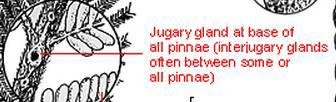
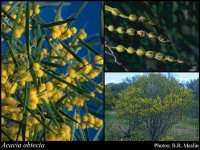
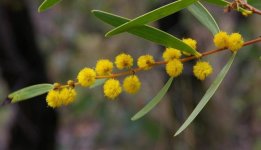
..i have seen floribunda of this form with the long phyllodes..(+ have you ever seen a floribunda with phyllodes this long? 3 main veins, anastomoses identical to other strains of i've seen, no basal gland, possible hybrid with longissima?)
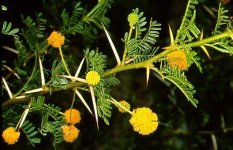
..A. cardiophylla is an australian bipinnate species in which White found tryptamines and phenethylamines in the pinnae (small leaves)..it seems mearnsii does at the right times have tryptamines..at least a couple of african bipinnate species contain DMT in the leaves..there are about 40 bi-pinnate species (sect. Botrycephalae) in australia..the most common are the ones you mention..do you have any advice bout ho wto distinguish decurrens dealbata and meansii?
very interested to hear anything you have on dealbata
also one thing i've never heard about is alkaloids in the leaves of bipinnate species?
 , (see previous post)