• Members of the previous forum can retrieve their temporary password here, (login and check your PM).

Trying to improve Acacia information

Migrated topic.
..here's one partly for the chemically minded and curious,
a couple of factors in acacia chemistry which could result in failure to efficiently extract alkaloids..despite many rumors of alkaloids binding to tannins (as the 'tannate) etc., i can find no direct evidence of this..instead the problems appear to be related to the Tars, which will vary seasonally in plants..
Wood Tars (Amphoteric Resins) are complex formations of phenols, cresols, guaiacols, and xylenols..
from JG's original A. maidenii experiments 1992 [see p10#197 here]..the first extraction went smoothly, but the 2nd:
On attempting to acidify, filter, and basify, considerable difficulty was experienced; the acidified residue seemed unfilterable, and when basified with NH3, a thick pink gel was formed which was impossible to extract. By a painful process of trial and error, I found that at very low pH, most of the resins became dissolved or suspended. At slightly low pH, the residue separated nicely into a tar and an aqueous phase. At slightly high pH, the mixture became a thick gelatinous solid. At very high pH, this solid redissolved. The result of this seems to be that much of the tar can be separated by successive extraction at moderately low pH (dilute HCl), and then that the addition of strong hydroxide will leave the amphoteric resins in solution, but make the alkaloids insoluble. These are then extracted into dichloromethane as before, and the organic layer is back extracted with salty NaOH solution to remove impurities.
..so yes, careful and fine manipulation of the pH (up or down) can resolve such an issue..

..what form of salts are the alkaloids in acacias..? unknown for sure, and probably varies, but turns out this could relate to Gum chemistry..many acacias of course contain gum exudates (both edible and anti-biotic), Gum Arabic being the most common (from A. nilotica & A. aribica)
the main acids which have been found in acacias are Uronic Acids (e.g. A. senegal, A. leata, A. mangium)
..they are a class of plant metabolite often bonded with polysachharides, a class of 'Sugar Acid'
..the gum of A. senegal (and others) comprises partly of the Uronic acids D-glucuronic acid, and 4-O-methyl-D-glucuronic acid [see Studies on uronic acid materials : PARTS XX - XXIV Anderson et al. 1968]

..water-soluble salts of the Uronic acids polymannuronic acid, polyglucuronic acid and polygalaturonic acid were prepared from the bases of the alkaloids pilocarpine, atropine, amphetamine, epinephrine (and others) in Ophthalmic Composition Comprising Water-Soluble Alkaloid Salts of Polyuronic Acids; Patent 1966..the study found that alkaloid Polyuronic salts were better than Hydrochloride salts for prolonged contact treatment (e.g. ointments)

..the other acid found in acacias (other than amino-acids, which i don't think form salts) is Pipercolic acid
(piperidine-2-carboxylic acid), found in some microorganisms and the Murchison meteorite!
..4-hydroxy-pipecolic acid is also known from acacias..
& A. concinnia contained Acacic acid ((3b,16a,21b)-Trihydroxyolean-12-en-28-oic acid)..

that should give the odd researcher something to think about..
............................................................................................................................................................................


ps. have started compiling info on Acacia confusa 海药周到的树 into The Acacia Confusa thread
..i figure more widely utilized species eventually deserve their own threads..

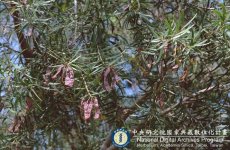
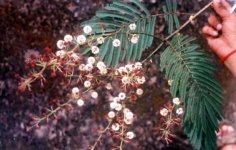
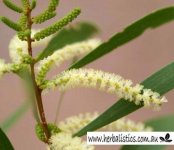
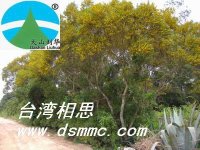
below are Acacia richii (synon. with A. confusa, perhaps a subspecies, common in Fiji and Pacific);
and then A. confusa growing in Taiwan..

.
 

Attachments

  • acacia+richii.jpg
    acacia+richii.jpg
    31.6 KB · Views: 0
  • Confusa+Taiwan.jpg
    Confusa+Taiwan.jpg
    115.6 KB · Views: 0
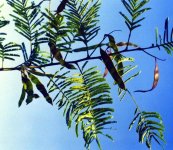
..another acacia found in Tawain is Acacia intsia 藤相思樹..it's also in India (where it is an ayurvedic medicine, 'Chilar'), Nepal (where it is known as केfन्द| 'Arkhu'), Sri Lanka, Laos, Myanmar, Thailand and Vietnam..it has tested positive for alkaloids a number of times [Plant Alkaloids: A Guide to Their Discovery and Distribution by R.F. Raffauf]..
 

Attachments

  • Acacia++intsia+_.jpg
    Acacia++intsia+_.jpg
    39.6 KB · Views: 0
..an interesting note on some China and Taiwan Acacias[cited in Trout's acacia notes (2003)]:
Partial translation of Liu et al. (1977) (from the
Chinese): (referring to Tawain)
First two paragraphs:
"...“Thoughtful Tree” (A. confusa) belongs to
our southern and southwestern regions, wild growth
such as the Thoughtful tree: The Gold Happiness
Tree
(A. concinna), The Wide Leaf Thoughtful Tree
(A. delayayi), The Duck Tree (A. farnesiana),
{ ? } (A. intsia), The Snake Vine Tree (A.
pennata
), The Yunan Thoughtful Tree (A.
yunnanensis
). The most common type in this
province [location?] is the Thoughtful tree, the Duck
Tree is located in the south area. The Thoughtful
Vine Tree [?] is located throughout the entire
provinces forests.
It can be used for medicinal purposes, for
lowering fever, for strength, anti-inflammation,
etc... The Thoughtful Tree is often used in Chinese
Medicine for muscle constricting agent and for
curing blood disease. As for the study of its
composition, earlier it was decided to be seed oil
and tree bark’s { ? } but because the root epidermis
composition has not been reported on thus this
study.”
..the leaves (pinnae) of A. pennata are cooked and eaten in Thailand, Burma and Laos..

of the other 'Thoughtful' trees, Acacia yunnanensis 云南相思树 is illustrated p18 , while
Acacia delavayi Franch. 光叶金合欢 is a mountainous species from Yunnan province, China..common name 'guang ye jin he huan' ('golden branch jade leaf')..it is bipinnate (pinnae in pairs of 3-5), has 1-2 globose flowers per head, and oblong pods..so i'm not sure what the 'wide leaf' meaning of the Taiwan name is (perhaps refers to another species)..no image, two sub-species..it has a smaller number of pinnae than most other bi-pinnate species..
the 'Thoughtful Vine Tree' sounds interesting, whatever it is..

certainly, plenty of interest in this part of world..A. caesia 尖叶相思 p8 (also found in Yunnan province) contains DMT,
and Acacia catechu (Khadira) [pictured below in China, also found Tibet, Nepal, India] is believed to contain
entheogenic tryptamines, still under investigation..
see Asia list p5 here..
.
 

Attachments

  • Acacia+catechu%2C+China.jpg
    Acacia+catechu%2C+China.jpg
    116.2 KB · Views: 0
Last edited:
Acacia Acuminata Phyllode Extraction.
Products used
59 gms Acuminata Phyllodes
Phosphoric acid
2lt Rain water
NaOH
Shellite
Turkey Baser
Evaporating dishes

A/B process using Phosphoric Acid to bring 2lt of rain water to ph of 3.5-4.0.
Using approx 400-500mls to cook for 45 mins, 1st cook bring to boil then simmer 45 mins, 2nd just on simmer for 45, 3rd just simmer for 45mins.
Combined all strained liquids and reduced on simmer for 30-40 mins to approx 1 lt.
After 30 mins of cooling, I put on safety glasses and rubber gloves, then I added 59grams 98% pure NaOH. (Caustic Soda) slowly, and gently rotated and swirled my 2lt plastic HTPO vinegar jug, ph 12.

At this point I added 100-150 mls Shellite and continue to swirl, Letting gasses off by loosening cap periodically, for 5 mins. After 4 hours and 20 swirlings I pulled off the Shellite and added more.
On the third pull I added 2 tea spoons of NaOH to the bottle and before the shellite I swirled to mix for a few mins.
These three pulls were evaporated over night in separate dishes. I have had trouble freeze precipitating other tests due to high humidity here (I think).

Surprisingly, the third pull yielded the cleanest looking crystalline substance.
I then separately evaped the 3 extracts.
Combined 3 pulls 435mg. Photo 1. Bio assay of 3x 15mg did not produce any noticeable psychotropic effects.
1st re-crystal.
After mixing the extract with 20ml of warmed Shellite and put in a warm water bath for 15-20 mins a large amount of gunk was separated leaving yellow shellite. Both of these samples were evaped (to see what was in the gunk). Photo 3.
After drying, the removed bottom gunk is now quite white and powdery and the shellite solution yellow goo. Both have an indole smell, the yellow goo more so. Not the result I was expecting.
Regards
 

Attachments

  • Acuminata-1.jpg
    Acuminata-1.jpg
    33.7 KB · Views: 1
  • Acuminata-2.jpg
    Acuminata-2.jpg
    33.3 KB · Views: 1
  • Acuminata-4.jpg
    Acuminata-4.jpg
    39.3 KB · Views: 1
  • Acuminata-3.jpg
    Acuminata-3.jpg
    40.8 KB · Views: 1
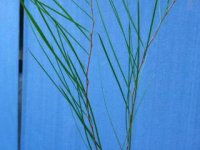
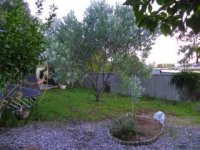
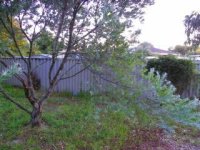
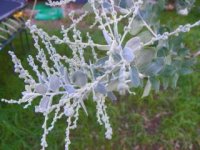
Just a few pics of my beloved Acacia Podalyriifolia and a few of my Acuminata.

You will notice a branch has broken and will need to be pruned for another go at extraction......

The photos of the Acuminata here (my babies)show the stem colour of greeny/silver.....
 

Attachments

  • 100_1014.jpg
    100_1014.jpg
    11.9 KB · Views: 0
  • 100_1010.jpg
    100_1010.jpg
    12.8 KB · Views: 0
  • 100_1006.jpg
    100_1006.jpg
    21.1 KB · Views: 0
  • 100_1004.jpg
    100_1004.jpg
    21.1 KB · Views: 0
  • 100_1003.jpg
    100_1003.jpg
    18.2 KB · Views: 0
congrats Gowpen :) ... were the phyllodes you used from the young acuminatas you got a little while ago?
By the way, would love to see a photo of your acuminata a little closer up. There's a fairly limited number of good detailed photos on the net...
 
..interesting (and thanks) Growpen..the paler sample looks quite pure..the yellow could be another related alkaloid (dmt-n-oxide or nmt) mixed with dmt..would be interesting to see what the differences are..and (as bricklaya asked) were these from the treelets? was it a narrow or broad leaf acuminata..? the Narrow Leaf seems to usually be mainly dmt (tests on the way)
.
 
Hi all. The phyllodes were from a young narrow phyllode plant yes but not my babies, they are way too small to be taxed yet. Too young a plant this time perhaps !!!
I will look further.

Thank you so much for this guidance.

The whiter extract was what I removed from the re x as gunk, the yellow goo was what remained in the shellite. Odd !

Still haven't got my hands on any DMT

I'm soooo trying nen/brickie.
 
Gowpen just on the note about your third pull having the cleanest spice, i also find the same with my pulls... i guess the first pulls probably gets more plant oils and residues and become cleaner as you go.

Currently working on roughly a kilo (maybe a little bit under .. unfortunately i didn't weigh before boiling) of very mature Floribunda inner trunk bark which we were able to salvage from a very old tree which had been cut down for building space. I am very curious as to how this will go, as I've gotten my extraction technique much more refined since my last failed flori attempts. This tree would have been ancient... I'd never seen such a thick trunk on a floribunda before. I'll post results

Nen, what do you prefer - defatting before basing the acidic solution, or just defatting the naptha pulls from the base mixture? And also do you think for the post pull defat that the acidic water should be shaken well? Or done gently? And if the latter, do you think gently turning the bottle over instead would be able to pull all of the spice from the solvent? Viracocha mentioned before that he's had trouble with loss of yield doing the double A/B due to emulsions
 
Gowpen said:
Still haven't got my hands on any DMT

I'm soooo trying nen/brickie.

I'm confused... isn't that DMT in the photos?
By the way, would love to see a photo of your acuminata a little closer up. There's a fairly limited number of good detailed photos on the net...
 
bricklaya said:
Gowpen said:
Still haven't got my hands on any DMT

I'm soooo trying nen/brickie.

I'm confused... isn't that DMT in the photos?
..yes, especially given that it's the narrow leaf strain, looks like you have quite clean DMT in the round glass bowl Growpen..almost certainly..you could try a re-x on the yellow..

Nen, what do you prefer - defatting before basing the acidic solution, or just defatting the naptha pulls from the base mixture? And also do you think for the post pull defat that the acidic water should be shaken well? Or done gently? And if the latter, do you think gently turning the bottle over instead would be able to pull all of the spice from the solvent? Viracocha mentioned before that he's had trouble with loss of yield doing the double A/B due to emulsions
..defatting is done when the solution is acidic..washing the post-basic solvent with salty NaOH removes other impurities and colour..only 1 defat should be done, more can create problems..
it is better to rapidly 'swirl' the mixture than to violently shake, which can cause bubble emulsions, however many emulsions are fixed by addition of a very small amount of basic material..
.
 
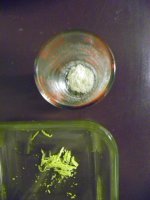
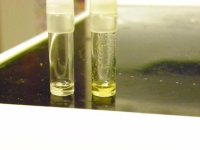
The white looking substance in the round shot glass is what dropped out of the shellite during a re x, I did'nt freeze it ! and I was going to discard this, I thought I would test it however, for indoles with my E test kit.I suspect this is NOT DMT. Update.. BOTH samples tested negative with a Ehrlich 'eztest' kit from UK. Left is the whiter crystal/powder right yello goo after evaping shellite from re x

The yellow goo that was dissolved into the shellite when re x is I hope DMT. (not, see update above) It 'should' be triptamine/indole but not sure yet... will bio assay soon (not). Both these substances have crystaline structures under a magnifying glass.....

I was extremely carefull with this extraction and the re x was more of a refinement hoping to get purer product. But, as you can see I have oily goo insted, not sure if this is psycho active....... I must have messed up somewhere along the line.

All I can say is, I hope DMT finds me before I find it.... (might take me too long ;-)
Maybe this plant was not an Acuminata ? (or I'll eat my hat) or a 'look-a-like acuminata ? Is there such a thing nen ?
or too young ?
Maybe wrong time of year ?, after heavy rain ? shaded bark or in full sun, ie south of the plant bark ?
Maybe not an acid enough cook ?
not high enough Ph to extract ?
Shellite ? (Bricklaya, you have success with this ?)
Freezing is Best I suspect, though I have had problems with melting x's (which may have been water droplets) and have a positive test (Ehrlich) to the extract from a suspected (nen) Neurophylla that was evaped, not freeze precip'd albeit a very small sample.

I was going to try the bark of the same tree. I will also take photos of the same tree that I test next time. The tree in question is a long bushwalk away.... doh! Steep learning curve for myself comming from a less Science/more psychology background. I wish I had studied Chemistry....... I have awesome respect for you guys, what a facinating subject area to study. DMT/Acacias in particular.

regards G
 

Attachments

  • 100_1044.jpg
    100_1044.jpg
    24.4 KB · Views: 0
..Gowpen, good thing the Erhlich's is about..so it seems quite possible that the plant is not acuminata (EDIT: see further botanical info. few posts on), which is fairly reliable, unless the plant was perhaps too young..or, if there was a lot of rain, but i haven't heard of a negative confirmed acuminata result yet..

..the extraction method i outlined p24 almost always works(if there are tryptamines in there), though i know other people's practiced techniques also work..
i will write up a more detailed version when i get a chance..i only usually recommend acetic or sulphuric acid (other acids incl.HCl have been more problematic, perhaps due to other plant compounds)..citric and fumaric seem to work too..this is just from my own experience, and others may have other tips..many suggest lighter fluid as better form of naphtha than shellite..better to leave solvent separating overnight to get all alks out, swirling at intervals..with naphtha freeze precipitation the way to go..

you could crush a small sample of plant material in methylated spirits, make slightly basic & test with reagent to save yourself the trouble of going through a whole process for nout, but scientific understanding of course..
see testing proceedures (TLC etc) , I, II, III
.
 
update... ANOTHER failed floribunda extraction.. I am really beginning to think either the floribundas down here in vic aren't active or aren't even floribundas... maybe a mixed strain... they are listed as them. this is about 7 failed flori attempts now.. the one just then on about a kilo of bark too..
 
first negative i got was from what i thought was floribunda but turned out to be thin phyllode variant of A. maidenii. negotiating seasonal, geographic and genetic variation can be tricky
looking very gnarly Gowpen!
i read in another thread here the idea it's better to learn to make coffee first before doing a full scale caffeine extraction.. if one had a quantity of phyllodes estimated to have dmt/nmt content of .2 to .3 and an amount of salt form rue harmalas, does anyone have any advice about making phyllode brews?
am happy to report back with experiences :)
 
..trees can be tricky, dear me..! ..neither floribunda or maidenii have a basal gland, and flowers similar, but maidenii has twisted/spiral pods, floribunda straight pods constricted between seeds..and it's Vic i hear the yielding flori reports from so, without photos, it's really hard to tell what's going on..i'm trying to work out what else could be mistaken for it or acuuminata..
..what really should make life easier, in Gowpen's case at least, is having a reagent..only a gram or two of phyllode/bark need be used to dab a basic spot on paper and get a colour reaction..this way a large number of samples can be done before deciding what to actually extract..as far as i can figure, the residue of a small methylated spirits sample of the ground plant made slightly basic should give an Ehrlich's reaction, without having to do TLC, but if there's a few things in there it could be unclear..hence TLC to separate the components for individual reagent testing..
..don't give up..you guys are so close and have developed the skills..

phyllode brews?..you just want to be sure what's in there first, by knowing the strain or extracting..and again, filtering vital..start conservative and work up..

..at this moment i'd really like to figure out what's going on here, bricklaya and growpen, with the plants that aren't showing evidence of tryptamines..either of you got close-up phyllode pics? and of course, pods/flowers usually the only way to be certain..
 
Hi nen, although my extraction came from what I thought was an Acuminata, in hindsight, the Phyllodes although long and thin were not as round as the Acuminata in my garden (babies), they were a bit flatter.

So, I will take my camera with me on my next bush walk and get some GOOD shots of potentials. Funny, at a set of traffic lights on the Freeway here there are 10 mature Acuminata 'looking' plants, but this is not a spot to jump out and sample. I have thought of 'breaking down' with a pretend flat tyre.

I have waited this long so a while more wont hurt. Flowering Acacias are just a few weeks away, and there are 100's of 1000's of them....containing tons of DMT. 30mg is all I need (well, 100mg)....

Kind regards and thanks again.
G
 
^..how much did you get from the presumed neurophylla? that looks like a good lead..
an indicator of the presence of tryptamines (though not a rule) is reddish new growth, and very bitter astringent phyllodes..as for what that white/yellow non-indole extract was, was there any colour change with the reagent? guessing phenethylamine, next most common acacia alkaloid..it would only show noticeable activity in amounts impractical to vaporize..but that's not what we're looking for here really..

..there are many acacias with with long narrow phyllodes..or with maidenii-like phyllodes for that matter..

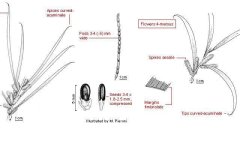
the other main characteristic of Acacia acuminata, which wasn't previously mentioned, is that the phyllodes are usually
slightly curved at the acuminate (pointy) apices (tips), when the tree is mature..the Broad Leaf variety sent to and tested by endlessness (and the Narrow to come) both displayed this..see drawings below of narrow phyllode (left) and typical form..
fimbriolate means 'minutely fimbriate' which means 'fringed'..
.
 

Attachments

  • acuminata+drawings.JPG
    acuminata+drawings.JPG
    28.9 KB · Views: 0
That is a most helpfull detail nen, I thought that charecteristic may have been a nutrient deficientcy of some kind. But that little detail may be the key I am looking for. My Garden babies show this charecteristic (I also have one indoors, MH lamp 600w, growing well with the same feature)..

I am so close now....

The yield from the (Suspected) neurophylla was VERY small, and the tree is about at the end of its life. It did test pos. On a bio assay of 15mg, there were colours with eyes closed, nothing more. And no more sample.... but an option....
 
..to give a visual example of how disorientating it can be to ID some of these species without flowers and pods..

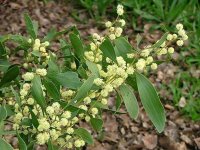
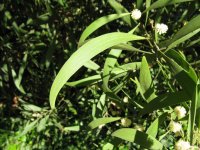
Photo 1) is the typical southern form of A. melanoxylon, with more rounded pointy phyllodes..it has thick curved pods with red aril..i don't think it's been tested..
Photo 2) is the more northern form, whose phyllodes (if it wasn't flowering) could easily be taken for A. maidenii (the bark can also look identical, and the phyllodes can get narrower)..the pods of this form of melanoxylon are narrower but more twisted than the above form..this form appears to contain almost no dmt..

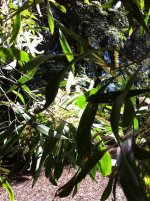
Photo 3) is a known high tryptamine A.maidenii..also, a much narrower phyllode coastal form is known to be high in content, but other forms (often darker phyllodes) are devoid of alkaloid..
Photo 4) is another form of A. maidenii which is active/high tryptamine content..
note clue to seed source..note this is definitely not obtusifolia..
 

Attachments

  • A+melanoxylon+southern+form.JPG
    A+melanoxylon+southern+form.JPG
    68.9 KB · Views: 2
  • Acacia%2Bmelanoxylon%2Bfoliage1.JPG
    Acacia%2Bmelanoxylon%2Bfoliage1.JPG
    230 KB · Views: 2
  • A+maidenii+active+var1.JPG
    A+maidenii+active+var1.JPG
    98.5 KB · Views: 2
  • A_maidenii+3.JPG
    A_maidenii+3.JPG
    17.4 KB · Views: 2
Back
Top Bottom