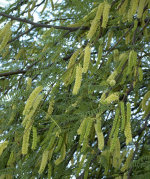
^..interesting
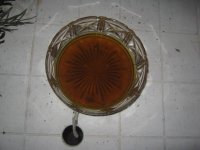
Seldom and thanks!..what an interesting colour...
and hey enjoy your island holiday..look forward to the holiday pics..
 wira
wira, nice to hear from you..your attention to knowledge and detail is profound enough..
The mucronata var. longifolia found near where I live has quite stiff and very narrow (a few mm), long (average 10cm or so) phyllodes, but a long way further south near the sea I did once (many years ago, when my wattle i.d. skills were poorer) find a small grove of what I think was mucronata var. longifolia, but the phyllodes were a lot longer, wider, greener and more flexible than the more local variety. It looked a lot closer to the illustrations in books, and forms like this are the ones that are more readily confused with floribunda, and easily separated by those phyllode characteristics i pointed out.
..while it initially seems, yes the absence of a basal gland would make it A. floribunda (and yes, it would be good to know) ..i'm ready to throw my virtual hardcover at 'lumper' botanists..they do nobody any favours..
..so for
A. floribunda we have
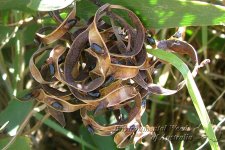
Pods subcylindrical, constricted between seeds, mostly straight, 6–12 cm long, 2–4 mm wide, chartaceous. Seeds elliptic, 3–5 mm long, glossy, brown; funicle folded about 4–8 times; aril small, irregularly thickened.A
chartaceous means 'papery' and thin..so a texture description helps, but they don't look chartaceous..now, while the somewhat poorly defined
A. mucronata is described from type with drawings of less pods constricted between seeds, this cannot be taken as definitive as i have seen it with highly constricted pods (and clear inflorescence ID)
..so, based on the seed
aril of acacian's pod shots i'll still go with
var. mucronata as the key parent (even if there is hybridisation) ..also, the 'iso-form' of A. floribunda has more pendulous, longer, thiner and slightly falacate phyllodes, as well as longer flower heads (spikes) ..floribunda i think refers to 'abundant flowers', and mucronata being much less abundant (sparser number of overall spikes) is still what acacian's photos look like to me..
but hey, i'm not paid as a professional botanist to apparently make things even more confusing..
.also we may have in victoria is a 'hybrid complex' between floribunda and mucronata..they would be likely to cross..in which the absence or not of gland may be varied and not indicative..
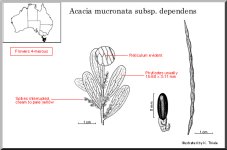
and the Tasmanian variety of mucronata,
sub sp. dependens is considered so anomalous by some botanists that it should be classed as a different species..
..but really, the poor botanical clarity on mucronata (and longifolia, obtusifolia) makes it difficult to work things out within systematic botany..
also, i want to break the conservative 'theory' of the past 15 years, and go with L. Pedley and D. R. Murray in defining
Acacia sophorae as it's own species, with it's own sub-species..
i will from now on adopt this Botanical position..
be well everyone..and great there's so many of you..! don't be afraid to interact..

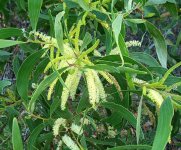
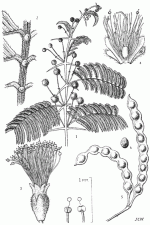
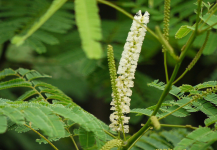
..so, below, another descriptive look at
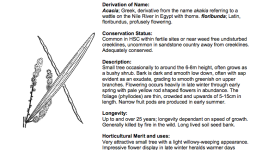
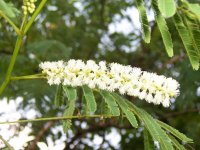
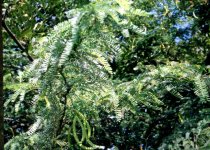
Acacia floribunda (originally named Mimosa floribunda in 1803 from plants Cultivated in Cels’ garden in France ..! ..probably the earliest australian acacian ambassador to Europe)
0.3-0.4% DMT, NMT , trace harmalas in the phyllodes..
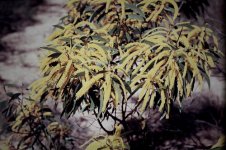
followed by
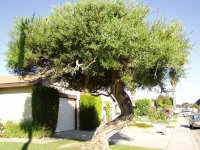
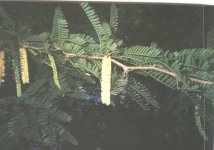
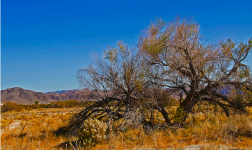
A. mucronata subspecies dependens, endemic to Tasmania, 1 negative test by JJ, but that's not conclusive..really should be it's own species IMO, or it's had sex with A. sophorae sometime..

.