..in agreement with the Dictionary of the Bible:
It has long been known that by shittah is intended one of the species of the beautiful genus acacia, the Hebrew word being no other than the Egyptian sont, or sunt, by which name it is known to the present day in the ancient country of the Pharaohs, the n being omitted when the word passed into the language of the Old Testament.
Dean Stanley also remarks, in speaking of the vegetation of Sinai:
The wild acacia, under the name of sont, everywhere represents the seneh, or senna, of the Burning Bush. A slightly different form of the tree, equally common under the name of sayal, is the ancient shittah, or, as more usually expressed in the plural form (from the tangled thickets into which its stem expands), the shittim, of which the tabernacle was made—an incidental proof, it may be observed, of the antiquity of the institution, inasmuch as the acacia, though the chief growth of the desert, is very rare in Palestine.
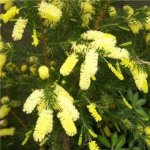
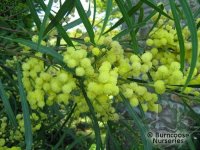
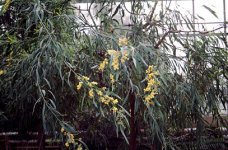
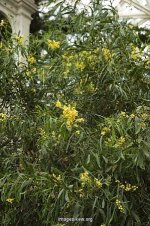
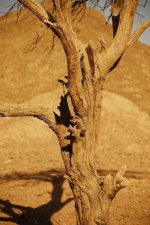
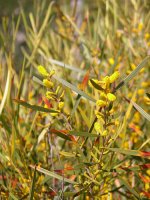
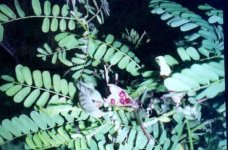
The name acacia means the thorn tree, and no name could be better deserved; for not only are the trunk and branches beset with pairs of thorns, but every twig presents a thorny point. And yet it is a pretty tree; the foliage with its many leaflets is graceful, and in the spring the tree is illumined by innumerable little golden balls of fragrant blossoms.
It is abundant everywhere in Egypt and in the desert, and furnishes the natives with the toughest material for tools and the frames of their boats, a considerable part of their fuel, and the gum arabic of commerce. The wood is closegrained, heavy, and extremely enduring; some specimens still exist which are believed to be five or six thousand years old...
...The noblest plants of this class are the acacias; and the noblest corresponding spiritual growths are those of a knowledge of the Divine protection—a knowledge which comes from experience of the Divine power in repelling and shutting out evil from the mind. Swedenborg says that shittim wood “denotes the good of merit and of justice, which is of the Lord alone. The reason why it also denotes love is because the Lord, when He was in the world, from Divine love fought against all the hells and subdued them, and thereby saved the human race, and hence alone had merit, and was made justice; wherefore the good of the Lord’s merit is His Divine love” (Arcana Coelestia #10178 ).
That is to say this wood corresponds, in individuals and in the heavens, to the sense that the Lord alone fights for man against the hells, and to the consequent sense that His is all the power of good. The same thing is taught in other passages, especially in Arcana Coelestia #9486,9715; in the latter of which numbers, after repeating that shittim wood denotes “the good of merit and justice which are of the Lord alone,” ...
...The planks of the tabernacle were of shittim wood, representing the sense, in heaven and in the Church, of the sustaining and protecting power of the Lord’s love (Arcana Coelestia #9634). The ark also, and the table, and the altarswere of shittim wood, overlaid with gold or with brass; because the acts and states of worship which they represent are interiorly of the Lord’s saving power.



 will keep you posted!