..sure sounds like a friendly wizard to me Jamie.

I wonder however, whether the smaller yield could possibly be attribute to the large amount of acid used? You only used vinegar right? people have mixed results with acacia when using too much acid and sometimes find reduced yields.. I am not exactly sure why this is, though I am sure nen or choco could elaborate? below an extraction of my own.. next will be mucronata. I'm just trying to figure out whether to gather the phyllodes today or after a longer period of no rain..
Acacia Floribunda extraction
Phyllode length = 12.5-15cm
Phyllode width = 0.5-1cm (phyllodes were larger the further down the stem)
Flower rods = 4.5cm .. very abundant
No basal gland
small white hairs present on phyllodes and stems
Rough trunk bark (observed often in the commercial varieties of floribunda grown in urban environments)
-Phyllodes and developing flower rods(not yet in bloom) were oven dried at 120 degrees celsius for an hour. the weight came out at 171.75. the phyllodes were then ground to a near powder. meanwhile as the phyllodes were drying, the twigs and stems were boiled whole for 2 hrs in water with a squirt of lemon juice
-A generous amount of water and a squirt of lemon juice was added to the ground phyllodes in a saucepan and boiled twice for an hr each. each boil was decanted. the first two boils were combined and filtered through cotton buds. the 3rd was brought to the boil and left to sit for 24 hrs before being poured off filtered and added to the previous two. the water from the twig boil was combined with the three boils at the end and reduced down to 400ml.
- 100ml xylene was added and mixed well in a swirling motion.. it was given a heat bath to speed the process as it was not separating well. the layers separated after 10 minutes in the heat bath. the xylene was then pulled from the solution
- 25g caustic soda was dissolved in 150ml warm water and left to sit until the solution was clear. the solution was then added to the acacia soup. precipitation was noticed as it was added and continued to do so while it was stirred for about 10 seconds before disappearing. however, the solution stayed a very light brown colour even after ph 12.5 had been reached. the solution was left to sit for 20 minutes
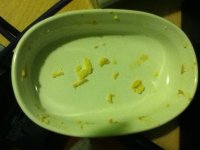
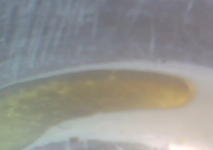
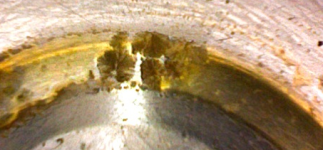
- 100ml xylene was added to the solution and mixed thoroughly in a swirling fashion, allowed to stand and separate and then pulled from the solution. It was a murky yellow colour. the xylene was left overnight and evapped today.. not looking like there's anything of interest.. a very slight yellow film again which I'll bioassay. it could be the weather in the melbourne, but I really don't think floribunda is a particularly reliable source for dmt at all. i think it must be a certain strain of it that is active.. i have done well over 20 floribunda extractions down here at differen't times of year and never gotten dmt. the yellow film smells similar to the stuff from the last extraction.. i wonder if this is a common chemical that occurs within species in certain environments or weather patterns
Notes:
-before the xylene was added, the basified solution was still quite light in colour - as it was tipped from side to side precipitates were observed and it was assumed that they were making the solution lighter in colour. After adding the xylene and mixing/separating, the solution turned to a very dark colour
-upon closer inspection tiny cream coloured particles could be seen floating in the xylene which was quite cloudy. could this perhaps be an alkaloid becoming insoluble as the xylene cools down in the cold atmosphere?