the Phyllode Tek Experiment 3
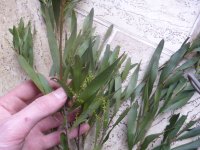
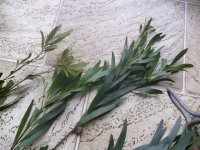
plant material..a friend and i observed an interesting looking small population of Acacia maidenii in NSW..this population shares some characteristics with A. obtusifolia in that it's pods are less coiled than typical maidenii (though not as 'straight' as obtusifolia, which typically has mildly convex pods), but it's phyllodes are not as thick and leathery as obtusifolia, nor blunt (as in the meaning of obtusifolia)..
it has been previously seen flowering in spring (September)
recently, i witnessed an experiment in which the leaf and twig were extracted as follows:
..500grams of A. maidenii phyllode and small twig were crumbled and broken by hand..leaves would have averaged 3-5 'breaks'/sections, meaning it was not especially finely ground/processed
..the material was covered with ethanol/H20/vinegar 90:5:5, and allowed to stand for 2-3 hours..
..the solution and plant material were then heated at approximately 70-80 degrees C, allowing the ethanol to boil..it took a medium red colour, around 2.3 litres..
..the liquid was poured off, reduced in volume by 75%, and filtered several times through unbleached cotton..a large of amount of particulate matter/tar amd gum was collected in the filter and discared..the volume was reduced to 300ml and brought to ph 5-6 with vinegar (a small dash)..this was labled ∂ (alpha)
..the plant material was then shaken with 250ml of ethanol for 30-45 seconds, this was discarded and combined with the first lot of liquid..
the phyllodes were then covered with H20 and approx. 100ml vinegar, and allowed to stand for 16 hours..it was then boiled for 40minutes..it took a golden/red colour with a slight milky cloudiness..
..the liquid was again poured off, reduced, and filtered several times..far less tar/gum was caught than in the alpha extraction..it was reduced to 300ml, final pH 5..this was labled the ß (beta) extraction..
..both acid solutions were then brought to pH 12-12.5 with NaOH/H20 solution, allowed to cool to room temperature, mixed with equal portions of dichloromethane, violently shaken for 10 minutes, and left to stand..clear separation of polar/non-polar layers took approx 1-2 hours..the NP solvent took on a mild yellow colour in both..
..the NP solvent was drained, washed once with H20/NaOH/NaCl solution (pH 8 ), re-separated after 20 minutes, and evaporated with a non-heat fan..
..after around 12 hours both extractions were a yellowish oil, though ∂ had more yellow, and signs of gum still congealing (pale brown paste)
..so..the results..?
∂ resulted in 30-40mg of a yellow/beige 'toffee' which would not completely solidify after another 24 hours of standing..experience and bioassay suggested that it was probably at least half nmt (n-methyltryptamine)
ß resulted in almost 1.5 grams (yes, 1500mg) of mainly off-white dmt soft crystals, with small amounts of yellow conglomerations..crystalization was sped up by scratching the surface of the 'oil' with a needle..later assay suggested mainly dmt, though it did not completely solidify, reverting to 'putty', often caused by nmt with betacarbolines, and perhaps trace fatty acids..these do not detract from the experiential aspect..
..a third 'pull', with 40minutes heat as in the beta, resulted in maybe 50mg alkaloid at most, so esstentially the ß extracted most of the alkaloids..
the percentage, then, of this A. maidenii was around 0.3% [from phyllode/small twig 80:20]..qualitively it was probably, in the case of the ß at least 85% dmt,with probably some nmt (slight duration extension and extra spatialness) and trace betacarbolines (as suggested by a slightly slowed onset at assay, and again slight time extension..according to the bio-assayer)
so, this would suggest, amongst other things, that some tests would find only a small percentage, not going through the extra stage as described here..also, it suggests that water slightly fortified with ethanol and a dash of white vinegar is the preferred solution..
..some brands of methylated spirits (95% ethanol) can be substituted, check carefully for residues;
methanol is the most efficient but is very poisonous and has no smell, so should not be used outside of safe lab conditionsl..due to reaction problems caused by some acids with acacias specifically i would suggest using (for now) only either acetic, dilute sulphuric, or citric acids
..as far as non-polar solvent choices go, hexane and xylene will work as well as described above in place of dcm; naphtha will usually require 2-3 pulls or extractions from the basic solution, whereas these other solvents require often only 1 solvent washing (they have a higher 'holding capacity', or solubility ratio)
..d-limonine..endlessness has achieved very good general dmt extraction results with the more 'natural' d-limonine (NP solvent derived from oil of lemon/citrus, naturally occuring in traces in the rind) ..this is perhaps what 'from plant' purists & organicists best use..
..chloroform is the common scientific standard NP solvent for such tasks, but should not be exposed to sunlight or left standing for long with alkaloids, or can react, as can to a lesser extent other chlorinated hydrocarbons..
for more detail on basifying alternatives to NaOH (some potentially less harsh)
and solvent choices/comparison, search the extraction subforums of the Nexus..
..hope this info is helpful, encourages sustainable leaf teks, and leads to less likely wastage of long grown plant material through inefficient or failed extraction..
please be kind to trees and grow them..