• Members of the previous forum can retrieve their temporary password here, (login and check your PM).

Desmanthus illinoensis, leptolobus and spp. Workspace

Migrated topic.

ntwhtyouknw

You do not have to see alike, feel alike or even t
Joined
Aug 25, 2011
Messages
645
Merits
42
Desmanthus illinoensis. ID

Kingdom Plantae –
Plants Subkingdom Tracheobionta –
Vascular plants Superdivision Spermatophyta –
Seed plants Division Magnoliophyta –
Flowering plants Class Magnoliopsida –
Dicotyledons Subclass Rosidae Order Fabales Family Fabaceae –
Pea family Genus Desmanthus Willd. –
bundleflower Species Desmanthus illinoensis (Michx.) MacMill. ex B.L. Rob. & Fernald – Illinois bundleflower

COMMON NAMES. Bundle Flower ; Illinois Bundle Weed

Region:
 

Attachments

  • DEIL.png
    DEIL.png
    19 KB · Views: 5
  • deil_003_thp.jpg
    deil_003_thp.jpg
    2 KB · Views: 5
  • deil_004_thp.jpg
    deil_004_thp.jpg
    2.4 KB · Views: 3
  • deil_008_thp.jpg
    deil_008_thp.jpg
    2.3 KB · Views: 1
  • deil_009_tvp.jpg
    deil_009_tvp.jpg
    3.2 KB · Views: 3
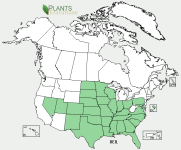
Just an FYI, USPLANTS data is around 10 years out of date (not a big deal for the state-level here, but something worth keeping in mind)...

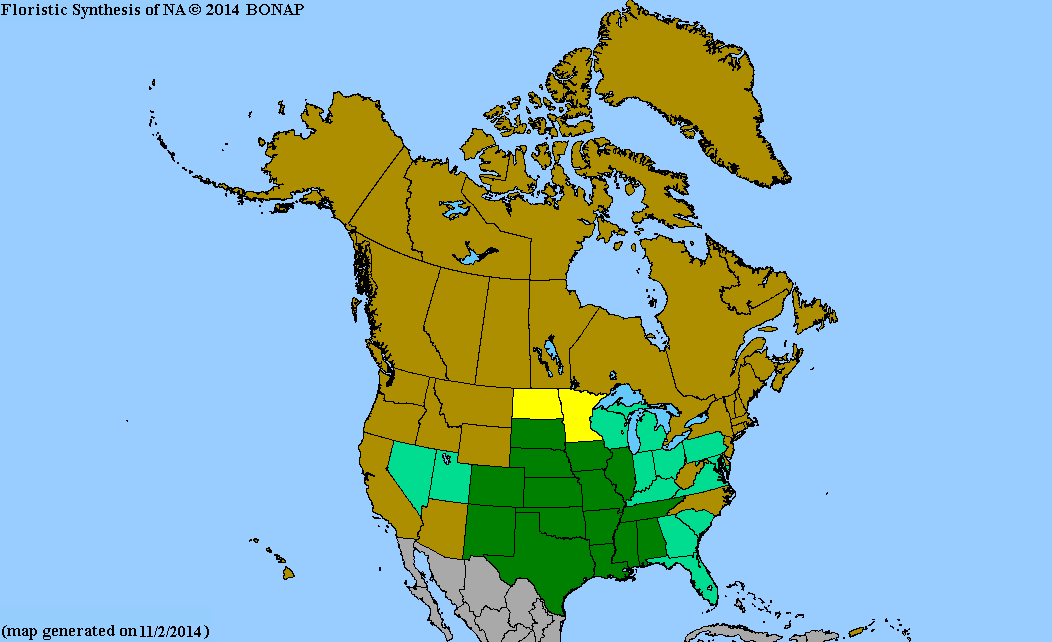
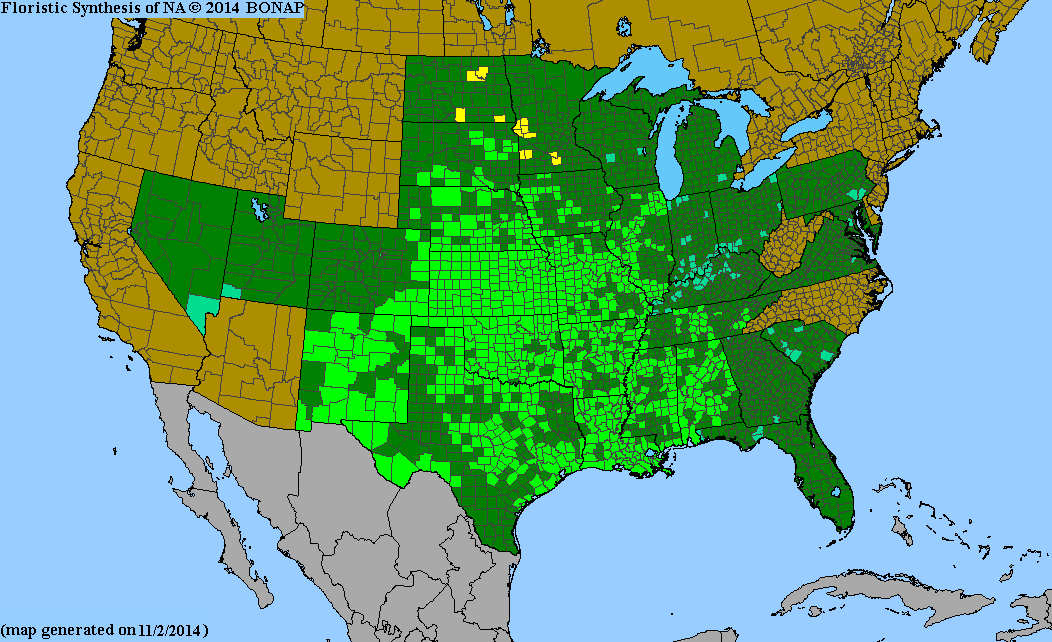
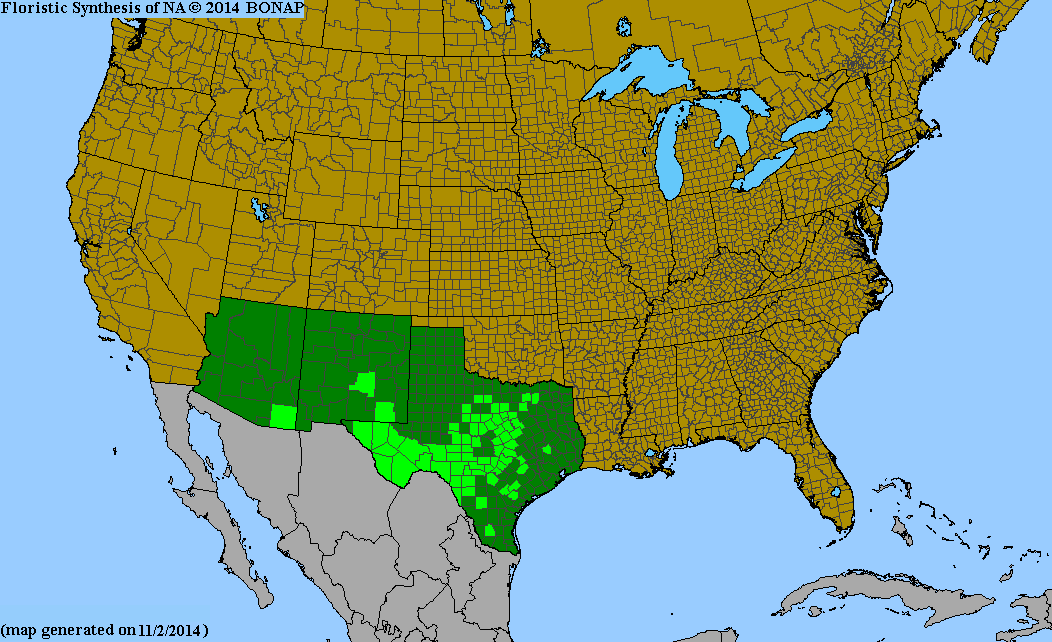
Here are state/county-level distributions for D. illinoensis as of 2013.

Green = Native, Yellow = Rare, Gray = Adventive/Introduced

Desmanthus%20illinoensis.png


Desmanthus%20illinoensis.png
 
Good to know, that's a much more detailed map of distribution. Bookmarked for future reference, thanks.
 
Desmanthus illinoensis
>up to 0.34% DMT roots: Thompson, Alonzo C., Gilles F. Nicollier & Daniel F. Pope 1987 Journal of Agricultural and Food Chemistry 35: 361-365. "Indolealkylamines of Desmanthus illinoensis and Their Growth Inhibition Activity."
reports of lower amounts (e.g. 0.14%)

Desmathus leptolobus is said to be higher in tryptamine levels
>DMT/NMT: Appleseed, Johnny 1992-1996 cited by http://trout.yage.net/sc/D_leptolobus_references.htm
Largely unpublished research. Desmanthus leptolobus information has appeared, among other places, in the 1993a Entheogen Review 2 (2): 26-27, "Ayahuasca analogues experiences." and in 1993b Integration 4: 59-62, "Ayahuasca analog plant complexes of the temperate zone: Phalaris arundinacea and the Desmanthus spec."
The latter piece also exists as an undated privately distributed manuscript.
[Extraction: simmering with hot HCl (pH 3), ammonia used to basify, CH2Cl2 recovered the alkaloid fraction. Co-tlc used known reference standards. TLC developed with Methylene chloride-Methanol-Concentrated Ammonia (80:15:1); run on Whatman Silica Gel 60 plates. Visualization of alkaloids: used Ehrlichs and/or Xanthydrol as spray reagents.]
 
Incedible!! I am not very familiar with this one... Though, it looks familiar.
Itis now on my list of things to find, extract, and research, thanks to this!
 
A few more things regarding Desmanthus spp...


Regarding what season to harvest for better yields, this post has very useful info:

Jackerspank said:
(re: desmanthus illinoensis) I have come to the conclusion that it is seasonal, around june and july, I was getting huge yeilds. This dropped off completely, at the end of august. Meaning i got rootbark, i went through the normal A/B extraction, i always used, and got nothing 3 times in a row at that time of year. Spring and early summer is the best time. .


And a few other things:

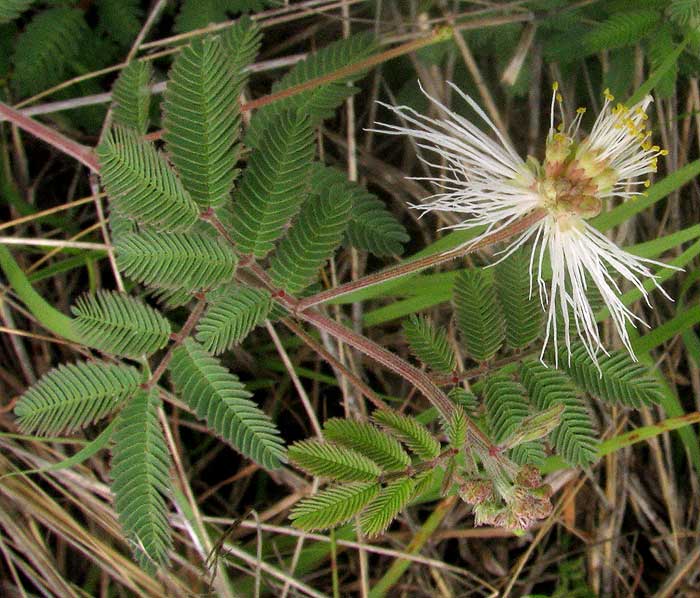
Desmanthus illinoensis
P-410-desmanthus-illinoesis-bundle-weed.jpg

Desmanthus%20illinoensis.png


- 0.34% in Root bark (dried) and 0.01 % in Root wood (dried) (Thompson et al. 1987) Substantially less is usually encountered. Sometimes none. (Trout's Notes)


Desmanthus leptolobus
Dl_P1.jpg

Desmanthus%20leptolobus.png

Screen_Shot_2019-04-04_at_1.40.47_PM.png

Desmanthus-leptolobus-prairie-mimosa-prairie-bundleflower-slenderlobed-bundleflower-1.jpg

Desmanthus_leptolobus_drawing.jpeg


- 0.14% yield of alkaloid. Identified by Johnny Appleseed 1992. TLC also tested positive 1993- 1995.
- Isolated and Bioassayed as pharmahoasca by J. Appleseed on 28 Nov., 1992.
- Isolated from Central Texas material and bioassayed as partially crystalline free base. Identity confirmed in bioassays by others, 1994 (ref Trout's Notes)

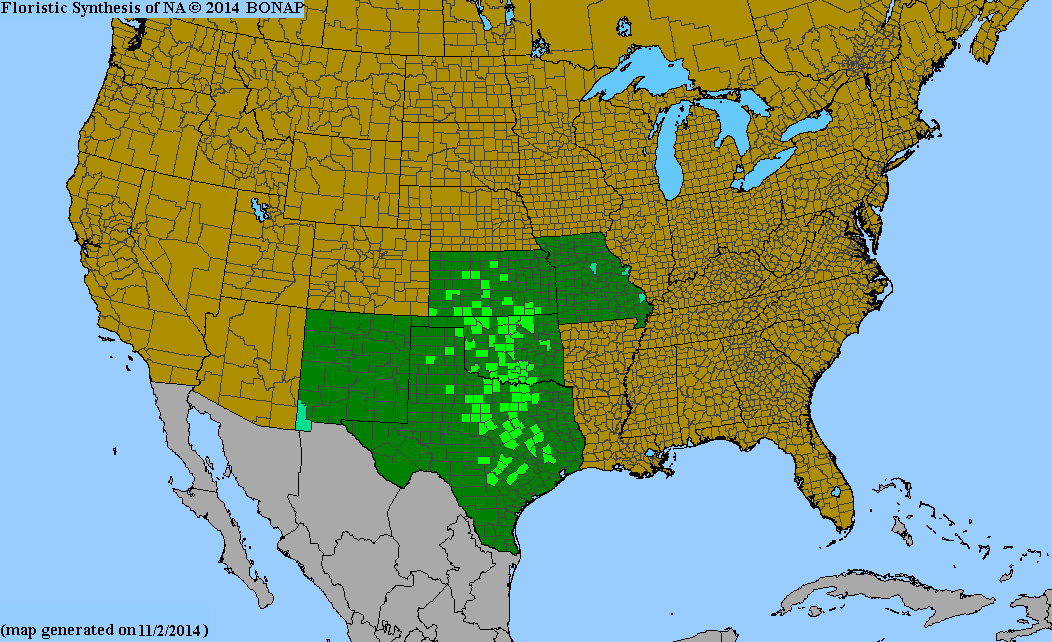
Desmanthus velutinus
map_of_Desmanthus_velutinus.jpg

Desmanthus%20velutinus.png

140622dt.jpg


- some tested positive but more tested negative. TLC by J. Appleseed ,1992 (ref Trout's Notes)
 
Some interesting info on Desmanthus illioensis...

There's this well-established research farm in Salina, Kansas called The Land Institute. Their principal focus is developing perennial polyculture agricultural systems for sustainable food production. The idea is that you can model farms on prairie ecosystems such that no tilling or fertilizer inputs are needed.

One of the key plants they've been researching and breeding for many years now is the Illinois bundleflower. It's important because, as a legume, it fixes nitrogen in the soil (in symbiosis with bacteria on its roots). Soil nitrogen is a vital plant nutrient which is depleted by successive crops--thus the general need to add fertilizers year after year. It also produces edible seeds.

Here's a link on their site for the abstract of a research paper on the subject.

This is what intrigues me the most:
There appears to be sufficient variation to support genetic improvement of agricultural characteristics of Illinois bundleflower.
While this plant may have low and variable concentrations of DMT, it's very possible that this trait could be selected for through breeding.

Think about that.

This is a plant that grows quickly, easily and in abundance on the prairie. It makes its own food. What if a plant that could provide a sustainable food source for humans and was grown on a massive scale could also provide the nutrition for a sustainable human MIND and SPIRIT on this planet and beyond?

One of these days, I hope to have my own research farm. An entheogenic, pan-sexual, inter-species breeding party to launch this orgiastic gaian mind into the eons before us.
 
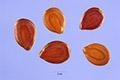
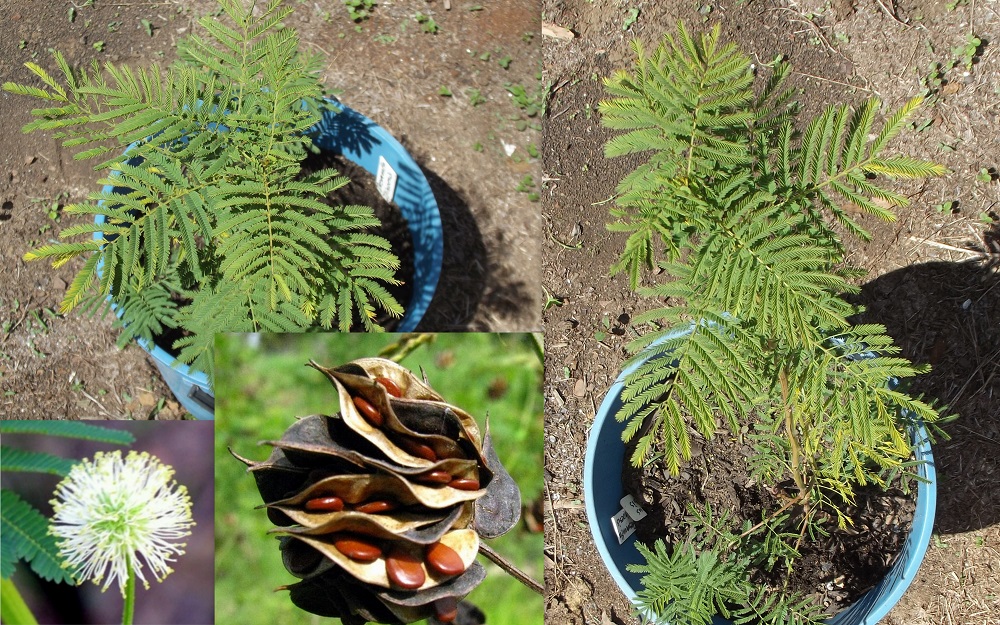
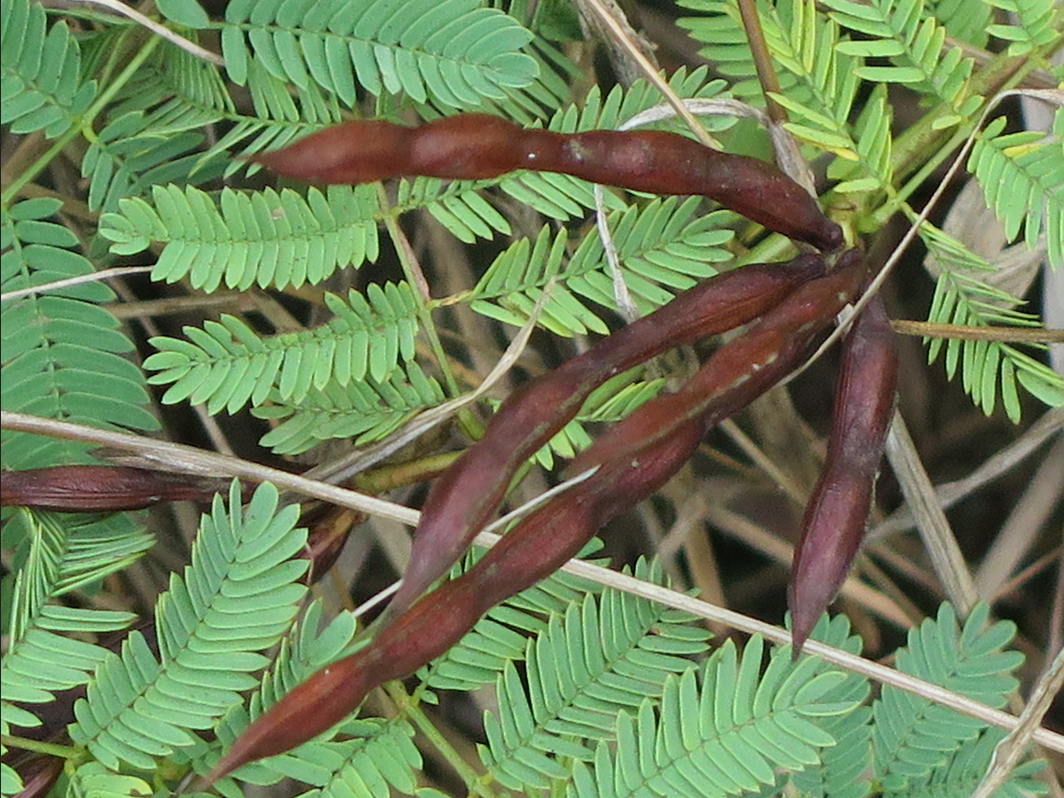
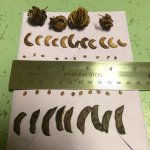
Tonight I was about to peel my bundleflower seeds, some are from plants that I raised and some are from wild plants. There was a big variation in the size of the pods and seeds. Everything else about the plants was identical, stems, leaves, flowers all the same. Shape of pod clusters, pods and seeds also the same. Only the wild plants had much larger pods, like double the size for some.

From the top is 1. Cultivated plant pod clusters (idk if that's the correct term).
2. Cultivated plant pods. 3. Cultivated seeds. 4. Wild seeds. 5. Wild pods.

Note. The wild clusters fell apart when I picked them so I only have pods.

The smaller ones are from an online vendor, the large ones were found growing in various locations along the north-central Gulf Coast of the United States.
 

Attachments

  • image.jpg
    image.jpg
    909.7 KB · Views: 4
Ordered some seeds recently, anyone have good advice?

i read somewhere that alkaloid content depends greatly on
the bacteria that live in legums, and give the plant nitrogen.
:?
All i can find is this saying Rhizobium giardinii is the bacteria.

i was just wondering
if there was a way, or is it necessary,
to collect / grow good bacteria tobe added to the legumes?

Maybe from an alibenzi mimosa?
 
I've found that they grow best in natural soil. If desmanthus occurs in your area then your soil should contain the fungus. The plants really don't need much help, just let them do their thing. You can trim them though if you want them more bushy, they tend to get lanky. If you direct sow in the ground, they sprout late in spring so don't get worried when all the other warm weather plants are out and the bundleflowers haven't sprouted yet. Last year the ones I direct sowed didn't sprout until April or May and I live on the gulf coast.

They attract plenty of bees and butterflies.

One thing you can do is plant them in a medium sized black plastic pot with local soil, when they become root bound just cut the bottom off the pot and bury it half way in the ground. When you harvest just cut the pot away and hose the roots off and collect. This way there's no need to dig so deep to get the roots. Makes things much easier.

I planted a lot of them, some I harvested in the fall, they grow relatively large tap roots in one season, though the older they get, the bigger the roots get. But most of them I left to continue growing. I'll harvest a few in spring and compare potency.

I suppose one could look at desmanthus as an annual crop, as long as they're allowed to set seed and reproduce.

I've found wild plants with very, very large tap roots, with these there's no need to take the entire root, a lateral root can be as big as the entire tap root of a one year old plant.

They also seem to enjoy being fed diluted ACRB brew every now and then. They seem very vibrant after.

Desmanthus is def a workable plant and deserves more attention.
 
For anyone who's seen or grown d. leptobolus, does the plant look the same as d. Illinioensis except for the seed pods or are there more differences?
 
It is much smaller and grows almost flat against the ground.
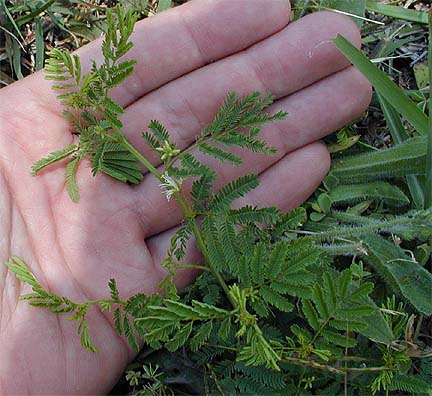
In their third year my plants were basically circular and about 16" wide. Those plants were something like 3-4" tall. The mimosa-like leaves were almost the same as illinoensis.
I took pics, I'm sure, but apparently I didnt rename them so theyre lost in a pile of ten thousand pics :lol:
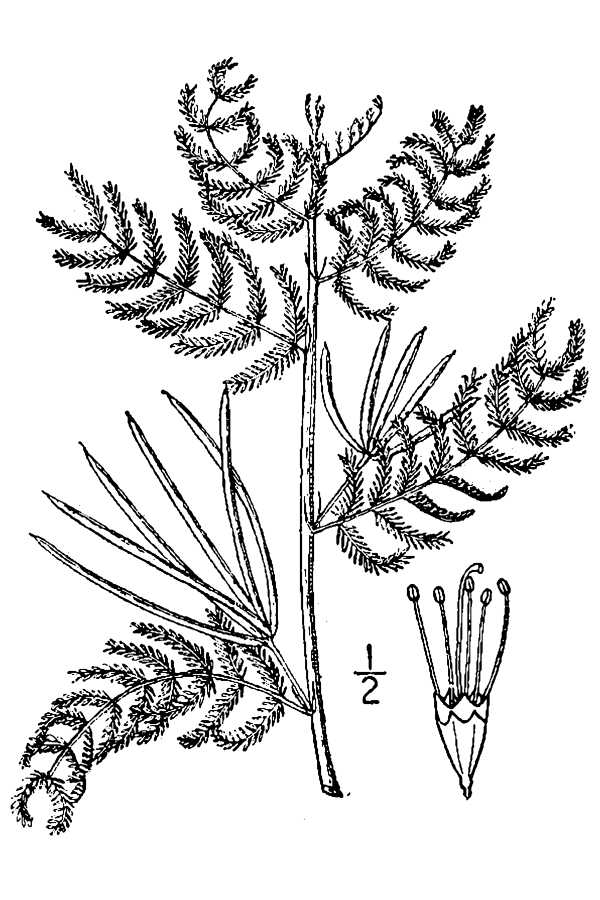
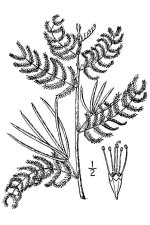
Heres a drawing of a branch (which would be laying on the ground)
 

Attachments

  • Desmanthus+leptolobus.jpg
    Desmanthus+leptolobus.jpg
    78.2 KB · Views: 1
Thank you all for the great infromation! :thumb_up:

Did anyone end up continuing tests? Curious as to storage recommendations as well as the variability in alkaloid content. Does it keep increasing as the plant ages?

I hope to collect a sizable sample this summer to do some testing with. Any other information would be awesome.
 
Last year I planted a dozen or so Desmanthus illioensis in my yard. They did their thing through the summer, and mostly died back to ground level in the winter. They are just starting to burst from the seems with new spring growth, I think this year they are going to get quite massive.

One thing I noted, the ones that I actually cut back the old dead growth early in the winter, are showing much more new growth then the ones I left the dead stock in place.


I will have to take some pictures!


I intend on letting them grow another season or two, and then seeing what magic they hold.
 
furhenden said:
Last year I planted a dozen or so Desmanthus illioensis in my yard. They did their thing through the summer, and mostly died back to ground level in the winter. They are just starting to burst from the seems with new spring growth, I think this year they are going to get quite massive.

One thing I noted, the ones that I actually cut back the old dead growth early in the winter, are showing much more new growth then the ones I left the dead stock in place.


I will have to take some pictures!


I intend on letting them grow another season or two, and then seeing what magic they hold.

The magic thing about bundleflowers is that one seed will turn into 1000s in one summer. I love this plant
 
They're quite abundant near my home (vicinity of the confluence of the Mississippi and Missouri rivers) so I don't have any plans for any controlled cultivation, but I do collect seeds at harvest, with the intent of scattering in appropriate places and spreading the desmanthus genome.


I've noticed they appear to prefer full sun and the specimens that I've found in deep silt (2 or 3 feet/ half to full meter, or better) and/or areas with frequent standing water, are typically magnitudes larger, with thickened taproots.

I found it was quite easy to liberate the root bark from the much harder root core, by smashing them with a hammer, but only when fresh. I have not found an effective method for separating the bark from dried roots.

From what I've seen in the literature, the nn dmt % is highest after going to seed in late summer but I can't verify.

If you were interested in planting on a larger scale, I've seen online vendors offering a kg of seed for US$20, as it is cultivated for animal feed throughout the US.
 
They're common here as well, near the mouth of the Mississippi. And I agree with all you said, except I have found them growing in a forest, under the canopy. But it was along a hiking trail, so perhaps someone planted them. Because not far from that spot, I found a spot on the edge of the forest, with an entire grove of them growing, much thicker than any natural growth I've found. I suspect someone planted those. But they will grow in the shade as well.
 
Back
Top Bottom