
I did mix the tincture with a bit of coca cola (acidic), approx. 40ml. But maybe that is too little?For this reason I would typically suggest adjusting the pH back to neutral with some ascorbic acid before oral ingestion

-
Members of the previous forum can retrieve their temporary password here, (login and check your PM).
You are using an out of date browser. It may not display this or other websites correctly.
You should upgrade or use an alternative browser.
You should upgrade or use an alternative browser.
Instant ayahuasca little lightening bolt TEK
- Thread starter Dorge
- Start date
Migrated topic.





I'm not sure. Definitive pH adjustment with a colourless substance seems preferable!I did mix the tincture with a bit of coca cola (acidic), approx. 40ml. But maybe that is too little?
Do you usually use a cola drink for this purpose, or generally with your brews?
This is the third time I've tried it, with the purpose of turning the DMT into a salt form. I feel ambiguous about it, but after 1+ year of drinking horrid vinegar brews I refuse to continue using vinegar. I've heard citric acid is more neutral-tasting acid, but have yet to try it.Do you usually use a cola drink for this purpose, or generally with your brews?
There are several other food acids which taste far better than vinegar! Besides citric and ascorbic acid, malic, succinic and tartaric acid all have a reasonable flavour profile. I go for ascorbic both because of its easy availability here and also because of it being a vitamin. It also pairs well with a bit of honey and a drop of lemon essential oil for masking harmala brewsThis is the third time I've tried it, with the purpose of turning the DMT into a salt form. I feel ambiguous about it, but after 1+ year of drinking horrid vinegar brews I refuse to continue using vinegar. I've heard citric acid is more neutral-tasting acid, but have yet to try it.

Would the product of the alcohol extraction after the lime treatment be pure enough for enhanced leaf/changa?
Also, would trace amounts of lime be (completely?) removed by running the tincture through a cotton ball filter? If it were only to remove trace amounts trapped in the upper layer, the process would simply be letting it run through the filter, yes?
Also, would trace amounts of lime be (completely?) removed by running the tincture through a cotton ball filter? If it were only to remove trace amounts trapped in the upper layer, the process would simply be letting it run through the filter, yes?
A cotton filter cleans it up nicely from lime. The thing to watch out for is mould if evaporating at room temperature, because of the water content. I'd advise use of a bain marie for evaporating the vodka-strength tincture. Redissolve in acetone or pure alcohol for mixing the changa.
Removing excess plant matter from the untreated vodka tincture was a more involved process than I had hoped for. The long and short of it is that you need to dilute the tincture with water because the vodka redissolves most of the precipitated plant matter once it thaws (unlike with water brews, where the plant matter conveniently sticks to the bottom).
The question now is whether there is still enough alcohol in there to prevent the lime to drag down the DMT along with tannins etc. So, it would be very useful to find out this:
Ideally, diluting with water would not cause an issue here. If really necessary some more ethanol could of course be added after the freeze/thaw cycles and before the lime step. (Evap of the alcohol before consumption seems preferable anyway, IMO).
But it is unclear to me whether 'dilutedness'/concentration of the alcohol matters for the lime step or if the issue is simply that there be enough ml of alcohol to hold the DMT, even if it is in a larger amount of water than initially.
That being said, I am probably done with this lime tek. I think it's a promising tek for convenient pharmahuasca but now that I have experienced first-hand (by way of contrast) the important role that the plants play in the experience, I will probably just continue working with alcohol brews for oral DMT adventures.
But for those who want to experiment further: it seems reasonable to assume that a freeze/thaw step would result in much less need for lime and hence a significantly bigger yield. (IMO it is unlikely that all the DMT is pushed up into the alcohol layer after the lime step, as Denverrevolution suggests. After pipetting off the alcohol of my first experiment, I diluted the remaining lime layer with water and it turned DMT-yellow, just slightly darker than the pipetted off alcohol layer. Though perhaps even negligible amounts of DMT could colorize water, I don't know.)
Will report back in the future if I have anything significant to share. Otherwise I probably won't be spending much time here anymore as I find that even small amounts of social media/internetting/etc. are disruptive to my peace of mind. Thanks for the help @Transform, I hope others will develop this tek further!
The question now is whether there is still enough alcohol in there to prevent the lime to drag down the DMT along with tannins etc. So, it would be very useful to find out this:
[This was a roundabout way of addressing the question about lower %ABV solvent - there is a yet-to-be-established lower limit where the solubility of DMT becomes too poor, and the lime precipitation would then co-occur with DMT. In such and instance, the DMT could still be recovered with a higher %ABV rinse.]
Ideally, diluting with water would not cause an issue here. If really necessary some more ethanol could of course be added after the freeze/thaw cycles and before the lime step. (Evap of the alcohol before consumption seems preferable anyway, IMO).
But it is unclear to me whether 'dilutedness'/concentration of the alcohol matters for the lime step or if the issue is simply that there be enough ml of alcohol to hold the DMT, even if it is in a larger amount of water than initially.
That being said, I am probably done with this lime tek. I think it's a promising tek for convenient pharmahuasca but now that I have experienced first-hand (by way of contrast) the important role that the plants play in the experience, I will probably just continue working with alcohol brews for oral DMT adventures.
But for those who want to experiment further: it seems reasonable to assume that a freeze/thaw step would result in much less need for lime and hence a significantly bigger yield. (IMO it is unlikely that all the DMT is pushed up into the alcohol layer after the lime step, as Denverrevolution suggests. After pipetting off the alcohol of my first experiment, I diluted the remaining lime layer with water and it turned DMT-yellow, just slightly darker than the pipetted off alcohol layer. Though perhaps even negligible amounts of DMT could colorize water, I don't know.)
Will report back in the future if I have anything significant to share. Otherwise I probably won't be spending much time here anymore as I find that even small amounts of social media/internetting/etc. are disruptive to my peace of mind. Thanks for the help @Transform, I hope others will develop this tek further!
Thank you for trying this out, I hope to be able to add to the technical notes over the coming months.
1)
I am trying out the lime tek with 100g of MHRB & 900ml ethanol. Will post an update with pics on the process once completed.
However, one 'weakness' of this tek is that ethanol is rather expensive [and preferable over vodka for easier evaporation and over IPA as well because a significantly more effective solvent in terms of getting DMT out of the bark, IME], so a way to recover the solvent would be good. If most of the solvent could be recovered, this would also make dilution to compensate for the large lime layer very feasible [will give more on a dilution step in a future post].
I've gathered that freeze precipitating DMT out of alcohol wouldn't work well. So that leaves the option of distilling the alcohol (except a small layer holding the DMT to then be evaporated, so that no DMT gets burned during the distillation process).
Anyway, since the goal is saving money I don't want to buy expensive distillation equipment. I'm thinking of attaching a tube like this to my Erlenmeyer flask, running it through an inverted plastic bottle filled with ice cold water and letting the hose drop in a jar to collect the distilled alcohol. Then heating the erlenmeyer in a hot water bath on the stove [with the bottle standing on a metal grid in a pot filled with water for continued heating]. More or less like what is done in this video.
Any educated guesses if that would work well enough? My main concern is the safety of the hose. The silicone hose I linked is supposed to be heat resistant and food grade. Does anyone know if I can trust that?
2)
I assume this tek would work with ACRB. If so, would the NMT in acacia also end up in the alcohol layer along with DMT freebase?
Thanks ahead.
I am trying out the lime tek with 100g of MHRB & 900ml ethanol. Will post an update with pics on the process once completed.
However, one 'weakness' of this tek is that ethanol is rather expensive [and preferable over vodka for easier evaporation and over IPA as well because a significantly more effective solvent in terms of getting DMT out of the bark, IME], so a way to recover the solvent would be good. If most of the solvent could be recovered, this would also make dilution to compensate for the large lime layer very feasible [will give more on a dilution step in a future post].
I've gathered that freeze precipitating DMT out of alcohol wouldn't work well. So that leaves the option of distilling the alcohol (except a small layer holding the DMT to then be evaporated, so that no DMT gets burned during the distillation process).
Anyway, since the goal is saving money I don't want to buy expensive distillation equipment. I'm thinking of attaching a tube like this to my Erlenmeyer flask, running it through an inverted plastic bottle filled with ice cold water and letting the hose drop in a jar to collect the distilled alcohol. Then heating the erlenmeyer in a hot water bath on the stove [with the bottle standing on a metal grid in a pot filled with water for continued heating]. More or less like what is done in this video.
Any educated guesses if that would work well enough? My main concern is the safety of the hose. The silicone hose I linked is supposed to be heat resistant and food grade. Does anyone know if I can trust that?
2)
I assume this tek would work with ACRB. If so, would the NMT in acacia also end up in the alcohol layer along with DMT freebase?
Thanks ahead.
Great to hear from you, literally only yesterday was I wondering how you were doing!
As far as home distillation goes, there's also the option of building (much of) the apparatus out of copper pipe, joints and fittings. I've done so myself and it wasn't so difficult. I may have a few practical skills but I'm far from being an expert. Building a Liebig condenser this way is barely intermediate level, the main trick being that you should be able to reliably make watertight solder joints.
If you can't be bothered with this, the silicone tubing will make a functional alternative, but again, you have to be sure that the seal around the exit pipe is firm, otherwise you'll get coolant in your distillate.
NMT freebase will certainly dissolve in ethanol. I'm guessing you're going for a dried lime paste before making the alcohol pulls, after the disappointment and frustration of the vodka/lime precipitation experiment - something which, incidentally, I'm still rather sorry you had to go through.
As far as home distillation goes, there's also the option of building (much of) the apparatus out of copper pipe, joints and fittings. I've done so myself and it wasn't so difficult. I may have a few practical skills but I'm far from being an expert. Building a Liebig condenser this way is barely intermediate level, the main trick being that you should be able to reliably make watertight solder joints.
If you can't be bothered with this, the silicone tubing will make a functional alternative, but again, you have to be sure that the seal around the exit pipe is firm, otherwise you'll get coolant in your distillate.
NMT freebase will certainly dissolve in ethanol. I'm guessing you're going for a dried lime paste before making the alcohol pulls, after the disappointment and frustration of the vodka/lime precipitation experiment - something which, incidentally, I'm still rather sorry you had to go through.
Back sooner than expected with a question. I am gradually adding lime to see the effect on the solution. This is with a 100g MHRB ethanol soak.
Pic 1 = the solution without lime after filtering the MHRB.
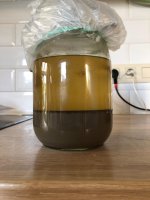
Pic 2 = approx. 24h after adding 33g lime.
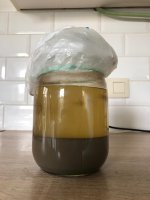
Pic 3 = approx. 24h after adding 7g extra lime (40g lime total).
[With 20g lime, the top layer remained near-black in color; I forgot to take a picture.]
My question: When should I stop adding lime? @Denverevolution's pics show an extremely pale lime layer, but previous posts by @Transform suggest that this may be excessive.
I intend to use to final product for pharmahuasca, so I suppose it does not matter too much, but I'd like to know how pure the extracted DMT should be if one were to make enhanced leaf / changa with this method. [Though I still wonder about the safety of potentially smoking invisible lime particles?].
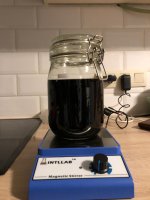
Pic 1 = the solution without lime after filtering the MHRB.
Pic 2 = approx. 24h after adding 33g lime.
Pic 3 = approx. 24h after adding 7g extra lime (40g lime total).
[With 20g lime, the top layer remained near-black in color; I forgot to take a picture.]
My question: When should I stop adding lime? @Denverevolution's pics show an extremely pale lime layer, but previous posts by @Transform suggest that this may be excessive.
I intend to use to final product for pharmahuasca, so I suppose it does not matter too much, but I'd like to know how pure the extracted DMT should be if one were to make enhanced leaf / changa with this method. [Though I still wonder about the safety of potentially smoking invisible lime particles?].
Thanks for this tidbit - it roughly aligns with the ABV for acorn tannin precipitation as suggested by the Chinese team. Perhaps this will help inspire some further experimentation during the (boreal) winter.There is a doctoral thesis by Alan Gaujac in Brazil, in which he found that the 50% ethanol, 50% water solution was the solution that extracted the most DMT.
Thanks for the update. I'd say that's looking pretty good. Filtering through a cotton plug should clear up much of that cloudy lime residue - but see also below.Back sooner than expected with a question. I am gradually adding lime to see the effect on the solution. This is with a 100g MHRB ethanol soak.
Pic 1 = the solution without lime after filtering the MHRB.
Pic 2 = approx. 24h after adding 33g lime.
Pic 3 = approx. 24h after adding 7g extra lime (40g lime total).
[With 20g lime, the top layer remained near-black in color; I forgot to take a picture.]
My question: When should I stop adding lime? @Denverevolution's pics show an extremely pale lime layer, but previous posts by @Transform suggest that this may be excessive.
I intend to use to final product for pharmahuasca, so I suppose it does not matter too much, but I'd like to know how pure the extracted DMT should be if one were to make enhanced leaf / changa with this method. [Though I still wonder about the safety of potentially smoking invisible lime particles?].
View attachment 101118
View attachment 101119
View attachment 101120
Your concerns about lime carry-over making its way into smoking mixtures can be allayed somewhat in knowing those particles will most probably be calcium carbonate already, or will otherwise get converted fairly rapidly on storage. A deliberate treatment with carbon dioxide may be worth considering, if there seemed to be excessive lime residue.

@Denverevolution thank you for taking the time to do this!At worst, my take is that Transform was being a bit lazy in saying "I think this could work, and I really hope someone tries it out, but I don't have the time/energy myself to do it." But from my perspective, he was being open about his preference to have someone else test his idea, and I was all-too-happy to try it.
For me, the lime step was welcome. I've personally gotten sick every time I've drank enough Aya to have a strong experience, and I didn't get sick either of the times I drank the final product from this process (after using lime), so that's one data point.
I never tried it without the lime, so I think you would be in a better spot to compare the experience with and without the lime step. We still don't know how much DMT potency we're losing with the lime step, nor how much vomit-inducing tannins and other crap.
I have a batch going now that I'll finish and take to the lab, and I'll continue to revise this into simple text for a written tek. For now, its in a Google Doc here, and I'd really appreciate any edits/contributions from either of you:

Alcohol Lightning Tek
Alcohol Tek This extraction technique is designed to be as simple as possible. The DMT yielded is much more pure than ayahuasca (Not likely to make you sick), suitable for oral, rectal, or possibly insufflated ROAs, but not clean enough to vape/smoke, so for now, we’re suggesting consuming it or...docs.google.com
I found this crazy useful. Do you have any updates? Especially the bulk instructions? Or additions for the other brew ingredients. This will be my first run at extracting this way, rather than the traditional water methods. This whole thread was/is an education.
Thank you all!
Just checking in here to clarify, you'll be trying the vodka pulls followed by tannin removal using lime? If this is the case I shall be awaiting reports with eager anticipation!@Denverevolution thank you for taking the time to do this!
I found this crazy useful. Do you have any updates? Especially the bulk instructions? Or additions for the other brew ingredients. This will be my first run at extracting this way, rather than the traditional water methods. This whole thread was/is an education.
Thank you all!
If we have a few more people trying the TnT* vodka+lime tek, it's high time we peel it off into its own thread.
[*TnT= "Thinking 'n' Tinkering" - thanks, RMS!]
对于任何给定量的酒精,建议最大限度地使用植物材料。使用 50g MHRB 和 300mL 伏特加,在热提取后,单宁在室温下会沉淀几天。
你测量过冰箱的温度吗?伏特加在冷冻时是否放在密封容器中?-22°C 似乎是冰晶分离的最佳温度,尽管这仍需要用实际温度计进行确认,因为(家用)冰箱上的恒温器尚未校准。
伏特加酒是去除单宁酸的最佳选择,方法是用石灰处理。它还具有价格低廉、易得和食品级的优势,至少在前两点方面,大多数地方都是如此。最近,我们进行了一项简短的测试,将 69.5% ABV 的谷物酒通过装有单宁酸石灰沉淀物的过滤漏斗,结果表明,相当一部分单宁酸重新溶解在浓酒中。因此,伏特加酒还可以节省石灰的使用量——虽然石灰价格相对便宜,但更多的石灰也会使混合和过滤变得更加
Can gelatin be used in tinctures to precipitate tannins? Some people in Taiwan use gelatin to precipitate tannins in tree bark decoctions. I wonder if it is feasible in alcohol?For any given volume of alcohol it would be advisable to maximise the amount of plant material used. With 50g MHRB and 300mL vodka, tannins precipitated over the course of several days at room temperature following the hot extraction.
Have you measured the temperature of your freezer? And did you keep the vodka in a tightly-sealed container while it froze? -22°C appears to be optimal for ice crystal separation, although this still needs confirmation with an actual thermometer since the thermostat on the (domestic) freezer has not been calibrated.
Vodka-strength alcohol has been found to be optimal for tannin removal via lime treatment. It also has the advantage of being cheap, readily available and food grade, at least in most places as regards the first two points. Recently, a brief test with running 69.5% ABV grain spirit through a filter funnel filled with the tannin-lime precipitate showed that a noticeable proportion of the tannin redissolves in the stronger alcohol. Thus, vodka-strength alcohol also brings efficiency savings regarding lime usage - more lime, while being relatively cheap, also becomes more tedious both to mix and to filter.
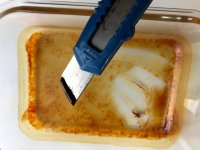
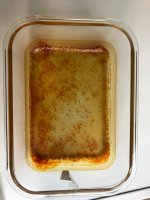
So, I finally got around to transferring the DMT ethanol layer from the lime layer and evaporating the alcohol (see post #153 above).
See pics attached for the result. It's brown and goo-ish, as expected.
Not sure how much DMT is in there, hard to weigh sticky goo. I plan to redissolve the goo in a small amount of alcohol, then weigh the solution and subtract the weight of the pure alcohol and the container it is in-- although I still won't know how much of that weight is actual DMT vs plant matter. Will update once I've done so. Then I will probably add mullein to turn it into enhanced leaf.
Has something happened to Transform? Anybody know if he will be returning to the forum?
See pics attached for the result. It's brown and goo-ish, as expected.
Not sure how much DMT is in there, hard to weigh sticky goo. I plan to redissolve the goo in a small amount of alcohol, then weigh the solution and subtract the weight of the pure alcohol and the container it is in-- although I still won't know how much of that weight is actual DMT vs plant matter. Will update once I've done so. Then I will probably add mullein to turn it into enhanced leaf.
Has something happened to Transform? Anybody know if he will be returning to the forum?
Attachments
Last edited:
Similar threads

- Replies
- 3
- Views
- 373
- Replies
- 10
- Views
- 1K


