• Members of the previous forum can retrieve their temporary password here, (login and check your PM).

liquid-liquid kratom extraction from isopropanol

Migrated topic.

meluzine

true love will find you in the end. •93•
I have around 400ml of 99% isopropanol that had 25 of kratom soaking in it in both hot and cold temperatures. I filtered it thrice.
Right now it is a deep black color which is green when diluted, I want to remove all the chlorophyll and tannins, and other impurities from this product.

Would basifying the mildly acidic isopropanol/kratom/citric acid layer with diluted lye, then extracting the freebased alkaloids in NPS?

Alternatively could I evaporate the isopropanol and wash the resulting solid with something that would pick up resins and chlorophyll without also picking up the mitragynine and other actives?

I could also do an A/B on the product produced after evaporating the iso, but I would like to avoid evaporation right now, as its very cold in my country and it would take a very long time.

Any ideas on getting as clean as possible extract from my current liquid?
I have glassware, xylene, naphtha, lye, 10% vinegar, and acetone leftover from another extraction as well as a deep freeze to use.
 
I have already searched for kratom extraction teks, the reason I made a specific post is because I want a specific answer to using isopropanol in place of water for basifying before pulling with a non-polar solvent.
 
Isopropanol will be partially soluble in your non-polar solvents so you may be better off evaporating it. This will yield a resin which you might be able to dissolve at least partly in slightly acidified water [this would be a good point to try is a defat on the acidified resin solution], followed by base, NPS, "etc"... you'd need to look through the kratom/mitragynine extraction threads for solubility of mitragynine/kratom alkaloids in various solvents.

Another option is to make the resin into a paste with sodium carbonate or calcium hydroxide and either pull that paste with whichever one of naphtha or xylene seems best (my hunch is xylene) or dry it out and pull with acetone for a more crude extract.

I haven't tried any of this, these are just standard extraction techniques that can be applied to your situation.

The other thing to apply is the Golden Rule of extraction - don't toss anything until you're sure you've got the goods! (This would include the kratom leaf, just in case isopropanol is a poor solvent for the kratom alkaloids. Maybe you checked this before starting the extraction - didn't you?)
 
thank you for the reply downwardsfromzero, re-dissolving the resin in acidic water should hopefully pick up the alkaloid, though it is poorly soluble in neutral water, then doing a defat is a great idea for cleaning it up. I will use xylene to extract from the aq. layer and see if I can get anything from it.

and the reason I used isopropanol is because it has generally similar properties as a solvent to ethanol but is available in much higher concentrations. also i am using lab grade iso which is free of bitterants or additives.
 
here is an update as of now for anybody interested.

It was easier to evaporate the isopropanol and redissolve it into acidic water than to extract directly from the isopropanol obv. after I did that I used naphtha for a defat while the PH was still low, but I had less naphtha than I thought so I only did one pour. after separating as much of the nahptha as possible I started raising the PH, I used 4g of lye dissolved in water at first but ended up using around 18g to bring it to a 10 on my PH scale.
I think i could have used less lye if I kept the liquid at less volume.

Then I poured about 400ml of xylene for the first pull. I forgot how noxious of a solvent this was, even with good ventilation the semi sweet smell lingered for an hour or so.

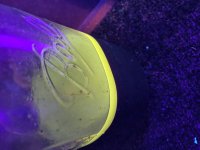
I checked using my black light to see if the non polar layer was flourescent, since I read that in other solvents it was. I was very happy when i turned on the black light and saw that thing low like a highlighter!
I let it bask in the UV-B light for an hour, hopefully helping to oxidise some of those molecules to 7-Hydroxymitragynine, though I admit I dont know much about that reaction yet, maybe using only UV-B wont cut it. anyway the fluorescence is a good sign.

at this point im letting the xylene sit in the dark over night.

Should i try to Freeze precipitate the final yield, or is evaporating the solvent the only way here?
undefined
 

Attachments

  • 20211018_200545.jpg
    20211018_200545.jpg
    2 MB · Views: 3
Back
Top Bottom