As I wait for my larger crop, I was able to scrounge another 106 g of P. brachystachys, mostly outdoor-grown. I used this for another batch with an improved method, ending in crystals of nearly gramine-free 5-MeO-DMT oxalate.
Extraction of Grass into Cold Water
As usual, the grass was frozen for storage, then chopped coarsely and placed in a 500 mL beaker. In a first pull, I simply covered it with 242 g of DI water and stirred by hand for a minute or so. No acid was used, but natural pH was 6.0 so that didn't seem obviously necessary. The grass was initially still frozen, so temperature was just above 0 C. This yielded 43% of my final total. I then sonicated for 20 min in an ice bath, increasing the yield in that first pull to 53% of total.
I did a second pull, also in an ice bath, this time with 200 mg citric acid, reducing pH to 3.9, and again sonicated. This yielded 27% of total.
I did a third pull, this time at 50 C, with 100 mg citric acid reducing pH to 3.6. This yielded 14% of total. A fourth identical pull yielded 6% of total.
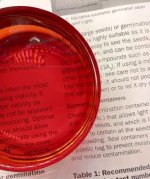
All the pulls were light green in color. In the first two, fine green sediment was easily distinguishable at the bottom, perhaps implying that the chlorophyll and other fats came off in bigger pieces at lower temperature? I combined the first three pulls and tried to filter under vacuum, but the filtrate was still green and the paper clogged. I tried a few mm of Celite 545, and for once that worked--the filtrate went from cloudy green to a beautiful pale red-brown, crystal clear.
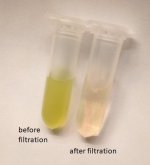
I reduced to 85 mL. This precipitated some light brown stuff with a cottage cheese consistency, but that stuck together in clumps and the solution remained clear. After three days in the fridge (which I'd guess were unnecessary; I just was busy), that was easily filtered.
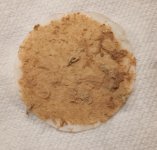
I'm pleased to have separated off those fats, which were going into an emulsion for me before. I suspect those are much easier to separate before reduction. (I made cacio e pepe last night, confirming that vigorous boiling is a great way to form and stabilize an emulsion.) I need to experiment more to determine what combination of the cold initial extraction vs. filtration accounts for this improvement.
Extraction of Water into Limonene
I titrated with solid potassium carbonate to pH 11.1. The solution turned darker and cloudy. I stirred it to suspend the solids as uniformly as possible and took a 20 uL sample for analysis, which I added to 1 mL of mobile phase and 80 uL of 10% citric acid (since the eluent is acidic, but weakly enough that the large amount of potassium carbonate overcomes that). This showed 83 mg 5-MeO-DMT, plus the usual smaller areas of DMT and gramine.
I extracted once with 25 mL limonene and re-tested the water, which dropped to 6.4 mg, 8% of initial. I extracted again with another 25 mL, and it dropped to 0.6 mg, 1%.
I combined the two limonene pulls, and extracted with 20 mL DI water. This initially went to pH 9.6, and pulled about 4 mg 5-MeO-DMT. (I was initially undecided as to whether I was washing or extracting; but that pulled enough I chose "extracting"). I titrated with oxalic acid, eventually reaching pH 4.5 with 30 mg acid. This would be about right for 5-MeO-DMT oxalate dibasic, so I stopped there. A sample of the water showed 69 mg 5-MeO-DMT.
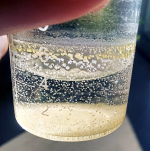
The extraction from limonene back into water proceeds rather slowly. I'd thought I was done when I reached my target pH after a few minutes of stirring, but five minutes later it had risen back to 7.8. If mechanical stirring is unavailable then this step will require some endurance. The initial extraction from water into limonene goes much faster. I was stirring pretty vigorously, with a big vortex and an apparently homogenous mixture. Since filtering off the fats per above, I've had zero trouble with emulsions, with clear separation within seconds of stopping stirring and a perfect interface after just a few minutes.
I pulled the limonene with another 20 mL water. pH fell to 2.9 with just 5 mg oxalic acid, suggesting very little alkaloids remained. A sample of that water showed 3 mg 5-MeO-DMT.
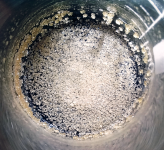
I evaporated the first water pull on a 75 C water bath under an air stream, yielding an orange-yellow resin with slight odor.
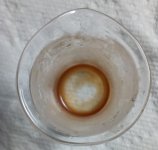
I redissolved that in 99% food-grade ethanol, which was cloudy even with 7 mL solvent and long sonication. I let that settle and decanted, leaving a very thin film of sediment. Potassium oxalate is reported to be insoluble in ethanol, so maybe some potassium carbonate carried over?
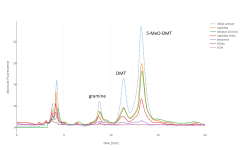
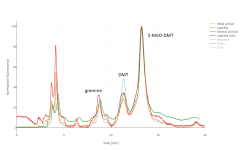
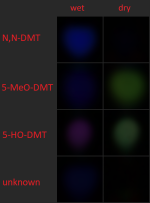
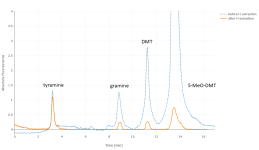
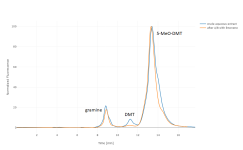
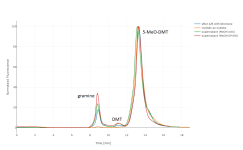
A sample of this ethanolic solution shows 71 mg 5-MeO-DMT. Comparing the chromatograms of this product and the initial aqueous extract, we see that our gramine is depleted (versus 5-MeO-DMT), but not significantly so. DMT is significantly depleted, as expected from my smaller-scale experiments earlier. If we were targeting DMT, then this method would actually enrich our extract in gramine, the wrong direction.
I like the limonene, though. The toxic and fire hazards aren't zero, but they're much lower than other options. It's volatile enough that my product has no significant odor. It should be reusable too, though I haven't tried that yet.
Crystallization
I reduced the ethanolic solution to about 0.5 mL, then left it to cool and evaporate at room temperature. This resulted in the same resin as I'd obtained when I evaporated the water, no crystals.
I tried redissolving in isopropanol, but it was only slightly soluble (about 3 mg/mL 5-MeO-DMT) so I abandoned that and evaporated. I redissolved in 1 mL ethanol, and titrated with a 5% solution of oxalic acid in water to pH 2.0, 800 uL for an additional 40 mg acid. I evaporated this to dryness at 50 C, and got the usual resin.
I'd intended to redissolve that in ethanol and slowly evaporate, so I added 0.5 mL and sonicated; but instead the whole thing abruptly formed tiny crystals, I guess since the ethanol instead acted as an antisolvent.
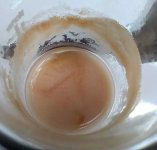
I added 3 mL more ethanol, but very little dissolved, in contrast to the easy solubility at higher pH. I added 2 mL methanol but it still didn't dissolve. I evaporated off the mixed alcohols at 50 C, and the alkaloids returned to the amorphous yellow resin. I added pure methanol, just barely redissolving all of it in 2 mL with sonication at 50 C.
I allowed the methanolic solution to cool and evaporate at room temperature for about five hours, after which I observed larger crystals at the bottom.
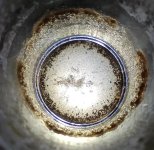
A sample of the supernatant still showed about half the alkaloids in solution. I added 99.9% isopropanol dropwise, and saw rapid crystallization with each drop. That stopped a little before 2 mL. I carefully syringed off the supernatant, washed the crystals in 2 mL ethyl acetate, syringed that off, and dried the crystals, obtaining 53 mg. The product lost most of its luster after washing and drying, but was still visibly crystalline.
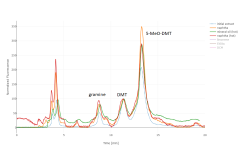
I dissolved the crystals in water, obtaining pH around 3.0, roughly as expected for the monobasic salt of oxalic acid. This took considerable effort, about ten minutes sonicating at 50 C. The gramine and DMT are both depleted to almost nothing. Comparing against my standard, the peak area implies 45 mg 5-MeO-DMT. I've unfortunately forgotten whether my standard was a freebase or salt, so I need to go back and check if that's reasonable; but regardless, I think this looks good.
I'd taken samples of the supernatant after this crystallization from methanol, and then also after adding isopropanol. They showed increasing enrichment in gramine, consistent with a pure precipitate. I also sampled the ethyl acetate wash, and it showed negligible alkaloids. Most of the remaining color was removed with the ethyl acetate.
I'd saved my supernatant and it continued to crystallize, so I probably should have waited longer here (unless that was gramine...). I evaporated that to dryness at 50 C, and it returned to the resin. I redissolved in 2 mL methanol and left it to crystallize overnight. That was too long, and the solvent evaporated completely; but the residue looked crystalline. I tried to suspend that in ethyl acetate, but the whole thing returned to resin. Nothing visibly dissolved with scraping or sonication, and the solvent didn't turn yellow; so I don't think anything good was happening. I evaporated that, and redissolved in methanol. I'll keep experimenting and see what I can learn from that remaining product.
Conclusions
I believe that:
- With careful filtration (or other mechanical separation, maybe a week or so settling), chlorophyll and other plant fats can be removed from the aqueous extract before boiling to reduce. This fixes all trouble with emulsions, and improves the color from dark brown to orange-yellow. I don't know whether this is necessary for the subsequent crystallization.
- Room-temperature limonene effectively extracts 5-MeO-DMT from water. Gramine is depleted slightly, but not usefully so. DMT is extracted less effectively, significantly depleted with respect to 5-MeO-DMT or gramine.
- Oxalic acid will indeed crystallize 5-MeO-DMT from Phalaris extract. This may occur only at pH ~ 2.0, I guess implying crystallization only as the monobasic salt. I can't find anything useful in the literature on this.
- At this low pH, the 5-MeO-DMT oxalate is somewhat soluble in methanol and water. It's not very soluble in ethanol, isopropanol, or ethyl acetate. Oxalic acid is quite soluble in the latter three, so excess free acid should be effectively removed if those are used to wash or as an antisolvent. Most of the color is also removed.
- This crystallization separates the gramine, because gramine oxalate is some combination of more soluble and less initially abundant.
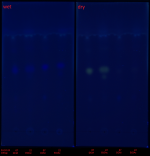
- A simpler crystallization might also work, like precipitation directly from the limonene, perhaps followed by washing in ethyl acetate. I just didn't want to try that first, since it's more trouble to recover from if it fails. If anyone wants a project, then TLC is sufficient to judge success.
- I'll try crystallizing more until I get gramine, and that should give a sense of how much initial gramine we can tolerate.
Overall I'm quite pleased here. The final product looks pure enough that it could simply be weighed, enabling accurate dosing without analytical facilities. More research is needed, but I think this has potential to be relatively safe. 5-MeO-DMT has the dubious advantage that it's more toxic per unit weight than almost all impurities, so that failed separation will result in disappointment rather than poisoning.
Smoking the oxalate seems like an unusually bad idea, but the gramine-free salt could of course be returned to freebase. The pH seems unpleasantly low for sublingual too, so I might try that next, following Ott and
@neurobloom. I guess I could also just titrate up with baking soda. I recently tried some unfermented kanna, which is high in natural oxalates (~0.5% fresh weight) around pH 5, with no irritation. This extract would be a lower total dose of oxalate, though about 3x that concentration.
As to subjective effects, I took the last of my previous batch in doses of ~10 mg 5-MeO-DMT with a similar amount of mixed harmala alkaloids sublingually. I felt the potentiation that Ott reported, a much stronger euphoria, intensely and purely physical. The psychological effects are harder to articulate, but certainly present. It's a less popular drug than DMT for good reason; but since I'm currently well-equipped to study it, I plan to proceed.
This method won't work well for DMT, since the limonene depletes that significantly. A similar method might work, with more and hotter limonene pulls, and a different salt and solvents for crystallization.
Edit: Simplify discussion of crystallization, which was rather confused before.