• Members of the previous forum can retrieve their temporary password here, (login and check your PM).

Research The nexian phalaris breeding programme

Research done by (or for) the DMT-Nexus community
The alkaloid concentration and composition of Phalaris aquatica can appear quite erratic.

Season, soil, and climate all influence the alkaloid profiles, and the interactions are complex and heterogeneous. Some plants fluctuate strongly, while others maintain a stable and potent profile across repeated tests. One thing we haven’t observed, though, is a plant switching between DMT and 5-MeO-DMT dominance.


This has direct implications for how we approach selection:
  • All plants are tested, and the weakest 50% are discarded
  • The process is repeated two more times with the remaining plants

As a result, any plant that makes it into the breeding line has been tested 3 times. This strongly favors individuals with both high yield and stable profiles.

The data collected during this process could eventually help us better understand these fluctuations. For now, though, most of the testing capacity is focused on selective breeding.

This season is going very well so far—I’ll post an update soon.
look u know what i think soli and climat test are great idea. i am gardener for a living and i wanna know more. can u tell me specific what soli and climate surcomestances u want to try ?
 
so how close are we to usable plants?
 

Enhancements in Thin-Layer Chromatography (TLC) Protocols


This season’s workflow saw several key upgrades to our TLC testing, focusing on sample prep efficiency and high-precision digital analysis. We shifted toward a more robust extraction method and integrated custom hardware for both sample loading and data acquisition.

1. Sample Preparation & Extraction

To ensure a high concentration of target analytes, we refined the extraction ratio and alkaline environment.
  • Protocol: 25 mg of desiccated leaf tissue is submerged in 1.0 mL of Methyl tert-butyl ether (MTBE).
  • Alkalization: 3 drops of aqueous ammonia are added to facilitate the release of free-base alkaloids.
  • Duration: Following a period of vigorous mechanical agitation, the samples are left to macerate for 8 hours to reach extraction equilibrium.

2. Precision Spotting

We moved away from manual capillary spotting to achieve better resolution and reproducibility.
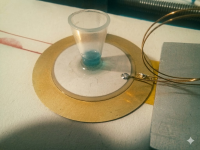
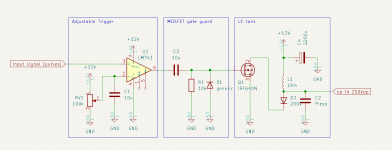
  • Hardware: A custom piezoelectric TLC loader was developed, utilizing a modified piezo buzzer as the micro-dispensing head.
  • Result: This allows for the application of narrow, uniform "lines" rather than erratic spots, significantly reducing band broadening during development.

3. Chromatography Parameters

We opted for a straightforward, high-polarity mobile phase to suit our specific chemical targets.
  • Stationary Phase: Unmodified 60Å Silica Gel (non-fluorescent) TLC plates.
  • Mobile Phase: Isopropanol (IPA) and 25% aqueous ammonia in a 12:1 ratio.
  • Method: Ascending development in a saturated chamber.

4. Digital Imaging & Fluorescence Induction

The most significant leap was in our detection and quantification setup. By bypassing standard consumer cameras, we gained much better raw data control.
  • Sensor Logic: Plates are imaged using an IMX462 back-illuminated sensor. This sensor is particularly effective due to its high near-infrared (NIR) sensitivity and low noise floor.
  • Processing: Raw data is pulled directly from the Bayer array via MIPI-CSI onto a Raspberry Pi, allowing us to process the signal without aggressive compression artifacts.
  • Excitation: Dual-wavelength UV LEDs are used to induce fluorescence:
    • 275 nm: For short-wave excitation of primary aromatics.
    • 365 nm: For long-wave fluorescence of conjugated systems.


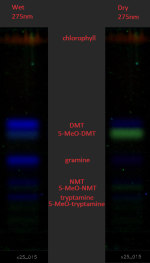
Exemplary Plate Analysis:
20260504_1__275w.jpg
wet plate exposed to 275nm

20260504_1__275d.jpgdry plate exposed to 275nm
 

How to Interpret a Rich Phalaris aquatica TLC Profile


The image shows an example TLC lane from a particularly rich sample within the Phalaris aquatica breeding line, annotated with the identified compounds at their positions.

Methoxylated and non-methoxylated compounds typically occur in pairs, with the methoxylated compound showing a slightly lower Rf value than its non-methoxylated counterpart.

1778076304298.png

As visible in the image, interpretation of this example lane is relatively straightforward.
 
I’m using a modified 27 mm piezo element from AliExpress (20 pcs for around $1).

To adapt it, I ground away the lead zirconate titanate material in the center, created a small hole in the metal base plate using a tungsten carbide needle, and epoxy-glued a small funnel above the opening holding the sample fluid.

1778140758570.png


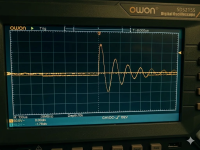
The piezo is driven with short pulses to dispense individual droplets.
1778140512232.png
1778140730753.png

For positioning, I use a NEMA 11 linear drive to move the piezo above the TLC plate while pulsing. Droplets are deposited with a spacing of approximately 200 µm.
 
I’m using a modified 27 mm piezo element from AliExpress (20 pcs for around $1).

To adapt it, I ground away the lead zirconate titanate material in the center, created a small hole in the metal base plate using a tungsten carbide needle, and epoxy-glued a small funnel above the opening holding the sample fluid.

View attachment 109305


The piezo is driven with short pulses to dispense individual droplets.
View attachment 109301
View attachment 109303

For positioning, I use a NEMA 11 linear drive to move the piezo above the TLC plate while pulsing. Droplets are deposited with a spacing of approximately 200 µm.
Fabulous, thank you very much indeed! This alone deserves highlighting in its own thread somewhere nearby (y)
 
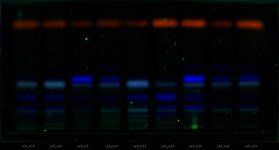
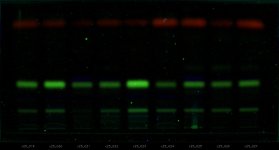
Breeding for DMT Produces Three Distinct Chemical Types in Phalaris aquatica

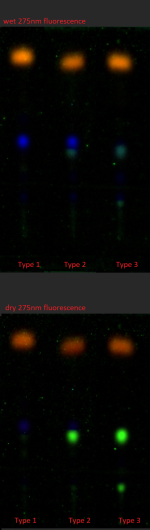
Following selection and selective breeding of Phalaris aquatica for DMT and related tryptamines, three distinct chemical profiles have emerged within the breeding line. These chemotypes appear to be genetically determined; individual plants do not switch between them. However, the relative proportions of individual alkaloids can vary somewhat depending on environmental factors such as climate and season.

Type 1: DMT-dominant
Type 2: DMT and 5-MeO-DMT
Type 3: 5-MeO-DMT and 5-MeO-NMT

1780686191161.png

The precise psychedelic properties associated with these different chemotypes are currently under investigation.


Interestingly, gramine-producing plants, as well as plants with generally low tryptamine content, disappeared from the breeding population after just a single generation of selection for elevated levels of DMT and related compounds.
 
Incredible work. I haven't been here since 2014, and at that point we were just seeing people start working with Phalaris, with many warning against gramine. I just read the entire thread and while I only understand half of it, it's amazing that the research is being done -- and by such serious and capable people. I just had to stop in and say this.

Very excited to see where this leads. The very idea of having plants specifically bred for this purpose is so so cool.
 
🧬 Major Milestone: Base Breedline Seeds from the Breeding Programme Now Available for release


‎Dear Phalaris enthusiasts

‎Today marks a significant milestone in our breeding programme. After years of systematic selection, chemical profiling, and careful cultivation, we are proud to announce that the first seeds from our base breedline are now available for release.

‎This is the foundation upon which our future DMT and 5-MeO-DMT cultivars are currently being built—and we're making it available to the community.

‎---

🧬 The Breedline: Three Distinct Chemical Types

‎The seeds now available for release represent a base breedline population.
‎This is not yet a stabilized cultivar, but rather the foundational population from which our future cultivars will emerge.
‎This breedline contains three distinct chemical types:

Research - The nexian phalaris breeding programme

‎Type 1 – DMT-Dominant: High DMT content this is the cleanest chemotype within the breedline population.

‎Type 2 – 5-MeO-DMT-Dominant: High 5-MeO-DMT content, no DMT (often contains a small ratio of 5-meo-nmt)

‎Type 3 – Balanced/Mixed: Contains both DMT and 5-MeO-DMT in varying ratios (no 5-meo-nmt) if you're into mixing DMT with 5-meo-dmt this is the only botanical source that reliably contains both. (a favorite of mine)

‎All three types have been preselected for high yield—there are no low-yielding genetics in this population. If you grow and extract from this seed population, you'll obtain a mix of all three types.
‎If you have access to TLC (or can send single-clone samples for analysis), you can select specific DMT or 5-MeO-DMT clones with very low to non-existent gramine content. The entire breedline population is already notably low in gramine (strong selection pressure was applied to remove Gramine), with only a minority of outlier clones showing high concentrations.
‎---
📦 Release Information
‎-What's Available: Base breedline seeds (mixed population containing all three chemical types)
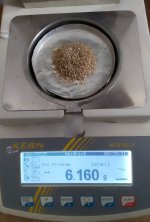
‎- Quantity: Limited initial release (6.1g which equates to roughly 6100 seeds) First come, first served
‎- How to order: DM me
‎---
‎#⚠️ Important Disclaimers
‎1. For Research Purposes Only: These seeds are being distributed exclusively for research, educational purposes
‎2. Chemotype Variability: This is a base breedline, not a stabilized cultivar. Individual plants will vary in their chemical profiles. TLC analysis is essential for identifying and selecting specific chemotypes.
‎---
🔬 Looking Forward
‎This seed release is just the beginning. We envision:
‎- Community-driven selection: Researchers growing and selecting their own preferred chemotypes.
‎- Future cultivar releases: Stabilized DMT and 5-MeO-DMT cultivars from this base population
‎- Expanded collaboration: More data, more analysis, and deeper understanding of this remarkable species
‎---
🙏 Acknowledgments
‎This milestone would not have been possible without the collective effort, data sharing, and constructive dialogue of this community. Thank you to everyone who has contributed observations, TLC analyses, and thoughtful discussion over the years.
‎---
‎To place an order or inquire further, drop a DM and I'll try to respond as soon as I can.
Seeds of segregated DMT and 5-meo-dmt breedlines will be available Next spring! ‎We look forward to seeing where this next chapter of our research takes us.

 

Attachments

  • IMG_20260627_134614_203.jpg
    IMG_20260627_134614_203.jpg
    243.8 KB · Views: 3
Back
Top Bottom