• Members of the previous forum can retrieve their temporary password here, (login and check your PM).

The official "Is this chem ok to use? / Where can I find ...?" thread

Migrated topic.
It is a common question that people ask, if a certain chemical is OK to use for extraction or not, and also where to find such and such chemical. Instead of cluttering up the forum with hundreds of threads about it, those who have these question can post here (and threads made with such questions will be merged here).

But before asking such questions, here's a few important links you should THOROUGHLY read:

Check what your solvent contains here thread

FAQ: Is my solvent/chemical OK to use ?

The Suppliers section
 
Hey, I was just wondering, would I be able to buy naphtha online from Amazon if I live in Southern California without getting into any trouble? I'm not sure how this banned thing works. Does it just ban the sales in stores or is it banned permanently?
 
Hi All, I have a question about the Lime i bought. I read that the hydrated lime is called "Cal" and went around to some mexican grocery stores looking for it. I found it, however when I got home and compared it to what's called for in the Q21Q21 tek I found that what I have is called "Cal" and below that it says "dehydrated lime". Did I buy the wrong thing?

This is my first attempt and I'm trying to be careful and get the right stuff! Thanks
 
blimpy, calcium hydroxide is also called "hydrated lime", so i am not sure if what you have is good for an extraction since its "dehydrated". Is there an msds for it? or a website to check for ingredients?

Wave, one member on the forum (Rivea) has used hexane with beautiful results. It is a hydrocarbon like naphtha, but has a lower boiling point if i remember correctly. Here is the thread started by Rivea on his extraction using hexane as a NP solvent. Good luck!
 
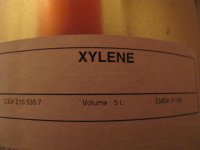
This xylene, which might one day comes on handy to finish extractions when out of other solvent...thought no brand name.
 

Attachments

  • IMG_0852.JPG
    IMG_0852.JPG
    342.2 KB · Views: 0
PEACE to everyone. I'm totally new to this, so I'll be very direct, I want some ready made DMT, i know no one sells, buys and stuff, but back in my country (Macedonia), no one has it, and I cant rescue to make it on my own if I find mimosa plant, even for the plant I'm not sure what is it. Really need some help here???

Moderator said:
Please read the Attitude page, talking about sourcing illegal substances is NOT allowed here, as clearly stated before every post you make. All the information for extracting your own dmt can be found in this community, take some time reading the forum and FAQ/Wiki
 
wow, that was quite direct indeed :D ... Btw just a note for Tolki !!! As i am coming from the same country i can only tell him that he is lucky he is living there as most of the solvents can be found quite pure from a chemical supplier here.The prices are high compared to the standard we have here, but it will not hit your pocket hard if you extract for your own personal exploration.


also the molecule of our research here is still very unknown for the public...so i advise him to be carefull to whom or how he spreads these information..Our social system is really fragile here and new laws are coming up by night.


Ambivalent
 
could I evap completly a xilene pull and then recrystalize the product to avoid the FASA method? seems kind of advanced for a noob and ive had read here at the forum that xilene pulls a lot of dmt (and other stuff too, jungle stuff)
 
yes I remember you refering xilene stink but believe me man, as long as I get crystals i dont mind, maybe later when become a regular user of spice i will become more picky, right now i just wanna shot my soul into hyperspace.
 
DMT in freebase form will be dissolved in the non-polar solvent (like toluene, xylene, naphtha, limonene, etc), so when you make a pull you have your non-polar with your alkaloids. Then, if you mix an acqueous acidic solution with that solvent, the dmt will migrate to the acqueous acidic solution (for example FASW, or vinegar). Then you evaporate that water instead and get your dmt salts. You can convert to freebase if you want, check teks like BLAB, amor fati and q21 for more info.

Advantage of salting is there's no need to evaporate your solvent, you can reuse it after it was salted. So you can recycle solvents for a long time, plus its not nasty to evaporate all that amount of petrochemical (limonene doesnt evaporate clean, you can only salt out)

With naphtha the advantage is you can freeze precipitate (considering you didnt use too much solvent, so its saturated enough), and then reuse, but you cant do that with xylene/toluene/limonene because alkaloids are too soluble in them even at freeze temperatures.
 
endlessness said:
DMT in freebase form will be dissolved in the non-polar solvent (like toluene, xylene, naphtha, limonene, etc), so when you make a pull you have your non-polar with your alkaloids. Then, if you mix an acqueous acidic solution with that solvent, the dmt will migrate to the acqueous acidic solution (for example FASW, or vinegar). Then you evaporate that water instead and get your dmt salts. You can convert to freebase if you want, check teks like BLAB, amor fati and q21 for more info.

Advantage of salting is there's no need to evaporate your solvent, you can reuse it after it was salted. So you can recycle solvents for a long time, plus its not nasty to evaporate all that amount of petrochemical (limonene doesnt evaporate clean, you can only salt out)

With naphtha the advantage is you can freeze precipitate (considering you didnt use too much solvent, so its saturated enough), and then reuse, but you cant do that with xylene/toluene/limonene because alkaloids are too soluble in them even at freeze temperatures.
Thanks. Been wondering about that. Does the salted form last longer in storage?
 
Back
Top Bottom