• Members of the previous forum can retrieve their temporary password here, (login and check your PM).

The smell of DMT

bodymechanics

Esteemed member
Joined
Jun 29, 2024
Messages
56
Merits
47
For the first time I smelled a fresh extraction done with xylene and backsalted immediately with naptha.
The yield was great, yet has absolutely zero smell.
I thought it may be due to using citric acid instead of vinegar.
Ran a new batch using my old routine of A/B with just naptha, still with citric acid and this time it smells as expected, like honeysuckle or new sneakers.

Makes me wonder, what causes the floral odor. Why is it very strong sometimes, and not there at all with others?
 
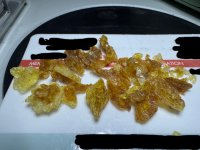
stink.jpgIMG_0180.jpg
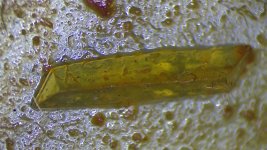
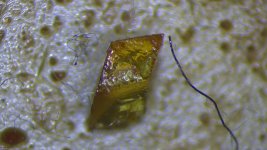
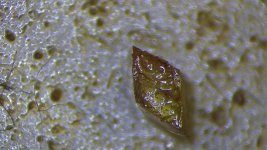
I found a closed quart jar that probably had hexane in it. It had evaporated all but some residue. There's a lot of oil, and several of the nicest crystals I've grown so far, covered in oil.
This jar REEKS! The DMT smell is so strong, for what might be a couple hundred mg of oil.

I wonder if smelly oil has to do with evaporation. Maybe the crystals grew on the bottom as the solvent evaporated, and the oil was precipitating at the surface, then falling with the solvent level. It actually looks like some blobs of oil were underneath the crystals before they grew, if that's what I'm seeing through them.
IMG_0179.jpg
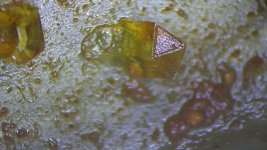
Some pockets of oil appear to be growing crystals out of them, or the crystals attracted the oil.

IMG_0194.jpg

Also, I'm pretty sure this jar of hexane was used to wash an aqueous solution of DMT benzoate in distilled water. The solvent picked up a yellow color, this was before freebasing. I meant to get around to backsalting this wash solvent to check for DMT content, but it appears the yellow didn't lie. So freebase can be pulled from dmt benzoate solution without base apparently. Or maybe it pulled the whole benzoate?
IMG_0176.jpg
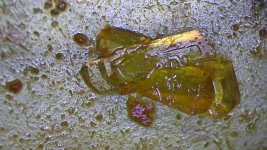
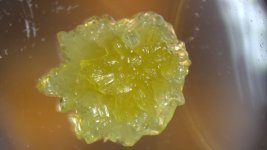
This last one is neat - it looks like a prism that is fanning out, and each branch is smaller, like a fractal.
IMG_0192.jpg
 
Last edited:
So freebase can be pulled from dmt benzoate solution without base apparently. Or maybe it pulled the whole benzoate?
I'd wager that the benzoate got pulled, at least partly. However, since we're dealing with a weak acid and a base of only moderate strength, there's a distinct possibility that the hexane may indeed have selectively pulled deprotonated DMT. This would then drive a further deprotonation in the aqueous phase to restore the equilibrium.

We'd also need to check the solubilities of benzoic acid in hexane and water for comparison, along with the specifics of the benzoate precpitation from whatever solvent our researchers happened to be using, all of which isn't something I recall off the top of my head at the moment.

Anyhow, that's a great observation which deserves a precisely executed attempt at replication. It may turn out to be quite useful if this phenomenon can be applied to various salts of DMT with weak acids, especially ones which have poor to zero solubility in NPS.
Would it be possible to pull DMT with the proton? Or would that molecule always be ionically linked with benzoic acid in solution? If some DMT deprotonates as it gets suspended in NPS, does that proton return to the benzoate, restoring it to benzoic acid?

Maybe I'm just confused when people say an acid donates a proton. Is the proton actually leaving the benzoate- ion temporarily to be with DMT+? Or are the ions sharing the proton and the proton never really leaves the benzoic acid?

The equilibrium you're referring to - is that the balance of freebase : ionic DMT in aqueous phase, relative to the pH? I previously measured my dissolved DMT-benzoate having 6.98 pH in distilled water. With DMT's 8.68 pKa, does that mean a few percent of DMT molecules in the solution would be deprotonated? In theory, yes, right? But you'd think the salt would have enough charge in solution to hold onto the same amount of DMT it held as a solid.

Is there a proper procedure for measuring solubility that you recommend I follow? Simply dissolve as much as I can and subtract the weight? I assume I want to use a volumetric flask and limit evaporation. What specifics of the benzoate would we like to know?
 
Last edited:
I haven't decided on a good way to remove those crystals without damaging them, so they've just been sitting in the jar, open to air. It's been about two weeks and there's still a layer of wet goo covering everything. The smell has reduced significantly, but it's still a nose full. Kind of gives that frontal lobe tingly headache smell.

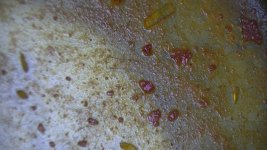
The color is changing. Mostly in the larger goo piles, but also along the edges of some crystals. Some yellow goos had tiny red yolks within them, not sure if I got a good picture; they were so small, like acne on the crystal face. The photos look more orange on my computer but on the TV it was more crimson.

IMG_0231.jpgIMG_0233.jpgIMG_0235.jpgIMG_0250.jpgIMG_0257.jpgIMG_0262.jpgIMG_0267.jpgIMG_0254.jpg

I really like that last one above, I think I missed it the first time I scanned this jar. It has a greener tinge than the others, with some reddening at its edges. I think I'll set this jar aside to see what happens over time. I thought the goo would have solidified by now, but it looks like it's going to take a lot longer. I think if I kept it a little warmer than room temp it could show more activity. I wonder how superficial the darkening is on the crystals, or if they could turn red while keeping their prismatic form.

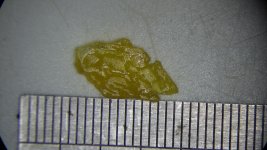
This last pic is one of several crystals I scraped from the side wall of the jar to do a melting point test on. I wanted to wait for the oil on them to dry, but maybe I'll save one of them as a control against the jar. The ones I separated have also been in open air but don't appear to have darkened at all. They probably had less goo on them to begin with, since they grew on the side... can't think of any other difference.
IMG_0274.jpg

Should I be worried about goo residue on the rest that I'd like to do a MP test with? What would be the best way to wash them if so?
 
That jar has been sitting open on my desk for over a year now lol. I guess it became its own experiment. It's been exposed to air, humidity, and cannabis vapors. Apologies for the fibers, but this is how the crystals look now. The goo has darkened, some puddles are significantly more red than others. The crystals appear to be breaking down somewhat, the edges look rough and the faces have even more goo on them, like they're sweating goo.

I still haven't measured the melting point because I think I got stuck on how to properly dry these or de-oil them to get an accurate melt.
IMG_0353.jpgIMG_0354.jpgIMG_0356.jpgIMG_0357.jpgIMG_0359.jpgIMG_0360.jpg

Anyway I've derailed the thread enough and want to get back to discussing the smell. I opened a jar of last year's yellow DMT prisms (tested 99.7% pure) that had no smell. There's a detectable smell in the jar now (amber glass with GL45 lid). Can anyone help explain this? If pure DMT = no smell, and pure DMT + 1 year = some smell, is the DMT breaking down to indole? Or is it "aggregation"? The scent is very light, the best of DMT smells.

To contrast, I just took a whiff from this jar that has been sitting open the past year. If you recall, it reeked! Well, the smell is still easily detected, only it's very sharp now. There's none of that new shoe / jasmine flower smell, it actually smells more like vaporized DMT. Rotten tooth smell. What amazes me is how strong it still smells after all this time. You'd think anything volatile enough to be smelt would have dissipated by now.

Then I have another jar of yellow semi-prismatic crystals that grew out of liquid freebase that was left sitting overnight between a layer of water and hexane. I don't recall what they smelled like initially, but there's the same light, jasmine smell as the yellow prisms. Only these prisms have darkened significantly!

Before: The crystal in the second image is at the bottom left of the "after" photo
105089-55333c984a5469722345458220944d0f.jpg
105088-2373223797a6bde5807f3bdd81345e4a.jpg

After:
IMG_1520.jpeg
The bi-colored one probably had one half growing into the hexane, and the other half growing into water. Maybe yellow was in contact with water, and since most of the yellow has browned, maybe that's due to polar molecules getting trapped in the lattice? It's weird that none of my other crystals grown last year have browned to that degree.

Anyway how does DMT odor even work? I assume a molecule must go airborne via volatilization for my nose to detect it. I previously theorized solvent residue playing a role in carrying non-volatile DMT into the air. But if you have pure DMT crystals, how could molecules be breaking free from the lattice and volatilizing?

I have another vial that's been sitting open on my desk the past year, from when I mixed DMT with benzoic acid via turpentine. There's still a faint pine odor, no DMT smell detected though.

Another jar of DMT-benzoate (prepared with hexane) has been sitting sealed the past year, and it has the typical new shoe smell; somewhere in between but much closer to light jasmine than rotten tooth.

Sorry this is such a disorganized collection of info, but I hope someone can help figure this out. I've heard that the color can darken over time due to autooxidation, but have not heard of the smell changing over time. Is that related to autooxidation? Or is there an additional process playing out that makes DMT odorize? I've been storing everything at room temp.

 
Last edited:
Back
Top Bottom