• Members of the previous forum can retrieve their temporary password here, (login and check your PM).

The smell of DMT

bodymechanics

Esteemed member
For the first time I smelled a fresh extraction done with xylene and backsalted immediately with naptha.
The yield was great, yet has absolutely zero smell.
I thought it may be due to using citric acid instead of vinegar.
Ran a new batch using my old routine of A/B with just naptha, still with citric acid and this time it smells as expected, like honeysuckle or new sneakers.

Makes me wonder, what causes the floral odor. Why is it very strong sometimes, and not there at all with others?
 
I'm going to guess degree of oligomerization as a possible hypothesis.

I have not noticed zero smell mysel, but different batches do seem to smell a little different.
This or a cold 😄, I’m pretty sure that when scraping it into a pile and putting it into a container will make the smell come back after a couple of days. It is a strange though the smell changes quite allot over time, so much so that I sometimes smell old containers just to get a intense whiff of it.
 
This is the first time it’s been odorless. So strange. No odor after scraping or putting in a glass container and stirring it up.
Funny I smelled another batch that’s ultra fine whit powder to see the difference.
That went straight up my nose 😅
 
You know it's worth noting the different solubilities of other stuff present and also the smell of deemz crystals freshly made versus the smell of cooked/vaporized deemz, completely different. I think it usually finds a floral new shoes to fresh tortilla smell after my usual stb, a/b, crystallization extractions, I've done crystallization which yield almost zero smell, and the zero smell crystals hit like the magic schoolbus with zero smell or taste, maybe the all too familiar "deemz taste/smell" is in fact not deemz at all? I've also heard people say it smells or tastes like burning plastic, again maybe contaminants?
 
You know it's worth noting the different solubilities of other stuff present and also the smell of deemz crystals freshly made versus the smell of cooked/vaporized deemz, completely different. I think it usually finds a floral new shoes to fresh tortilla smell after my usual stb, a/b, crystallization extractions, I've done crystallization which yield almost zero smell, and the zero smell crystals hit like the magic schoolbus with zero smell or taste, maybe the all too familiar "deemz taste/smell" is in fact not deemz at all? I've also heard people say it smells or tastes like burning plastic, again maybe contaminants?
Mayhaps even degradation products are partially to blame for the smell.
 
Pure DMT presents itself with different structures since it loves to stick to itself (aggregate). That could be a reason for different smells.

The different DMT structures (from different degrees of aggregation) also change the vaporization temperature. Less aggregated DMT vaporizes at lower temperature. Lower vaporization temperatures make it easier to vaporize DMT before burning (but with good technique, a sweet spot can still be maintained even for highly aggregated DMT goo and the narrower temperature window between vaporization and burning).

The simple fact that DMT is a polymorph can explain all your observations. No need to imagine there are contaminants or oxidation (assuming oxidation is a historic mistake I believe). Contaminants can be somewhat common, expecially for beginers.

Even the most seasoned extractors are affected by polymorphism. DMT in plants could present itself with some degree of agregation. Fortunatley, an abundance of Na+ or (even better) K+ ions while extracting breaks up DMT aggregation (see salt teks like max ion).

Aggregation also affects DMT solubility (less aggregated DMT is easier to dissolve). It had long been assumed that the ionic strengh in the salt teks made it easier to move DMT into naphta from "salting out" effects in the partition coefficient. However, the abundant cations disrupt DMT aggregation, making the "loose" DMT molecules easier to dissolve in the solvent, and solubility will have a huge effect on the partition. This max ion effect on dmt aggregation is very important and went unnoticed for many years (I think).
 
Last edited:
It also can depend on your plant source.. I find DMT extracts vary a lot in smell with different Acacia species.. especially comparing bark/phyllode extract. Mimosa has the new shoes smell more than Acacia IME.. which has a more creamy/floral scent overall.
 
Anybody know whether synthesized DMT smells different than extracted? I've only ever extracted my own (MHRB, lab-grade naphtha, regular lye) and it smelled of new shoes. I have 1g of synthesized DMT (mostly a rocked chunk) and a .5g cart with synthesized DMT. The rocked chunk smells kind of chemical-like. Is the synthesizing process likely to result in a different smell than extracted?
 
I'm going to guess degree of oligomerization as a possible hypothesis.

I have not noticed zero smell mysel, but different batches do seem to smell a little different.
I'm also curious about the smell. Some stuff I have now is completely scentless. I think it's the first time I've seen it like this. I'm going to jar it up and see if I can build up a scent.
Can you break down more specifically how polymorphs are playing a roll? I assume the smell is coming from the "aromatic" rings. How does that even work though? When you inhale from a jar of DMT, are you taking up actual molecules of DMT that have vaporized? Or is the surface constantly breaking down molecules to indole and that is getting sucked up the nose?

Is it simply due to higher surface area in crashed-out powders vs more dense crystals seeming to smell less?

Or is like, a pi-stacking polymorph shielding the aromatic ring? Could smell-level be an indicator for polymorphs?
Pure DMT presents itself with different structures since it loves to stick to itself (aggregate). That could be a reason for different smells.

The different DMT structures (from different degrees of aggregation) also change the vaporization temperature. Less aggregated DMT vaporizes at lower temperature. Lower vaporization temperatures make it easier to vaporize DMT before burning (but with good technique, a sweet spot can still be maintained even for highly aggregated DMT goo and the narrower temperature window between vaporization and burning).

The simple fact that DMT is a polymorph can explain all your observations. No need to imagine there are contaminants or oxidation (assuming oxidation is a historic mistake I believe). Contaminants can be somewhat common, expecially for beginers.

Even the most seasoned extractors are affected by polymorphism. DMT in plants could present itself with some degree of agregation. Fortunatley, an abundance of Na+ or (even better) K+ ions while extracting breaks up DMT aggregation (see salt teks like max ion).

Aggregation also affects DMT solubility (less aggregated DMT is easier to dissolve). It had long been assumed that the ionic strengh in the salt teks made it easier to move DMT into naphta from "salting out" effects in the partition coefficient. However, the abundant cations disrupt DMT aggregation, making the "loose" DMT molecules easier to dissolve in the solvent, and solubility will have a huge effect on the partition. This max ion effect on dmt aggregation is very important and went unnoticed for many years (I think).
What do you mean by aggregate exactly?

I've been using that term a different way lately, to describe the crystal formations that look like bouquets of thin planar points. I consider those aggregates.

I think of gems as forms with no aggregates. Just isolated prisms; one crystal with no twins or neighbors branching off it. I got a batch of gems recently and there's no smell. But maybe by your meaning, maximum aggregation = solid isolated prisms?
 
What do you mean by aggregate exactly?
@Loveall was referring to aggregation at a molecular level, whereas you're talking about macroscopic crystallisation phenomena or similar.

DMT seems to do some curious things at the molecular level which result in puzzling behavior in bulk!
 
@Loveall was referring to aggregation at a molecular level, whereas you're talking about macroscopic crystallisation phenomena or similar.

DMT seems to do some curious things at the molecular level which result in puzzling behavior in bulk!
Aren't they related though? As Loveall put it:
The different DMT structures (from different degrees of aggregation) also change the vaporization temperature.
What's the relationship between the structures and degrees of aggregation? I take structure to mean the macro crystals?
 
Maybe "molecular alignment" would be more a accurate way of putting it. The DMT molecule isn't completely rigid - it retains the same structure but the side-chain is mobile in three dimensions to a certain extent. While one set of alignments at a molecular level during crystallisation may be more more favorable under one set of conditions, other conditions may favour something else.

Another aspect of molecular aggregation is that it can persist over changes like dissolution in a solvent, and perhaps also on melting. Something occurs which forms stronger intermolecular forces than the usual Van der Waals' interactions. I'm not convinced anyone has definitively proven what this is, although @Brennendes Wasser did a considerable amount of work on the matter.

And yes, these molecular-level phenomena can have an impact on the macroscopic properties of the material. If molecular aggregates (oligomers/polymers) are effectively distinct molecular species in a mixture with solid, monomeric DMT, one of the effects of this now being a mixture is the depression of melting point, which seems to be one likely reason for goo formation, just as one example.

The different crystalline forms (but not clusters of crystals of the same type versus perfect single crystals) are a result of polymorpism, which is something different. Clusters (crystal aggregates) form as a result of random imperfections during the crystallisation process itself.
 
Another aspect of molecular aggregation is that it can persist over changes like dissolution in a solvent, and perhaps also on melting. Something occurs which forms stronger intermolecular forces than the usual Van der Waals' interactions.
How is that possible? Would that mean that instead of individual DMT molecules being solvated, it would be small groups of them?
 
Yes, let's continue dissecting this please! I want to one day be able to play an animation in my head of the side chain rotating into favorable positions and how that steers the unit cell.
Maybe "molecular alignment" would be more a accurate way of putting it. The DMT molecule isn't completely rigid - it retains the same structure but the side-chain is mobile in three dimensions to a certain extent. While one set of alignments at a molecular level during crystallisation may be more more favorable under one set of conditions, other conditions may favour something else.

Another aspect of molecular aggregation is that it can persist over changes like dissolution in a solvent, and perhaps also on melting. Something occurs which forms stronger intermolecular forces than the usual Van der Waals' interactions. I'm not convinced anyone has definitively proven what this is, although @Brennendes Wasser did a considerable amount of work on the matter.
Are you referring to polymerization here? Aggregates = polymers? Big fan of @Brennendes Wasser :)
Are pi interactions suspected to be the stronger forces? Or something happening at the pyrrole nitrogen?

If molecular aggregates (oligomers/polymers) are effectively distinct molecular species in a mixture with solid, monomeric DMT, one of the effects of this now being a mixture is the depression of melting point, which seems to be one likely reason for goo formation, just as one example.

The different crystalline forms (but not clusters of crystals of the same type versus perfect single crystals) are a result of polymorpism, which is something different. Clusters (crystal aggregates) form as a result of random imperfections during the crystallisation process itself.
Do you think the oligomers are always non-solid? I was under the impression that the dimer is one of the polymorphs studied.
Falkenberg:
The hallucinogenic indole alkylamine, (N,N)-dimethyltryptamine, crystallizes in two modifications having the same monoclinic space group, P2/a and P21/c (Z= 8). For the latter, which has two molecules in the asymmetric unit, data were collected on an automatic diffractometer. Unit-cell dimensions area= 12.99, b= 12.08, c= 18.38/~, and fl= 127"85 °. The structure was determined by the symbolic addition procedure and refined by the method of full-matrix least squares to R = 0.048 for 2080 observed reflexions. The molecular structures of the two molecules are almost identical. The indole nuclei are planar, and the ethylamine side chain is almost fully extended (torsion angle z2= 176 and 188 ° for molecules A and B respectively) and lies near a plane which is approximately perpendicular to that of the indole(rl= 102 and 90°). Relatively strong N-H...N hydrogen bonds join A-molecules (2.92 A,) and B-molecules (2.89/%,) separately in two different helically fashioned hydrogen-bonding systems around screw axes.
Transparent colourless, hexagonal prisms, Monoclinic, P21/c, Z= 8
I see he is talking about the side chain rotation, and two molecules forming a pair. My hunch is the dimer crystal has stronger bonds, higher melting point, lower smell, lower solvability. I have some crystals that are stubborn to dissolve in either water or NPS, along with no smell and 67-69 mp.

I think it probably can oligomerize further, and maybe that's the oil. Or maybe the dimer is as far as it goes, and the oil is just from dimers crashing out too quickly?
In addition, I think the different solid crystal presentations are due to more than just polymorphs. If one polymorph is all monomer, and the other polymorph is all dimer, and they're both similar monoclinic prisms, then what are the macro aggregates?

Clusters (crystal aggregates) form as a result of random imperfections during the crystallisation process itself.
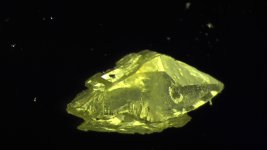
Couldn't one of the random imperfections be a strand of oligomer, or a dimer? I'm thinking the clusters might be combinations of polymer-polymorph. Also, check out this sweet crystal I found last night that has a big imperfection in its crystal face. It doesn't seem to have stopped it from being a prism, but in the hole you can see acicular cluster formations.
IMG_0168.jpg
 
Last edited:
Back
Top Bottom