• Members of the previous forum can retrieve their temporary password here, (login and check your PM).

Trying to improve Acacia information

Migrated topic.
..hey acacia researchers..i really hope this is my last post apologising for the INDEX still not re-worked..been overtime work and lots of things..soon..

first up, bricklaya wrote:
nen, i remember you saying a while ago that there was a finding of tetrahydroharmine in acacia baileyana?
do you know if this was a one off finding or have there been numerous reports.. if the latter do you know of what percentages were found? interested in finding a replacement for caapi vine for my changa blend that is capable of mild maoi inhibition when smoked.
..the report of TetrahydroHARMAN in A. baileyana was from one of two experiments done by a friend of A. Shulgin..see TIKHAL..at a second time of year it contained tryptamine..not sure percentages..however, i also have a fairly reliable report of 0.1-0.2% DMT from twigs..also note that while TetrahydroHARMINE (in some Calliadras in B. caapi) has CNS effects when smoked, it is not a strong enough MAOI to orally activate tryptamines..

tweakmode..hi, and thanks for the A. simplex [see here, pacific island acacias] youngling photo..:)..i think this is a very good species to grow, with high percentages..i always wondered what Formyltryptamine was like (no data on toxicology), which was found in small amounts in A. simplex (with DMT/NMT)..as this obscure tryptamine was present in small amounts in an A.mucronata sample, it has now been safely bio-assayed 3 times (at the several milligram level, at least, with other alkaloids) ..also trace in A. elata..

pirateb0b..thanks for pic..yet another form of A. maidenii..!

and spacechick..welcome..i would suggest using twigs/small branch bark of A. longifolia [see entry here]..avoid flowering..keep the leaves also for use..i only recommend the tek mentioned again in the last couple of pages..other methods do work well, and some not so well (such as the 'DMT Handbook' method)

and above all, be kind to trees (& they'll be kind to you)
.
 
thanks nen, was that finding in the phyllodes or bark do you know? been smoking cones of the phyllodes lately cos they taste really nice... noticed a familiar stoning effect, very mild but definitely there
 
^..the best advice i can give on additives/impurities in either methylated spirits or NP solvents is to, as often recommended, evaporate a small amount and see if there is any kind of residue..if not, shouldn't be a problem..

as for extraction generally..i've tried to mention before i don't want to get lost in details in this thread, and it would be better for someone to start a separate Acacia Extraction Thread..it's practice and experimentation (plus intuition) which leads to good extractions..here p25 is one more bit of extraction discussion within the thread..
 
thanks nen888 :) i think a lot about this thread .. i can 'confirm' (i know from recently meeting 2 anonymous researchers that particular people already know this) that an evaporated ethanolic tincture of branch bark from a. concurrens http://i39.tinypic.com/25f605i.jpg is definately psychoactive when taken orally in combination with MAOI.

edit* i don't advocate this method for anyone unprepared to see reality through the eyes of their own corpse, dosing is ballpark and stupid at best for unknown species
 
^..thanks Seldom..and i've corrected the A. concurrens index ref..a post or so on from that linked post is one on A. leiocalyx..i have been tossing up between this species and concurrens in attempting to ID the tree which did contain 0.3% approx DMT in the stem/branch bark..
it was not flowering at the time, and was in a remote location..both species (part of a species 'complex') are worthy of further research..

..below, Acacia concurrens (leiocalyx is slightly, minutely different, and usually has slightly narrower phyllodes, darker red stems, and more broken flower rods)..found predominantly S.E. Qld, Australia..
 

Attachments

  • Acacia_concurrens.jpg
    Acacia_concurrens.jpg
    29.5 KB · Views: 1
  • Acacia-concurrens-01.jpg
    Acacia-concurrens-01.jpg
    40.7 KB · Views: 1
^..yeah, very attractive in the wild..needs wider cultivation..

ps. bricklaya, re A. baileyana, i believe it was leaf that the tetrahydroharman one time of year/tryptamine another was found..don't know %, but i think it was fairly small..but this is only 2 tests, of course..
 
^ - nen, in terms of improving our understanding of the alkaloid contents of the Acacias - in the interests of ruling out incompetent experimental technique (such as mine :) ) maybe it would be helpful to have a more quantified extraction technique e.g.

* what proportion of water / vinegar / metho? (Is the metho really worthwhile when it will boil off soon into the acid cook, presenting a fire hazard in the process?)
* what pH should the base side be? What ratio of water to bark / phyllodes?
* what ratio of NP to plant material? Is Australian "Shellite" OK?
* evap or freeze precip?

I understand in a way the idea behind leaving people to find their own way... but it does not help in the quest to understand the contents of various species and cultivars if people are using potentially ineffective methods.

My negative A. floribunda result, in conjunction with bricklaya's, have me wondering. If we could eliminate some variables in the extraction method, we might have a hope of getting a handle on the variation of intrinsic DMT content between species/cultivars/time of harvesting/part of plant.
 
^..i realize how vast this thread is, but if you check through the extraction info, this is all covered..the method i suggest is what works for me..i don't use the exact same ratios every time..i intuit and improvise..that's my way..
as suggested before: * approx 30-50% alcohol; *ph 11.5-13 (13 max); equal amount NP solvent; some people say shellite is ok, never worked well for me; *freeze precip only work with napatha, so evap..

..i think it's good to practice method with known reliable material (MHRB,P. viridis, A. confusa), that way one can see if it's technique or plant..

..but as all plants vary their overall composition seasonally (i.e all the other compounds as well as alkaloids) the excat ratios/measurements (e.g. pH) often need to be adjusted..'worked with'..this is the best and most real advice i can offer..
.

so, if you want the 'textbook' method (as posted previously):
"..repeated maceration with methanol. The extract was concentrated, an equal volume of dilute sulphuric acid added, and
after filtration the filtrate was made basic with ammonia. Extraction with chloroform gave
a crude alkaloid solution. The alkaloid was extracted back into dilute sulphuric acid, the acid
fraction basified with ammonia, and extracted with chloroform. The chloroform was evaporated
off to give the alkaloid (40 g(!), 0.3% dry wt.)." [CSIRO 1967]
..but, obviously such a method needs to be adapted to be more safe in a non-lab environment..hence the JG92 method which was adapted to the nen-method..

..i think a general understanding of A/B theory (which can then be adapted) is what helps the most, and i highly recommend this thread by Dozuki: Art of Liquid-Liquid extraction..i don't suggest using STB for acacias..
really hope that helps a bit..
.
 
..so, the p1 INDEX is as of now updated (if there's any mistakes let me know) ..still a few redundant post# refs within the thread..

THIS INDEX IS THE KEY TO THIS THREAD..USE IT TO NAVIGATE..

......

..because i've had a few enquires, i just want to be clear that i think the so-called Acacia jurema, from Brazil (see Index, said (by one source) to contain DMT/NMT..) is either Acacia olivensana or Acacia santossi [Author: G.P. Lewis
Reference: Kew Bull. 51: 372 (1996) ; Classification: Subgenus Aculeiferum
Distribution: Brazil; Alternative Generic Names: Senegalia olivensana and santossi]
..both are bi-pinnate [see Botanical Terms here], and previously mis-identified as Mimosas..

..used in Afro-Brazilian 'ayahuasca' type rituals..
.

also, there is more info on extraction ratios used in particular experiments in
The Acacia Analysis Thread..the ratios and amounts change according to available options, conditions, behaviour of material and 'whim'..

..and, remember, ID requests in the Acacia Identification Thread..
.

..see you all around..:)
.
 
..two important points which have been mentioned in the thread, but may have been overlooked..

Seasonal Variation: ..plants, particularly acacias, can vary their alkaloid composition seasonally..flowering/seeding can affect either quality or quantity, and i don't think flowering is a great time to try an experiment, though is crucial for ID..i'll try to add index refs for variation soon..there are quite a few throughout the thread, though none detailed as, well, data is still incoming in this relatively 'new' field of research..the less variance, the more 'reliable' a species or strain could be said to be..

Harvesting of Root Bark Kills Trees:
..i have checked a number of suppliers of Acacia confusa bark for Chinese medicine (easy to find) and in all cases they are supplying trunk or stem bark, Not root bark, as (unlike Mimosas) this will kill an Acacia tree..the % alkaloid in stem bark is perfectly good (approx 1.0% average, up to 1.5%, from several reports)..and reliable
..so, while there may have been a higher yielding result in One scientific test of the root bark, this is no reason to use confusa or any species' root bark..

..fortunately A. confusa is common in a number of regions, and not generally considered endangered, though it may be in it's originally native Phillipines..
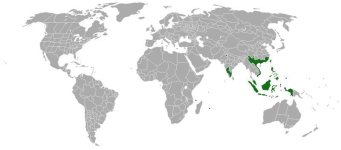
below Acacia confusa 台灣相思, including native habitat, and distribution range..for more info see the Acacia Confusa Thread..
be well all acacia lovers..
 

Attachments

  • confusa+flowers.jpg
    confusa+flowers.jpg
    38.6 KB · Views: 1
  • Acacia-confusa++____.jpg
    Acacia-confusa++____.jpg
    11.7 KB · Views: 0
  • image007.jpg
    image007.jpg
    231.6 KB · Views: 1
  • Acacia-confusa-range-map+(2).jpg
    Acacia-confusa-range-map+(2).jpg
    25.7 KB · Views: 1
..oh, and BTW..really looking forward to some more bioassay reports..:) how you all goin?

r2pi wrote:
I understand in a way the idea behind leaving people to find their own way... but it does not help in the quest to understand the contents of various species and cultivars if people are using potentially ineffective methods.

My negative A. floribunda result, in conjunction with bricklaya's, have me wondering. If we could eliminate some variables in the extraction method, we might have a hope of getting a handle on the variation of intrinsic DMT content between species/cultivars/time of harvesting/part of plant.
..i sincerely hope my responses on Extraction have not been too obscure, but (aside from having had very little time in my life for cyberland recently) that's about how much info/detail I was given before doing my first extraction (by a brilliant young chemistry student!)

Formula = basic theory of polarity/non-polarity + wood-membrane structure concept + careful observation + adaptability (and sometimes patience)

..that's how i was taught..really..

may the force be with you,
all of you..
 
bricklaya, you might be mixing up tetrahydroharmine (THH) with tetrahydroharman, which is what was found in baileyana.
 
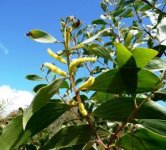
Hi all, I am going to try some more extractions from my old friend A. Podaliafolia.
Now I have the right technique (A/B).... stay tuned...

I feel sure there is something in this beautiful plant.......

Bioassay on Acuminata is FANTASTIC (OOTW) by the way........ My seedlings are 2m tall
Love and peas:thumb_up:
G
 
r2pi said:
Gowpen said:
Now I have the right technique (A/B)...

Any special tips to share? :d

Well, to start with I only do 250gms at a time..... I use 1 part vinegar 2 parts distilled water making up about 750mls of liqid to acid cook 3 times...... = 3x 750ml...... Filter it all out and you have nearly clear brown liquid....... Did you get to this part ? leaving bark and bits in the liquid can make problems later.
... reduce the combined liquid to about 1 - 1.5 lts & let it cool..... to room temp.
meanwhile..... I have added 200gms NaOH to 200mls water very slowly and stir till all clear.

Slowly add this NaOH solution to your brownish acid extract... mixing as you go !!!
mix..... being carefull with the pressure build up and heat, Please say you understand this step ??? If not I will expain....
Let this cool to roomish temp.........
.

You now have a blackish liquid of about 1.2-1.5lts.....
Where next would you like assistance ? :thumb_up: This works with twigs and phyllodes and branch bark....

Then add 150ml of shellite, again.... when you shake this, a huge amount of build-up pressure needs to be released, so just shake very gently at first and immediately release the pressure build-up, then again then again... I use plastic orange juice bottles (Premium Orange juice) to let me 'read' the pressure build-up by squeezing the bottle itself to let more air out than would without squeezing.... Hope this makes sense :)

when you're happy that it is safe to shake... do so gently for about 5 mins. then evey 30 mins give it another gentle swirl/shake
Then.....
 
Thanks Gowpen -- yep sounds pretty similar to what I did. So I guess I can just blame the starting material :thumb_up: .
 
r2pi said:
Thanks Gowpen -- yep sounds pretty similar to what I did. So I guess I can just blame the starting material :thumb_up: .

Is it r²π or r2pi :twisted:
 
Back
Top Bottom