• Members of the previous forum can retrieve their temporary password here, (login and check your PM).

Trying to improve Acacia information

Migrated topic.
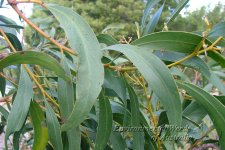
no worries :) its not necessary to completely avoid bark as long as you are careful and respectful in your harvesting method..i was mainly referring to the root/trunk which is difficult to take without causing harm. pruning a few branches is a good way to aquire useable amounts of bark with minimal harm required..

..if you find a large stand of trees (which won't be a problem with such a widespread and common tree like pycnantha) you'll be able to generate a sufficient amount of material from simply pruning a branch here and there... plus you'll get a mix of phyllodes and twig/stem bark which you can test separately in order to understand the tree a little better.. be on the lookout for fallen branches too as they are a common occurrence after storms.. fallen material will often still contain alkaloids in good amounts

keep us posted
 
There's probably 30-50 in a 200m radius from me, lol.
I wasn't completely sure about root bark, about how I'd even go about collecting it,
And I think it would look a little seedy and attract unwanted attention, haha.
So I was leaning towards leaving that out, and after what you said about twigs and phyllodes it doesn't seem necessary anymore. :)


Awesome, I can't wait to start experimenting.
I was planning on taking a small branch or two from each tree, and run the twigs and phyllodes seperatly
 
kubizm said:
Has anyone done extensive work on A Pycnanta?

Starting this Spring and continuing for a year,
I plan on extracting from several Acacia Pycnantha's, at different times of each season, see if someone can crack this tree.

..while all the info is within this thread..or tapestry of chance (and also tree evolutionary defence mechanism)

..here is the data to date (at least what has been reported..a lot goes on which isn't, believe me ;) )


Acacia pycnantha - ('Golden Wattle')

- 1944 E.P. White reports 0.1% alkaloid in phyllode.
- c.1992-94 this author shown in internal paper compiled by a group of university of sydney chemistry graduates which reports 0.4-0.5% tryptamines from bark..the source is reliable..it was from a single tree and was reported at IntraCortex conference 2002.
- c.1999 (?) Snu Voogelbreinder reports small amounts of DMT from phyllode.
- 2014 Nexian Seldom reports impressive results and yields of tryptamines from stem in this thread.


..while it is common, nonetheless please be kind to trees..
.

-
 

Attachments

  • acacia+pycnantha5.jpg
    acacia+pycnantha5.jpg
    194.3 KB · Views: 0
  • acacia+pycnantha1+-+GJ.jpg
    acacia+pycnantha1+-+GJ.jpg
    265 KB · Views: 0
..for any Israelites, and all, here is Judiac Law on trees...

.. Tu Bishvat is the traditional holy 'birthday of trees', honouring their protection..

"It is forbidden to cut down fruit-bearing trees outside a besieged city, nor may a water channel be deflected from them so that they wither. Whoever cuts down a fruit-bearing tree is flogged. This penalty is imposed not only for cutting it down during a siege; whenever a fruit-yielding tree is cut down with destructive intent, flogging is incurred. It may be cut down, however, if it causes damage to other trees or to a field belonging to another man or if its value for other purposes is greater.

החוק אוסר על הרס רק מופקר ... לא רק אחד שחותך את עצים, אבל גם אחד שמנפץ מוצרים לבית, קורע את הבגדים, הורס בניין, עוצר את אביב, או הורס את מאמרים של מזון עם כוונה הרסנית עוברת את הפקודה ' אסור לנו להרוס. "אדם כזה לא הולקה, אבל הוא מנוהל על מכות משמעתיות שהוטלו על ידי הרבנים

The Law forbids only wanton destruction... Not only one who cuts down trees, but also one who smashes household goods, tears clothes, demolishes a building, stops up a spring, or destroys articles of food with destructive intent transgresses the command 'you must not destroy.' Such a person is not flogged, but is administered a disciplinary beating imposed by the Rabbis."

(Maimonides, Mishneh Torah, Laws of Kings and Wars 6:8,10)
.


"The tree of life has five hundred thousand kinds of fruit, each differing in taste. The appearance of one fruit is not like the appearance of the other, and the fragrance of one fruit is not like the fragrance of the other. Clouds of glory hover above the tree, and from the four directions winds blow on it, so that its fragrance is wafted from world’s end to world’s end.”

(Yalkut Bereishit 2)
.

When a tree that bears fruit is cut down, its moan goes from one end of the world to the other, yet no sound is heard
(Pirket de-R. Eliezar 34)

.

'And God said: “Let the earth put forth grass, herb-yielding seeds, and fruit trees bearing fruit of its kind.” “Fruit tree” means the Tree of Knowledge of Good and Evil, which put forth blossoms and fruit. “Bearing fruit” is the tzaddik, the basis of the world. 'Of its kind' means all the human beings who have in them the spirit of holiness, which is the blossom of that tree. This is the covenant of holiness, the covenant of peace -- and the faithful enter into that kind and do not depart from it. The Tzaddik generates, and the tree conceives and brings forth fruit of its kind.'
(Zohar - Bereishit 33a)
.


"I will plant in the wilderness the cedar, the acacia-tree, and the myrtle, and the oil-tree; I will set in the desert the cypress, the plane-tree, and the larch together; That they may see, and know, and consider, and understand together, that the hand of the LORD hath done this, and the Holy One of Israel hath created it."


..Peace unto all of of you.

and respect to the trees..
.
 
Thanks for that nen!

I had a look through this thread for Seldoms post about the pycnantha success, but I couldn't find it, I'll look again!

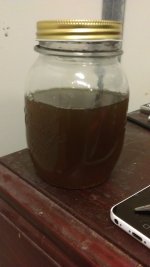
I'm in the middle of an extraction on a suspected floribunda. (phyllodes and twigs)
 
Only experimented with 65g.
Retrieved very little goo, probably 100mg?

I didn't use the last 3 pulls from the acid boils, they were very clear, only slightly yellow.
Instead for shits and gigs I based with clear ammonia and it's turned pretty damn dark now, will pull with shelly later and see what happens lol.
 

Attachments

  • IMAG0118.jpg
    IMAG0118.jpg
    830.5 KB · Views: 0
Heres one for you nen, and other acacians whom may be interested. I noticed one of the ingredients in 'wonder white' bread is acacia gum.. A peculiar place for it to turn up I thought, a substitute for gluten? Or a coagulant of some kind?
 
..thanks DreaMTripper..interesting place to turn up indeed..
yes some acacia gums (usually A. senegal, now Senegalia senegal ) are used in food preparation..
will look more closely at acacia gums in the thread in future when i get a bit more time..
.
 
^ getting back to gums, and thanks for the question DreaMTripper..if you think supermarket white bread an odd place for acacia gum to turn up..it’s also in coke!

Gums is an extensive subject, worthy of an entire book
(such as 'Plant Gum Exudates of the World: Sources, Distribution, Properties, and Applications' by Amos Nussinovitch)

..the most widely known and used Acacia gum is of course ‘gum arabic’, derived as the exudate from lesions in the trunk of Acacia senegal and less commonly Acacia seyal (i refuse to adhere to the Senegalia/Vachellia reclassification, as it’s taxonomically incorrect..’acacia’ comes from ‘akkis’ meaning thorn, and the thorned ones are principally in Africa, the middle east, and central America)

..the ancient Egyptians referred to gums (sticky substances) from the acacia as ‘qemai’ or ‘kami’..
the bandages which wrapped mummies were glued with gum arabic..they also used it in ink and papyrus preparation..

many other acacias around the world exude gums, though these are not nearly as studied in either ethnobotanical usage (of which there is some) or chemistry as gum arabic, which is widely used in food and soft-drink manufacturing as an emulsifier and stabiliser, as well as in pharmaceuticals and cosmetics..

the gum arabic composition of A. senegal and A. seyal is similar but varies in ratios of compounds..
these are principally polysaccharides (sugars)
Rhamnose, Arabinose ,Galactose, Glucuronic acid, as well as Nitrogen and Protein;
the amino acids are Hydroxyproline, Serine, Threonine, Proline, Leucine, Histidine, Aspartic acid, Glutamic acid, Valine, Phenylalanine, Lysine, Alanine, Isoleucine, Tyrosine, Arginine, Methionine, Cysteine and Tryptophan.
(for a good chemistry summary see 'Gum Arabic: More Than an Edible Emulsifier'; Mariana A. Montenegro et al. )

"Gum arabic contains three fractions. One, known as the AGP (arabinogalactan protein) fraction, includes proteins responsible for the emulsification properties. Arabinogalactan provides most of the hydrophilic groups that orient to the water phase of an emulsion. The non-polar amino-acid side chains of the protein orient to the oil. This makes it a natural emulsifier, allowing oil and water to be mixed together and stay together without separating. This property makes gum arabic useful in water-based beverages with oil-based flavor components, as it keeps flavor components well-mixed throughout the beverage rather than in an oil puddle on top. And, because it is natural, it is a much more “label-friendly" ingredient than many other emulsifiers."
(it is widely used as an) ".. ingredient for coating cereal, confections and snack foods. And, in bakery products, the gum’s binding and emulsification abilities aid in the formulation of icings and frostings, as well as baked goods like cakes and muffins."
(Mary Lou Cunningham, R&D innovations manager with TIC Gums, Food Product Design - Berlijn hotels )

in food it’s additive code is E414..

..the largest supplier is Sudan, which has lead to political and even combat situations over it:
"In 1997, when the US government brought sanctions against Sudan – the world's biggest producer of the gum – for giving refuge to Islamic terrorists, lobbyists protested and as a result the only product exempt from an export ban was gum arabic…"
..it’s one of the key ingredients in coca-cola (and of course pepsi) ..hmm, ingredient x ?

..at the other end of the health spectrum, away from coke and co., it is a good source of dietary fibre, reduces cholesterol, and boosts pro-bacteria in the gut.

interestingly, it’s expanded use was approved in the US by the FDA last year
The US Food and Drug Administration has amended food additive regulations to allow expanded safe use of acacia gum (gum arabic) in foods, in response to a petition filed by Nexira, supplier of a dietary soluble acacia gum marketed as Fibregum.

..for a part II of this post i’d look at other kinds of acacia gums in the world and their uses..when time permits..

on a final note, returning to the Judaic Law theme from the last post, gum arabic is in the Kosher Ink:
The main ingredients for ink acceptable in writing Torah Scrolls and other articles that have the same standard are: Water, Oak Gall Nut, Gum Arabic, Soot, Logwood, Copper Sulfate or Iron Sulfate. There are many recipes for this ink and many laws the Scribe must follow to produce kosher ink.


wishing all acacias well..
and peace unto all of you..
.


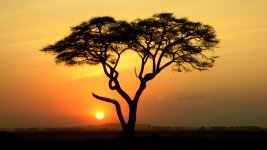
..below, Acacia senegal in Sudan...

 

Attachments

  • acacia-sunset-copy.jpg
    acacia-sunset-copy.jpg
    2.3 MB · Views: 0
  • high+quality+gum+arabic.jpg
    high+quality+gum+arabic.jpg
    296.7 KB · Views: 0
  • taking+the+gum.JPG
    taking+the+gum.JPG
    13 KB · Views: 0
^..that's a lovely picture, thanks DreaMTripper,

leads me to..


...what are the trees of paradise?

At-Talh [acacia tree] is a tree of Hijaaz, a kind of 'idah' [a fair sized thorny shrub], but in Paradise its fruits will be ready to eat, with no effort required.

What Allah has told us about the trees of Paradise is only a small part of what Paradise contains. Hence Allah told us : "In them [both] will be every kind of fruit in pairs" ['Ar-Rahman', 55:52]
(http://www.islamicislamic.com/paradise_description.htm)

"The tree of Sidrah on the sixth and seventh skies (Surah Najm) was the one, which was the tallest of the area and one of the most beautiful creations of God, and of course this plant was the subject of description and glory of most of the Prophet. The same tree has been mentioned in another Surah (Waqia) when Scene of Paradise is projected, and the word Sidre-Makhdud meaning thornless Sidrah, has been mentioned because in the next sentence of the same Surah, the tree named Talha is mentioned which is a thorny tree i.e. Acacia seyal."
Divine Trees in the Quran
.


> Quran, Ar-Rahman 48-52:

"Of spreading branches.
Which is it, of the favours of your Lord, that ye deny?
Wherein are two fountains flowing.
Which is it, of the favours of your Lord, that ye deny?
Wherein is every kind of fruit in pairs."


سُوۡرَةُ الرَّحمٰن

نشر الفروع
الذي هو عليه، من تفضل من ربك، أن ينكر أن كنتم
حيث نوعان من النوافير المتدفقة.
الذي هو عليه، من تفضل من ربك، أن ينكر أن كنتم
حيث هو كل نوع من الفاكهة في أزواج
.


stay well acacians,
and peace unto all of you
.
 
It's nearly spring!
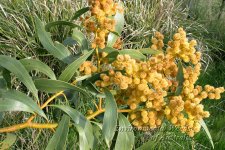
The golden-flowered trees are blooming heavily in Victoria :)
I've been keeping a mental-map of all the varieties in my local area. To make sure they stay healthy and un-adulterated by naive fellows.
 
Sphorange said:
It's nearly spring!
The golden-flowered trees are blooming heavily in Victoria :)
I've been keeping a mental-map of all the varieties in my local area. To make sure they stay healthy and un-adulterated by naive fellows.

That they have, it's a wonderful sight. I've seen plenty of A.Floribunda in bloom. A couple of A.Burkittii and a suspected A.Maidenii along the train line to work - the first Maidenii I've seen other than the ones I've grown. Plenty of P.Subaeruginosa mushrooms in mulch along the lines too, although I suspect that will be the last of them moving into spring.
 
Tryptallmine said:
Sphorange said:
It's nearly spring!
The golden-flowered trees are blooming heavily in Victoria :)
I've been keeping a mental-map of all the varieties in my local area. To make sure they stay healthy and un-adulterated by naive fellows.

That they have, it's a wonderful sight. I've seen plenty of A.Floribunda in bloom. A couple of A.Burkittii and a suspected A.Maidenii along the train line to work - the first Maidenii I've seen other than the ones I've grown. Plenty of P.Subaeruginosa mushrooms in mulch along the lines too, although I suspect that will be the last of them moving into spring.

Yeah the polar events we've been having this winter, along with the intermittent relative "heat waves" (especially at night) are a fungi paradise. :D

I know of a substantial implexa grove that I'm going to test for alks every 2 months or so, hopefully put to rest the ambiguity regarding it. Who knows? I might find a nice surprise.
 
greetings all!

I've recently moved from South Australia to a town named Mildura, on the border of NSW and Victoria. It's a desert here! The earth feels like sand and puts a hot, red hue on the flat horizons. It seems most of the acacias here are untested, and save for some (very scarce) A. burkitti the ones that have been tested were not successful. I spent some time compiling a list of my local wattle trees that are in abundance and came up with:

acanthoclada
brachybotrya
colletioides
euthycarpa subsp. Euthycarpa
hakeoides
halliana
ligulata
loderi
melvillei
montana
oswaldii
rigens
stenophylla
victoriae
victoriare subsp. victoriae
nyssophylla
sclerophylla
salicina
microcarpa

I know this road to eventual enlightenment will be long, tiring and frustrating at times, but I intend to (eventually) test them all and more. But...would anyone happen to know where to start? :p I think victoriae or oswaldii? Victoriae for the few positive results, and oswaldii for its abundance and spread. But then, ligulata is also aplenty. Any starting advice welcome!

Cheers.
 
LowHP said:
greetings all!

I've recently moved from South Australia to a town named Mildura, on the border of NSW and Victoria. It's a desert here! The earth feels like sand and puts a hot, red hue on the flat horizons. It seems most of the acacias here are untested, and save for some (very scarce) A. burkitti the ones that have been tested were not successful. I spent some time compiling a list of my local wattle trees that are in abundance and came up with:

acanthoclada
brachybotrya
colletioides
euthycarpa subsp. Euthycarpa
hakeoides
halliana
ligulata
loderi
melvillei
montana
oswaldii
rigens
stenophylla
victoriae
victoriare subsp. victoriae
nyssophylla
sclerophylla
salicina
microcarpa

I know this road to eventual enlightenment will be long, tiring and frustrating at times, but I intend to (eventually) test them all and more. But...would anyone happen to know where to start? :p I think victoriae or oswaldii? Victoriae for the few positive results, and oswaldii for its abundance and spread. But then, ligulata is also aplenty. Any starting advice welcome!
Cheers.


I've heard A. Victoriae is known to contain DMT :)
 
^^^

Sphorange said:
Tryptallmine said:
Sphorange said:
It's nearly spring!
The golden-flowered trees are blooming heavily in Victoria :)
I've been keeping a mental-map of all the varieties in my local area. To make sure they stay healthy and un-adulterated by naive fellows.

That they have, it's a wonderful sight. I've seen plenty of A.Floribunda in bloom. A couple of A.Burkittii and a suspected A.Maidenii along the train line to work - the first Maidenii I've seen other than the ones I've grown. Plenty of P.Subaeruginosa mushrooms in mulch along the lines too, although I suspect that will be the last of them moving into spring.

Yeah the polar events we've been having this winter, along with the intermittent relative "heat waves" (especially at night) are a fungi paradise. :D

I know of a substantial implexa grove that I'm going to test for alks every 2 months or so, hopefully put to rest the ambiguity regarding it. Who knows? I might find a nice surprise.


it is so magnificent to see the wattle in bloom ! <3 :love:

...

pirateb0b wrote:
So, would a two year old A. Confusa have alkaloids?
..around 2 years is when the full adult alkaloid profile emerges..would love to see them..


.

thank you all contributors, Sphorange, Tryptallmine, LowHP, polmos..
.


endlessness said:
Excuse me if this has been posted already but going through this year's publications that included the keyword 'DMT', I came across this one I found interesting:

Anticonvulsant and neuroprotective effects of the Acacia tortilis growing in KSA


Apparently the benefits are from simple acqueous extracts , and it is possible that flavonoids, saponins and alkaloids are all responsible for the effects

..thank you endlessness...much in the spirit of acacia phytochemical research

in fact every year a bunch of quiet new medicinal research findings on acacias are published, a budding field..
i've been a bit quiet online of late (which i'll address in the next post)
but first, getting into the area of acacia research, i ran into an old school semi-well known ethnobotanical researcher the other week, to whom i commented ‘dmt is the least interesting thing about acacias’, and, after i ran through a range of other compounds, he took my point… now, obviously i’m being a touch ‘ironic’ in that statement, but i’ve mentioned in the past regarding firstly the diversity of alkaloids present, presenting unique and varied ‘translations’ of information via the CNS, and more vitally, deep physical healing, through a wide range of compounds and mechanisms, many already mentioned in this thread..

among interesting tangents for future research -

- Hypermolecules (similar to Yuramemine from M. tenuiflora) and their stability;
see Complex Indole Alkaloids ('Hyper-Tryptamines'?) from plants

- Tannins (polyphenols) ..despite all this attention i’ve seen in places at wanting to remove them, many are really good! not just as anti-oxidants, but also potential anti-diabetics and cholesterol reduction, as seen in this study with A. mearnsii polyphenols on obese mice:
Anti-Obesity and Anti-Diabetic Effects of Acacia Polyphenol in Obese Diabetic KKAy Mice Fed High-Fat Diet. Ikarashi et al. Evidence Based Complement Alternat Med. 2011

..we’ve looked at the omega-3 and nutritional benefits of Fatty Acids present in many acacia seeds;

also, another kind of compound which can turn up are
‘Fatty Alcohols’..for instance - Octacosanol, a constituent of vegetable waxes, which has been isolated from wax on green blades of wheat, it is a 28-carbon alcohol (name also used to denote a mixture of 24,26,28, and 30-36-carbon alcohols), present as alcohols or acetates and can also be isolated from plants including several Euphorbiaceae, Cassia, and stem bark of Acacia modesta [Ravi J, et al. Indian Drugs. 1993;30]..as for it’s biological activity: “..its application to seedlings and growing plants increases growth rate and fruit yield. It is being investigated in humans for use as an antiviral for herpes and for the treatment of inflammatory skin diseases. The biologic activity of [various forms of it] are poorly understood.” [Octacosanol Uses, Benefits & Dosage - Drugs.com Herbal Database]


long chain compounds can be interesting indeed - there’s the polymer matices i described in looking at tars in the thread..

and as for alkaloids and other active compounds, there’s the triterpenes, histamines, spermadines, beta-carolines, flavonoids, unknown alkaloids, and more, which are found in acacias, all potentially active and with various potentially useful modes of medicinal actions

it’s partly why they’re such culturally revered trees in many places and times..
much to learn
-

pictured Acacia modesta (Senegalia modesta), native to Pakistan (known as 'Phulai'), India and Afghanistan

.
 

Attachments

  • Flowers-Acacia_modesta.JPG
    Flowers-Acacia_modesta.JPG
    1.4 MB · Views: 1
Back
Top Bottom