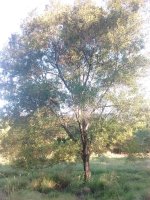
..great experimental initiative Sphorange..enough for me to emerge from my research 
with A. retinodes we're also dealing with slightly blurred and several times redefined species and sub-species lines, which could also be responsible for the varied reports..and possibly completely 'new' alkaloids,
as i mentioned on p.15:
Roveli's unknown alkaloid did not conform to any reference alkaloids he had on hand, including tryptamines, phenethylamines, and histamines..
good advice from endlessness on reagents and TLC...and sometimes the simple phyllode method needs a bit of complexity...if the phyllodes are still green, there's still chlorophyll and likely some fatty acids..
so, yes proceed with caution (vaporisation the safest method if assayed, as often said) but very good work in furthering our understanding of this now world distributed species..thank you for the report so far..
.
with A. retinodes we're also dealing with slightly blurred and several times redefined species and sub-species lines, which could also be responsible for the varied reports..and possibly completely 'new' alkaloids,
as i mentioned on p.15:
..a very interesting wattle in terms of distribution and content is Acacia retinodes (Swamp Wattle, or Wirilda) being native to southern Australia, and naturalized in such diverse places as Hawaii, Bolivia, France and Spain..
it has several sub-varieties..
..one German reported test found 0.5% alkaloids (DMT, NMT, nicotine); Roveli in Australia [1967] found 0.2% of a completely unknown alkaloid, and no nicotine..
the closely related Acacia provincialis was once classified as A. retinodes X saligna..nexian yatiqiri found 0.2-0.5% of an unknown mix of alkaloids which had tryptamine-like and also some possibly unique effects [see question about my acacia spice thread]
..certainly a tree for further, cautious chemical investigation..
Roveli's unknown alkaloid did not conform to any reference alkaloids he had on hand, including tryptamines, phenethylamines, and histamines..
good advice from endlessness on reagents and TLC...and sometimes the simple phyllode method needs a bit of complexity...if the phyllodes are still green, there's still chlorophyll and likely some fatty acids..
so, yes proceed with caution (vaporisation the safest method if assayed, as often said) but very good work in furthering our understanding of this now world distributed species..thank you for the report so far..
.

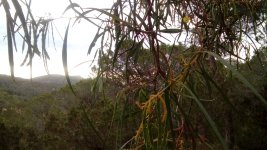
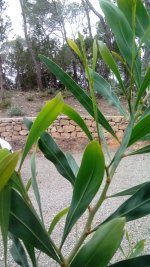
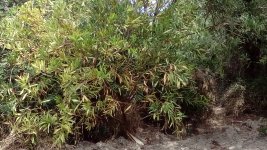


 yes actually, I ended up with roughly 150mg of floury white goo, which is due in part to a mistake I made in the clean up; I went straight to freeze precip without room temp evap. So I think it was a bit watery/icy. Definitely smelled like tryptamines. My friend has a test kit I can borrow. I did try and dissolve it into acetone but it failed miserably and I ended up with a cream coloured wax.